
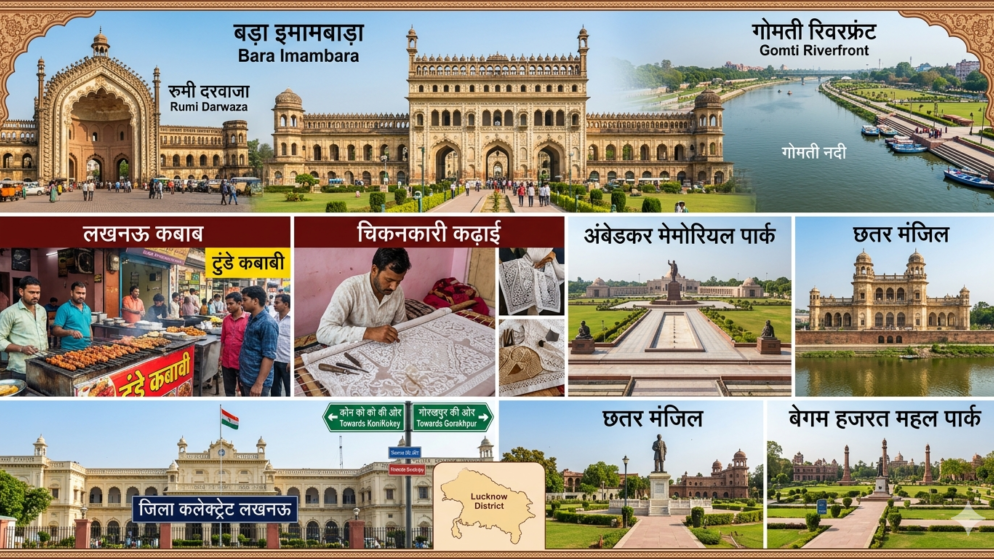
Lucknow District :- The City of Nawabs and Center of Culture
Detailed History
Lucknow, the capital of Uttar Pradesh, is a city globally renowned for its etiquette (Tehzeeb) and sophistication (Nafasat). Legend has it that the city was founded by Laxman, the brother of Lord Rama, earning it the name ‘Laxmanpuri‘. It rose to its zenith under the Nawabs of Awadh in the 18th century, becoming a hub for Kathak, Shayari, and culinary arts. It played a pivotal role in the 1857 First War of Independence. Today, it stands as a perfect blend of modern infrastructure and regal history.
Detailed Architecture
Exterior Description :–
The city’s exterior showcases a dual personality. ‘Old Lucknow‘ is a maze of Indo-Islamic marvels like the Rumi Darwaza, while ‘New Lucknow’ (Gomti Nagar) features grand stone parks and planned avenues. The Ambedkar Memorial Park, constructed with red sandstone, displays a majestic modern architectural style with its tall columns and elephant galleries.
Interior Description :–
The interiors of sites like Bada Imambara are legendary. The Bhul-bhulaiya is an intricate labyrinth built above a massive pillarless hall, a feat of 18th-century engineering. The Chhota Imambara is adorned with Belgian glass chandeliers and exquisite calligraphy on its inner walls, reflecting the luxury of the Nawabi era.
Nearby Attractions
- Bada Imambara & Labyrinth :– An architectural wonder with a massive arched hall and a mysterious maze.
- Rumi Darwaza :– A 60-foot tall gateway modeled after the Sublime Porte in Istanbul.
- The Residency :– Historical ruins that tell the saga of the 1857 Siege of Lucknow.
- Janeshwar Mishra Park :– One of Asia’s largest landscaped parks.
- Hazratganj :– The premium shopping and cultural district with a Victorian vibe.
Travel Guide & Routes
- How to Reach :–
- By Rail :– Lucknow Charbagh (LKO) is a major railway junction with direct connectivity to all of India.
- By Road :– Accessible via Agra-Lucknow Expressway and NH-24. Approx. 500 km from Delhi.
- By Air :– Chaudhary Charan Singh International Airport (LKO) connects the city globally.
- By Metro :– A state-of-the-art metro system facilitates easy travel within the city.
- Tickets & Timings :– Nominal fees for ASI monuments. Timings: 6:00 AM to 6:00 PM.
- Photography Spots :– Sunset at Rumi Darwaza, grand vistas of Ambedkar Park, and the bustling lanes of Chowk.
- Local Taste :– Famous for ‘Tunday Kababi’, ‘Galauti Kebab’, ‘Lucknawi Biryani’, and ‘Prakash Kulfi’.
- Famous Markets :– ‘Aminabad‘ for variety, ‘Chowk‘ for authentic Chikan embroidery, and ‘Hazratganj‘ for luxury.
Interesting Facts
- The Bada Imambara’s central hall is one of the largest arched constructions in the world without any supporting beams.
- Lucknow was often called the ‘Constantinople of the East’ during the colonial era.
- The city’s railway station, Charbagh, resembles a chessboard from an aerial view.
Important Questions and Answer :-
Question No 1:- Why is Lucknow called the ‘City of Nawabs’?
Answer:- Because it was the seat of power for the Nawabs of Awadh, who shaped its unique culture, cuisine, and arts.
Question No 2:- Which river flows through Lucknow?
Answer:- The sacred Gomti River.
Question No 3:- What is Lucknow’s most famous craft?
Answer:- Chikan-kari, an exquisite style of hand embroidery.
Question No 4:- What is unique about the Bhul-bhulaiya?
Answer:- It is a complex maze of interconnected passages built to support the weight of the massive hall below without pillars.
Question No 5:- Who is believed to have originally founded Lucknow?
Answer:- Laxman, the brother of Lord Rama.
Author’s Thoughts :-
Lucknow is not just a city; it is an experience of grace. From the greeting “Pehle Aap” (After you) to the aroma of slow-cooked kebabs, it charms everyone. It is a destination where history speaks from every corner and modern life pulses with a gentle rhythm.
“Between the echoes of history and the aroma of royal kitchens, Lucknow continues to hold its crown of culture and grace.”