
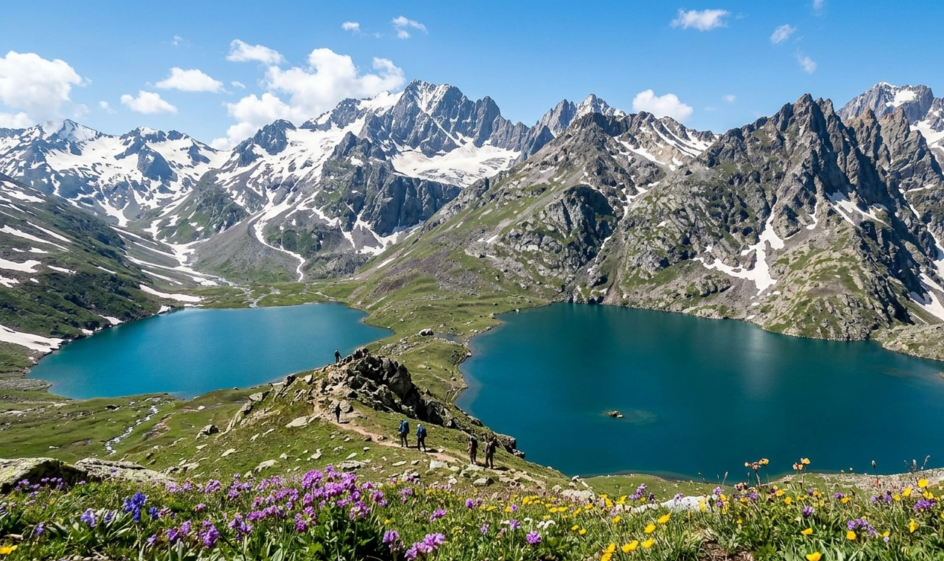
Vishansar & Krishansar :- The Divine Twin Lakes of Kashmir
Detailed History
Vishansar and Krishansar are two spectacular alpine lakes located near Sonamarg in the Ganderbal district of Jammu & Kashmir. Named after Lord Vishnu and Lord Krishna, these lakes hold significant spiritual value in regional folklore. Situated at an elevation of 3,710 meters, they have been pristine landmarks for high-altitude travelers and shepherds for centuries. Today, they are the highlight of the world-famous ‘Kashmir Great Lakes‘ trek.
Detailed Architecture/Structure
Exterior Structure :–
- Twin Formation :– The lakes are positioned in a picturesque sequence, separated by a small ridge. Krishansar lies slightly higher than Vishansar.
- Mountain Backdrop :– Enclosed by jagged peaks and silver-tongued glaciers that feed the lakes throughout the year.
- Flora :– The lakes are fringed by lush alpine meadows which, during the monsoon, erupt into a carpet of wildflowers like blue poppies and buttercups.
Internal Ecosystem :–
- Color Palette :– Vishansar displays a vivid turquoise hue, while Krishansar is often a deep, meditative blue.
- Clarity :– The water is crystalline, reflecting the surrounding peaks with mirror-like precision.
- Aquatic Life :– These lakes are a premier destination for Trout fishing, particularly the Brown Trout, which thrives in these freezing temperatures.
Nearby Attractions
- Sonamarg :– Known as the ‘Meadow of Gold‘, it serves as the gateway to these alpine wonders.
- Nichnai Pass :– A high mountain pass that trekkers must cross to reach the Vishansar valley.
- Gadsar Lake :– The next destination after Krishansar, famous for its wildflower-covered banks.
- Thajiwas Glacier :– A breathtaking glacier accessible from the base camp at Sonamarg.
- Sindh River :– The runoff from Vishansar eventually joins the Sindh river system, enriching the valley below.
Travel Guide & Routes
- Tickets :– No entry fee; however, trekking permits from the local authorities and forest department are mandatory.
- Timing :– The ideal window is from July to September.
- How to Reach :– From Srinagar, travel to Sonamarg by road. From Sonamarg, it is a moderate 2-3 day trek involving an ascent over the Nichnai Pass.
- Photography Spots :– The ridge overlooking both lakes provides a classic panoramic shot of the two water bodies side by side.
- Local Taste :– Hot ‘Kashmiri Kahwa‘ served at the high-altitude campsites.
- Famous Markets :– Sonamarg market for traditional woolen wear and local honey.
Interesting Facts
- Vishansar is known as the ‘Lake of Vishnu‘ and is said to be guarded by the mountains.
- The lakes are completely inaccessible in winter as they freeze solid under several feet of snow.
- It is one of the few places in India where the water is so pure you can drink it directly from the source.
Important Questions and Answer :-
- Question:- Where are Vishansar and Krishansar located?
- Answer:- They are in the Ganderbal district of Jammu & Kashmir, near Sonamarg.
- Question:- What is the best month to visit?
- Answer:- August is the best month to see the alpine flowers in full bloom.
- Question:- Can we go there by car?
- Answer:- No, these lakes are only accessible via a multi-day trek from Sonamarg.
- Question:- What is the altitude of these lakes?
- Answer:- They sit at approximately 3,710 meters (12,172 feet).
- Question:- Is Trout fishing allowed?
- Answer:– Yes, with a valid permit from the Fisheries Department of Jammu & Kashmir.
Author’s Thoughts :-
Vishansar and Krishansar represent the pinnacle of Himalayan beauty. The transition from the rugged climb of Nichnai to the sudden expanse of these blue waters is a soul-stirring experience. It is a place where you realize that the best things in life are indeed earned through effort. For anyone seeking the crown jewel of Kashmir’s wilderness, these twin lakes are the answer.
“A celestial mirror reflecting the legends of the blue gods—Vishansar and Krishansar.”