
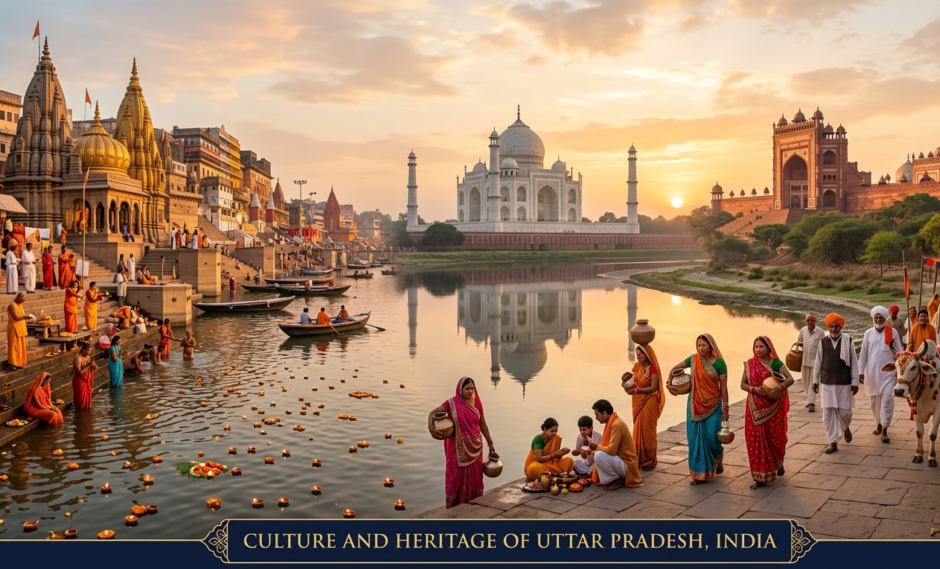
Uttar Pradesh :- The Cradle of Indian Civilization, Architectural Synthesis, and Sacred Heritage
Detailed History
Situated in the fertile alluvial plains of the Indo-Gangetic basin, ‘Uttar Pradesh’ (UP) stands as the absolute socio-cultural core and political bellwether of India. Universally recognized in ancient scriptural texts as ‘Madhya-Desh’ (The Middle Country) or ‘Aryavarta‘, this vast landscape has served as the primary canvas for the evolution of Indian civilization from the dawn of the Paleolithic era to modern democratic India. Uttar Pradesh is the sacred birthplace of the two most profound epics of the subcontinent—Ayodhya, the sovereign seat of Lord Rama, and Mathura, the birthplace of Lord Krishna. Furthermore, it houses Varanasi (Kashi), scientifically documented as one of the oldest continuously inhabited urban centers on Earth.
By the 6th century BCE, the region formed the geopolitical epicenter of ancient India, holding 8 of the 16 powerful Mahajanapadas (great kingdoms) including Kosala, Vatsa, and Panchala. It served as the crucible for the dissemination of Buddhism and Jainism; Lord Buddha delivered his first transcendent sermon at Sarnath and achieved his ultimate Mahaparinirvana at Kushinagar. Following the golden administrative epochs of the Maurya, Gupta, and Kushan Empires, the territory transformed into the heart of the Mughal Empire during the 16th and 17th centuries under Akbar and Shah Jahan. Under British governance, the region was consolidated as the ‘United Provinces of Agra and Oudh’, which was officially renamed ‘Uttar Pradesh’ on January 24, 1950.
Detailed Architecture :-
The structural heritage of Uttar Pradesh is an extraordinary chronicle of architectural evolution, showcasing a monumental timeline from pristine ancient Buddhist brickwork and classical Hindu stone temples to grand Mughal citadels and the whimsical, symmetrical structures of the Nawabs of Awadh:
1. Ancient Lithic Art and the Nagara Revival :–
- The Dhamekh Stupa (Sarnath) :– A colossal, cylindrical Buddhist brick monument originating in the Mauryan era and heavily expanded during the Gupta period. The structural core features precise dry-stone alignment, highlighted by exquisite relief carvings of geometric patterns and floral bands etched into the lower stone casing.
- The Bhitargaon Temple (Kanpur) :– Dating back to the 5th century CE, this is the oldest surviving entirely terraced brick temple in India, boasting an early stepped shikhara roof and magnificent terracotta sculptural panels.
- The Sri Ram Janmabhoomi Mandir (Ayodhya) :– A contemporary masterpiece built strictly according to the classical Nagara Style of temple architecture. Constructed exclusively from premium pink sandstone quarried from Bansi Paharpur in Rajasthan, the structure completely shuns the use of structural steel or iron. It features multiple ornate pavilions (Mandapas), intricate pillar carvings depicting Vedic iconography, and a soaring structural spire.
2. The Pinnacle of Islamic and Mughal Symmetry :–
- The Taj Mahal (Agra – UNESCO World Heritage Site) :– The definitive global icon of symmetry, commissioned by Shah Jahan. Crafted entirely from fine white Makrana marble, its architecture relies on perfect bilateral balance, featuring a double-shell bulbous dome and walls inlaid with highly complex ‘Pietra Dura’ (precious and semi-precious stone inlays).
- Agra Fort and Fatehpur Sikri :– Imperial walled citadels built of fine-dressed red sandstone, displaying a flawless structural integration of Hindu-Rajput structural brackets and Islamic arches.
3. The Secular Innovations of the Awadh Nawabs :–
- The Bara Imambara (Lucknow) :– Commissioned by Nawab Asaf-ud-Daula, this structure is a marvel of indigenous engineering. Its central vaulted hall is celebrated as one of the largest arched constructions in the world built entirely without internal pillars, columns, or steel beams. Above this vault lies the ‘Bhool Bhulaiya’ (The Labyrinth), an intricate multi-level network of interconnected passageways designed to structurally distribute the dead weight of the roof.
Travel Guide & Routes
Mandatory Permits & Entry Regulations :–
- No Inner Line Permits (ILP), religious entry clearances, or specialized military transit permissions are required for domestic Indian nationals or foreign passport holders to explore the historical or sacred complexes of Uttar Pradesh.
Tickets and Entry Fees :–
- The Taj Mahal :– Entry tickets are priced at ₹50 for domestic Indian citizens (plus an additional ₹200 for entering the inner mausoleum dome), ₹540 for SAARC/BIMSTEC citizens, and ₹1100 for all other international foreign passport holders. Digital bookings receive structural discounts.
- Bara Imambara (Lucknow) :– Standard entry is priced at approximately ₹50 – ₹60 for Indian residents and ₹500 for foreign nationals.
- Sacred Temples (Ayodhya, Varanasi, Mathura) :– General admission and spiritual entry into the core shrines are entirely Free of charge.
Timings (Visiting, Opening & Closing Times) :–
- Best Time to Visit :– The winter season from October to March presents highly ideal weather conditions for extensive heritage exploration. This period aligns with spectacular regional festivals such as ‘Dev Deepawali’ in Varanasi (Nov), where millions of oil lamps light up the steps of the Ganges, and the high-energy ‘Lathmar Holi’ in Mathura and Vrindavan (March).
- Operating Hours :–
- The Taj Mahal :– Open daily from sunrise to sunset (Strictly closed to the public on Fridays).
- Historical Forts and Monuments :– Open daily from 06:00 AM to 06:00 PM.
- Core Shrines (Varanasi, Ayodhya) :– Generally accessible from 04:30 AM (for the early morning Mangala Aarti) to 10:00 PM, with brief operational midday closures for ritual purposes.
How to Reach (Routes) :–
- By Air :– The state hosts a comprehensive network of international aviation gateways. The Chaudhary Charan Singh International Airport (LKO) in Lucknow, Lal Bahadur Shastri International Airport (VNS) in Varanasi, and the newly commissioned Maharishi Valmiki International Airport (AYO) in Ayodhya provide daily direct connections to major global and domestic industrial centers.
- By Rail :– Uttar Pradesh holds the most extensive and dense rail infrastructure in India. Major junction terminals include Lucknow (LJN), Kanpur Central (CNB), Prayagaraj (PRYJ), and Agra Cantt (AGC), operating high-speed Vande Bharat, Shatabdi, and Rajdhani Express networks linking directly to all Indian state capitals.
- By Road :– UP is renowned for its premium multi-lane expressways, including the Yamuna Expressway, Purvanchal Expressway, and the Ganga Expressway, which ensure flawless automotive transit across the state. The UPSRTC operates an extensive fleet of luxury ‘Janrath’ and AC Volvo buses. Within city limits, urban transport is managed by rapid metro rail services (Lucknow, Kanpur, Agra, Noida) and eco-friendly E-Rickshaws.
Photography Spots, Local Cuisine, and Famous Markets
Photography Spots :–
- The Ghats of Varanasi (Ganga Aarti) :– Best captured from an elevated boat positioned on the river facing Dashashwamedh Ghat at dusk, framing the synchronized ritual fire movements of the priests against the ancient stone facades.
- The Taj Mahal from Mehtab Bagh :– Offers pristine, symmetrical reflection shots of the white marble monument across the waters of the Yamuna River during the golden hour.
- Ram Ki Paedi (Ayodhya) :– Ideal for capturing spectacular wide-angle reflection shots when the entire stepped riverfront ghat network is dynamically lit with millions of oil lamps and laser displays.
Local Cuisine :–
- The culinary landscape of Uttar Pradesh is famously split into the regal, slow-cooked Awadhi (Mughal-Nizami hybrid) style and the rich, vegetarian Braj and Banarasi styles. Lucknow is universally celebrated for its legendary melt-in-the-mouth ‘Tunday Kababi’ (Galouti Kebabs), saffron-infused Sheermal bread, and rich Awadhi Biryani. On the vegetarian side, the iconic ‘Kachori-Sabzi’ and hot Jalebis of Varanasi, the pure-milk ‘Pedas’ of Mathura, and the crystalline Petha of Agra stand out. The winter-exclusive ‘Makhan Malai’ (Malaiyo) of Varanasi—a light, dew-infused milk foam garnished with saffron and pistachios—remains an absolute culinary hallmark.
Famous Markets :–
- Chowk & Aminabad (Lucknow) :– The global center for authentic, hand-crafted ‘Chिकनकारी’ (Chikan Embroidery), a legendary 400-year-old textile art featuring delicate shadow-work hand-stitched onto fine muslins and cottons.
- Vishwanath Gali (Varanasi) :– The ultimate market for sourcing authentic, hand-loomed ‘Banarasi Silk Sarees’, universally celebrated for their heavy gold and silver brocade (Zari) work woven into fine mulberry silk.
- One District One Product (ODOP) Hubs :– Other world-class artisanal markets include the lock-making centers of Aligarh, the intricate brassware (Moradabadi Bartan) markets of Moradabad, the natural rose and oud distillations (Attar) of Kannौज, and the hand-knotted carpet markets of Bhadohi.
Nearby Attractions
- Prayagraj (Allahabad) :– The sacred site of the ‘Triveni Sangam’, the holy confluence of the Ganga, Yamuna, and the mythical Saraswati rivers, which hosts the Kumbh Mela—the largest peaceful gathering of humanity on earth.
- Vrindavan & Barsana :– The core landscapes of Lord Krishna’s youth, famous for architectural wonders like the Banke Bihari Temple, Prem Mandir, and historical sandstone temples.
- Kushinagar and Sravasti :– Major international Buddhist pilgrimage hubs housing the ancient Nirvana Stupa, the reclining Buddha statue, and ruins of ancient monasteries.
- Jhansi :– The historic city of Rani Lakshmi Bai, featuring the imposing hilltop Jhansi Fort, displaying a distinct blend of Maratha and Bundelkhand military architecture.
- Dudhwa National Park :– Situated on the Indo-Nepal border, this expansive swamp forest and grassland reserve preserves critical populations of Bengal Tigers, One-horned Rhinoceroses, and Swamp Deer (Barasingha).
Interesting Facts
- The ancient city of Varanasi is locally believed to be anchored directly onto the tip of Lord Shiva’s structural trident rather than the shifting tectonic plain, mythologically insulating it from complete earthly destruction.
- The acoustic engineering of the Bhool Bhulaiya within Lucknow’s Bara Imambara is so advanced that the thick brick walls are built with internal hollow air channels. A whisper made at one end of a 50-meter-long structural gallery can be heard clearly by a listener standing at the opposite terminal wall, serving as an ancient mechanical surveillance framework.
- Uttar Pradesh holds unmatched political influence in modern India, serving as the definitive political launchpad that has produced 9 of the nation’s Prime Ministers.
Important Questions and Answer :-
Question 1:- What are the specific structural and seismic advancements utilized in the construction of the new Sri Ram Janmabhoomi Mandir in Ayodhya?
Answer:– The Sri Ram Janmabhoomi Mandir is engineered to achieve a structural lifespan exceeding 1,000 years without requiring modern maintenance materials. By completely omitting structural iron and carbon steel—which oxidize and crack over time—the engineering rely on structural copper plates and mortise-and-tenon stone interlocking to absorb mechanical stresses. The foundation features a 14-meter-thick engineered plinth crafted from 56 individual layers of fly-ash and roller-compacted concrete, turning the base into a synthetic monolithic rock. This design structurally isolates the temple from subterranean moisture and allows it to safely withstand seismic accelerations up to a magnitude of 6.5 on the Richter scale.
Question 2:- How does the intricate ‘Pietra Dura’ inlay work on the white marble walls of the Taj Mahal achieve its seamless appearance?
Answer:– Known locally as Pachhikari, the Pietra Dura work on the Taj Mahal is an advanced lapidary technique where semi-precious stones are chemically and mechanically embedded into solid marble slabs. Master artisans hand-carved microscopic, angled grooves into the polished Makrana marble. Following this, exotic, hard gemstones—such as Lapis Lazuli from Afghanistan, Jasper from Cambay, and Jade from Central Asia—were cut into ultra-thin segments using wire saws to form fluid floral patterns. These segments were meticulously fitted into the stone grooves using a specialized waterproof resin made of lime, marble dust, and natural gums, ensuring the joints are completely invisible to the naked eye.
Question 3:- What architectural parameters allow the flat-vaulted ceiling of the main hall in the Bara Imambara to stand entirely without pillar support?
Answer:– The central vault of the Bara Imambara is a structural masterpiece of equilibrium. To build a flat arched roof spanning 15 meters in width and 15 meters in height without internal columns, the architects utilized a lightweight brick formulation bound together by a traditional mortar composed of lentils (Urad dal), jaggery, lime, and wood-apple pulp. The roof is engineered as a self-supporting catenary arch where the dead weight is transferred laterally down into the massive, 5-meter-thick hollow side walls. To prevent the walls from buckling under this outward thrust, the weight was balanced by constructing the complex multi-level Labyrinth (Bhool Bhulaiya) directly on top of the arch, creating a perfect vertical counterweight system.
“Resounding with the deep echoes of Shiva’s drum across the ghats of Kashi, the symmetrical marble romance of the Taj, and the delicate threads of Chikan lace hand-woven in Awadh, Uttar Pradesh remains the definitive living archive of the Indian soul.”