
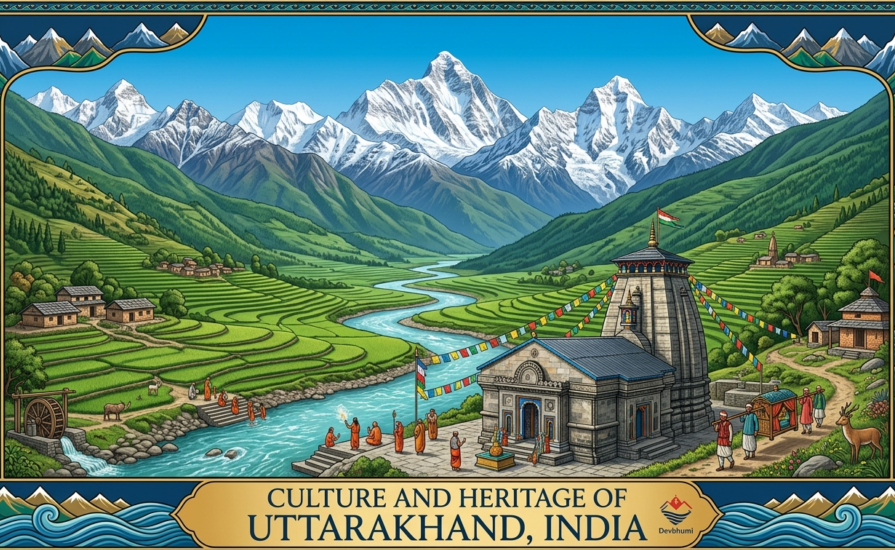
Uttarakhand :- The Terrace of the Gods, Alpine Lithic Architecture, and Sacred Watersheds
Detailed History
Nestled profoundly within the snow-capped northwestern extensions of the Central Himalayan arc, ‘Uttarakhand’ is universally venerated as ‘Devbhoomi’ (The Land of the Gods). The textual antiquities of the land are meticulously preserved within ancient Vedic literature and the Puranas, where the sacred territory is categorized into two distinct spiritual topographies: ‘Kedarkhand’ (the modern-day Garhwal division) and ‘Manaskhand’ (the modern-day Kumaon division). This high-altitude geographic zone serves as the pristine glacial cradle for the Indian subcontinent’s most sacred lifelines—the Ganges and the Yamuna rivers—which emerge from the sub-surface cavities of the Gangotri and Yamunotri glaciers respectively.
Historically, the region evolved under the indigenous sovereign governance of the Katyuri, Chand, and Panwar (Shah) dynasties. The highly rugged, vertical mountain topography acted as a natural military bulwark, protecting the kingdom from prolonged conquests by medieval lowland empires. In the 8th century CE, the great philosopher-saint Adi Shankaracharya traversed these vertical alpine terrains to establish the Jyotirmeth at Joshimath and systematically reconstructed the structural sanctums of Badrinath and Kedarnath, permanently cementing Uttarakhand as the heart of trans-Indian pilgrimage networks. Following the British annexation of the hills and a prolonged post-independence socio-political grassroots movement, the territory was officially carved out of Uttar Pradesh to form the 27th sovereign state of the Indian Union on November 9, 2000.
Detailed Architecture
The architectural vernacular of Uttarakhand is an exceptional structural adaptation to intense alpine weather conditions, sub-zero temperatures, and high seismic vulnerabilities, relying on the strategic deployment of local stone slate and dense deodar timber. The dominant styles include:
1. The Monolithic Katyuri Stone Order :–
- The Kedarnath Temple :– Elevated at 3,583 meters above sea level, this structure is an elite manifestation of early medieval Katyuri stone architecture. The entire temple envelope is assembled from massive, uniformly dressed grey granite slabs interlocked using dry-stone structural joints without any binding lime mortar. The structural thickness of the walls and the massive stone Amalaka crowning the stepped spire provide an unyielding layout that famously insulated the core shrine from the catastrophic 2013 glacial outburst flood.
- Jageshwar Dham (Almora) :– A structural cluster of 124 stone shrines exhibiting a flawless amalgamation of Nagara design principles and mountain stone masonry, characterized by narrow sanctums and steep, tapering stone spires set amidst dense deodar canopies.
2. The Koti Banal Seismic Engineered Vernacular :–
- Originating in the Yamuna and Tons valleys of Uttarkashi, this is an indigenous, 1000-year-old earthquake-resistant engineering framework. The construction features a modular alternating stack of dry-laid stone masonry courses bounded by thick, horizontal structural logs of local Deodar wood (Cedrus deodara). Built over multiple storeys on deep stone platforms, these structures possess highly flexible structural friction points that allow the entire framework to flex and dissipate intense seismic shockwaves without catastrophic structural failure.
3. Traditional Garhwali and Kumaoni Residential Formats :–
- These mountain dwellings feature a functional two-tier vertical allocation: the damp ground floor (Gaukh) houses livestock to generate geothermal warmth, while the upper level serves as the primary family living zone. The definitive hallmark of these homes is ‘Likhai’, a highly intricate traditional art of manual wood-carving executed on the structural doorframes (Kholi) and window panels. The sloped gabled roofs are clad with heavy, locally quarried stone slates (Pathal) to systematically shed heavy winter snow accumulations.
Travel Guide & Routes
Mandatory Permits & Entry Regulations :–
- While general low-altitude holiday stations (such as Nainital, Musuri, and Rishikesh) require no bureaucratic clearances, all participants of the seasonal Char Dham Yatra must secure a Mandatory Char Dham Biometric Digital Registration Pass issued by the state tourism board. Furthermore, expeditions pushing deep into the high-altitude inner-line zones adjacent to the international border (e.g., Gaumukh Glacier trek or the Nelang Valley) strictly require an official Inner Line Permit (ILP) processed via the Uttarkashi administration.
Tickets and Entry Fees :–
- Admission into all active historic spiritual sanctuaries (Badrinath, Kedarnath, Gangotri, Yamunotri) is entirely Free of cost.
- Jim Corbett National Park :– Standard wilderness entry permits for Indian nationals are priced at approximately ₹200 – ₹300 (safari vehicle and mandatory naturalist guide fees are separate), while international foreign passport holders are charged ₹3000.
- Valley of Flowers National Park :– Entry permits cost ₹150 for domestic Indian citizens and ₹600 for international foreign tourists for a continuous 3-day exploration window.
Timings (Visiting, Opening & Closing Times) :–
- Best Time to Visit :– The premium windows for unhindered mountain exploration are spring-summer (March to June) and post-monsoon autumn (October to November). The core monsoon months from July to September are highly volatile due to heavy sub-Himalayan cloudbursts and flash landslide hazards.
- Char Dham Pilgrimage Calendar :– The high-altitude shrines open their structural gates annually on the auspicious day of Akshaya Tritiya (April/May) and are ceremonially sealed for the harsh winter on Bhai Dooj (October/November). During the heavy winter snow lock, the ritual deities are shifted to down-valley winter seats at Ukhimath and Joshimath.
- National Park Openings :– The premium core zones of Jim Corbett and Rajaji National Parks operate seasonally from November 15 to June 15 annually.
How to Reach (Routes) :–
- By Air :– The primary aviation hub is the Jolly Grant Airport (DED) in Dehradun, offering robust daily direct flights to New Delhi, Mumbai, Lucknow, and Bangalore. For the eastern Kumaon sector, domestic flights land at Pantnagar Airport (PGH) and Naini-Saini Airport in Pithoragarh.
- By Rail :– Key railheads terminating at the base of the mountains include Haridwar (HW), Dehradun (DDN), and Kathgodam (KGM). These stations operate premium express networks like the Shatabdi and Jan Shatabdi. The ongoing construction of the massive Rishikesh-Karnaprayag Broad Gauge Railway line is set to introduce high-speed rail connectivity deep into the central Himalayan interior.
- By Road :– The state is seamlessly connected to New Delhi via National Highway 58 (NH-58) and NH-72. The newly developed Char Dham All-Weather Highway Network has drastically reduced transit times and significantly mitigated traditional landslide vulnerabilities along the mountain curves. The UTC operates a vast fleet of air-conditioned interstate luxury buses from ISBT Kashmiri Gate, New Delhi. For intra-state mountain travel, heavy-duty 4×4 sharing utility jeeps (Maxx/Bolero) form the primary transport grid.
Photography Spots, Local Cuisine, and Famous Markets
Photography Spots :–
- Triveni Ghat & Lakshman Jhula (Rishikesh) :– Provides pristine frames during the evening Ganga Aarti, capturing the synchronous movement of large brass oil lamps reflecting off the fast-flowing glacial waters of the Ganges.
- The Snowy Peaks of Auli :– Winter photography at this high-alpine ski resort yields dramatic, crisp landscape frames of the imposing, sun-lit 7,816-meter peak of Mount Nanda Devi.
- Naini Lake Viewpoint (Nainital) :– High-altitude vantage points like Tiffin Top offer stunning panoramic captures of the crescent-shaped emerald lake dotted with colorful wooden yachts.
Local Cuisine :–
- The cuisine of Uttarakhand relies heavily on drought-resistant local millets, unpolished lentils, and therapeutic wild herbs. The culinary centerpiece is ‘Kafuli’, a nutrient-dense, thick green gravy prepared from locally harvested spinach and mustard greens slow-cooked in traditional iron cauldrons. Other regional delicacies include ‘Phanu’ (a complex multi-lentil soufflé gravy), ‘Gahat ke Paranthe’ (flatbreads stuffed with horse-gram paste), and wild ‘Bhang ki Chutney’ (a tangy paste made from roasted hemp seeds and mountain lemons). For dessert, the regional signature is Almora’s iconic ‘Bal Mithai’ (roasted milk-fudge brown chocolate blocks coated with tiny white sugar globes) and ‘Singaori’ (sweetened khoya cones wrapped in the aromatic leaf of the Malu tree).
Famous Markets :–
- Paltan Bazaar (Dehradun) & The Mall Road (Nainital/Mussoorie) :– Highly sought-after markets for authentic, hand-knotted Himalayan woolens, pure pashmina drapes, traditional woolen Garhwali caps, and hand-carved deodar wood artifacts.
- Organic Mountain Co-operatives :– These specialized local outlets offer high-value local agricultural exports including organic Himalayan Rajma (kidney beans), Jakhiya (wild dog-mustard seeds used for crunchy tempering), raw forest honey, and concentrated Rhododendron (Buransh) Flower Juice.
Nearby Attractions
- Haridwar & Rishikesh :– The twin spiritual cities where the Ganges leaves the mountains, globally celebrated as the ‘Yoga Capital of the World’ and famous for high-intensity spiritual retreats.
- Valley of Flowers & Hemkund Sahib :– A high-altitude UNESCO World Heritage alpine valley in Chamoli known for its seasonal blooms of endemic flora, situated adjacent to the sacred glacial lake sanctuary of Hemkund Sahib.
- Ranikhet & Kausani :– Serene hill stations of the Kumaon division providing an unhindered, 300-km-long panoramic view of the central Himalayan range. Kausani was historically lauded by Mahatma Gandhi as the ‘Switzerland of India’.
- Tehri Dam Reservoir :– One of the tallest earth-fill dams globally, whose massive turquoise reservoir has been converted into a premium eco-tourism destination for extreme water sports, jet-skiing, and parasailing.
- Chopta Valley :– Coined as the ‘Mini Switzerland of Uttarakhand’, this lush alpine meadow serves as the baseline trek camp leading to Tungnath, the highest structural Shiva temple on Earth.
Interesting Facts
- The phenomenal survival of the Kedarnath Temple during the catastrophic 2013 deluge is attributed to the ‘Bheem Shila’—a massive boulder that washed down from the collapsing upper glaciers and wedged itself perfectly mere feet behind the temple’s rear wall. This boulder acted as a natural structural breakwater, diverting the roaring mud-and-boulder floodwaters away from the sanctum.
- The architectural engineering of the Koti Banal framework is so robust that several five-storeyed timber-and-stone palaces in the Uttarkashi region have successfully withstood major catastrophic earthquakes for over 800 continuous years without showing any structural displacement.
- The abandoned ‘Beatles Ashram’ (Chaurasi Kutia) in Rishikesh is the historic site where the legendary English rock band ‘The Beatles’ resided in 1968 under the guidance of Maharishi Mahesh Yogi, composing over 48 songs that formed the core of their famous White Album.
Important Questions and Answer :-
Question 1:- What are the specific hydraulic and mechanical factors that make the dry-stone interlocking masonry of the Kedarnath Temple structurally indestructible?
Answer:– The structural durability of the Kedarnath Temple lies in its reliance on dry-stone interlocking masonry, completely rejecting modern brittle binders. The massive granite block slabs are chiseled with customized tenon-and-mortise geometric systems that snap into one another, creating a single cohesive unit that remains slightly flexible. When hit by the intense kinetic energy of a hydraulic flood or a major seismic shear wave, this micro-flexibility allows the stone blocks to rub against each other and safely dissipate the energy instead of cracking. Additionally, the temple’s heavy stone plinth and north-facing wedge-shaped orientation act as a hydro-dynamic shield, causing heavy external pressures to split and slide past the main structure.
Question 2:- How does the alternating layered layout of Deodar timber logs in Koti Banal architecture act as a natural seismic base-isolation system?
Answer:– Koti Banal architecture utilizes Deodar timber (Cedrus deodara) because of its high tensile strength and natural resistance to rot. In this system, master builders do not anchor the building rigidly to the ground. Instead, they build a deep base of dry-stacked stones, topped by horizontal timber logs laid out in square, cross-hatched layers. This creates a highly uniform, layered network of alternating timber-stone-timber courses. When a major earthquake strikes, the flexible wooden beams act as structural dampening shock absorbers. The wood bends slightly under lateral pressure, allowing the building to sway dynamically without collapsing, which keeps the vertical center of gravity safe.
Question 3:- What makes the ‘Likhai’ woodcarvings of Kumaon unique in terms of both structural craftsmanship and cultural symbolism?
Answer:– The art of ‘Likhai’ requires selecting seasoned hardwood from local Deodar or Tun trees, which contain natural oils that prevent warping and insect damage in alpine climates. The structural process involves carving deep, relief patterns into thick doorframes (Kholi) and window sills before they are assembled into the house walls. Culturally, these designs are deeply connected to ancient Tantric and folk-tribal iconography. The carvings feature complex lotus patterns (Kamala), repeating rows of swans, stylized peacocks, and geometric alignments drawn straight from Aipan (sacred ritual floor art). This detailed craftsmanship serves as both a public display of the family’s social lineage and a symbolic protective seal to ward off negative energy from entering the home.
“Anchored by the ancient granite endurance of Kedarnath, the flexible deodar beams of Koti Banal palaces, and the roaring glacial waters echoing through the yoga ashrams of Rishikesh, Uttarakhand stands as a timeless, stone-carved monument where the raw geometry of the Himalayas meets the ultimate seeking of the human spirit.”