
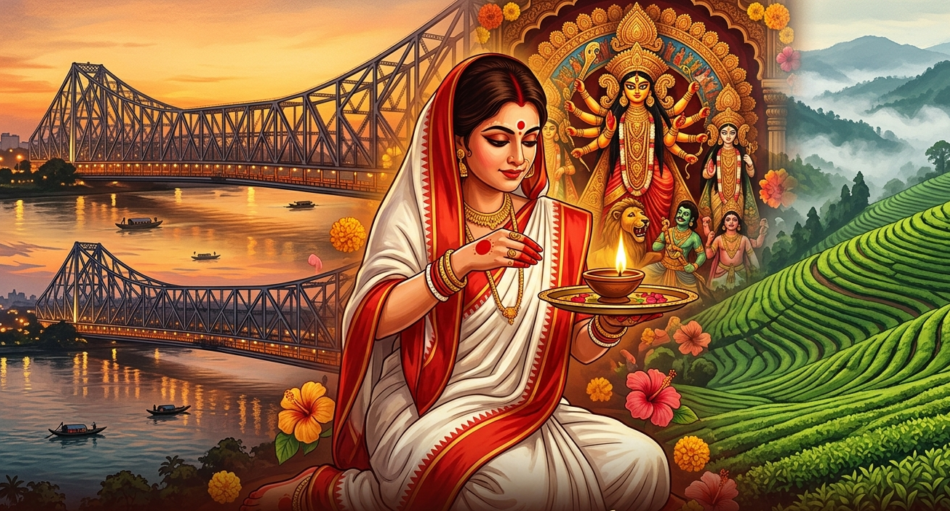
West Bengal :- The Cradle of Indian Renaissance, Terracotta Masterpieces, and Colonial Grandeur
Detailed History
Positioned strategicially along the massive deltaic convergence of the Ganges and Brahmaputra rivers, ‘West Bengal‘ represents the intellectual, literary, and artistic crucible of the Indian subcontinent. Known antiquitously in Vedic and Puranic literature as ‘Vanga‘ or ‘Gauda‘, this flat, fertile landscape was the geopolitical engine of the historic Pala Empire, under whose imperial patronage Mahayana Buddhist art and classical Hindu sculpture reached unmatched heights.
During the medieval epoch, the region transitioned into the Bengal Sultanate and subsequently emerged as the wealthiest Subah (province) of the Mughal Empire, often heralded in contemporary global trade chronicles as the ‘Paradise of Nations‘. Modern Indian history was fundamentally reshaped here when the British East India Company secured structural dominion over the subcontinent following the watershed Battle of Plassey in 1757. Consequently, Kolkata (formerly Calcutta) served as the imperial capital of the British Raj until 1911. This prolonged cross-cultural exposure catalyzed the monumental ‘Bengal Renaissance’ during the 19th and early 20th centuries. This socio-cultural awakening produced luminaries such as Raja Ram Mohan Roy, Swami Vivekananda, Ishwar Chandra Vidyasagar, Netaji Subhas Chandra Bose, and the subcontinent’s first Nobel Laureate, Gurudev Rabindranath Tagore. Following the geopolitical partition of 1947, the western segment integrated into the Indian Union as the sovereign state of West Bengal.
Detailed Architecture :-
The built heritage of West Bengal stands as a striking structural archive, showcasing a continuous transition from early medieval vernacular baked-clay masonry to grand European neoclassical civic installations:
1. The Malla Terracotta Order of Bishnupur :–
- Rasmanch and Madan Mohan Temple :– Located within the Bankura district, these shrines represent a phenomenal architectural solution to geological limitations. Lacking natural stone quarries, the 17th-century Malla rulers utilized the rich local alluvial clay to manufacture high-density bricks and structural terracota tiles. The temples feature the traditional ‘Ek-chaala’ and ‘Char-chaala’ (curved parabolic roofs) derived directly from rural thatched huts. The exterior walls are entirely clad in interlocking terracotta reliefs depicting highly complex narratives from the Ramayana, the Mahabharata, and the divine Rasleela of Lord Krishna with microscopic precision.
2. Imperial Neoclassical and Cantilever Engineering :–
- The Victoria Memorial (Kolkata) :– Commissioned to commemorate Queen Victoria, this monumental white edifice is a brilliant execution of Indo-Saracenic Revival architecture, blending British Palladian layouts with Mughal structural elements. Built entirely from fine Makrana marble, its layout features a massive central dome crowned by a rotating bronze ‘Angel of Victory’ that acts as a mechanical wind vane. Its grand colonnades, structural arches, and allegorical Italianate sculptures reflect supreme European monumental design.
- The Howrah Bridge (Rabindra Setu) :– A definitive marvel of 20th-century structural engineering, this massive installation is a balanced cantilever bridge stretching across the Hooghly River without a single supportive riverbed pier.
3. The Syncretic Nizamat and Zamindari Rajbaris :–
- Exemplified by the Hazarduari Palace in Murshidabad, this style reflects a bold integration of European Neoclassical architecture into the regional aristocratic landscape. The palace incorporates precisely one thousand grand structural doors—including hundreds of strategically placed faux mirror-doors (Dummy Doors) designed to disorient potential military assassins.
Travel Guide & Routes
Mandatory Permits & Entry Regulations :–
- Standard travel across urban and historic corridors of West Bengal requires no domestic Inner Line Permits (ILP). However, charting expeditions into the core biospheres of the Sundarbans Tiger Reserve requires Mandatory Forest Entry Permits issued by the West Bengal Forest Department at Canning or Sonakhali. Foreign passport holders must present valid visas at checkpoints close to the international Bangladesh border.
Tickets and Entry Fees :–
- Victoria Memorial :– Admission to the core museum galleries is priced at ₹60 for domestic Indian nationals, ₹100 for SAARC citizens, and ₹500 for international foreign tourists. Access to the formal gardens alone is ₹30.
- Bishnupur Terracotta Temples :– Under the protection of the Archaeological Survey of India (ASI), entry tickets cost ₹40 for Indian residents and ₹600 for international visitors.
- Darjeeling Himalayan Railway (Toy Train) :– The historic UNESCO Heritage Joy Ride (Steam Engine) is priced between ₹1500 – ₹1600, while the modern Diesel Engine variant costs approximately ₹1000 per reservation.
Timings (Visiting, Opening & Closing Times) :–
- Best Time to Visit :– The optimal travel climate spans from October to March. Visiting during October allows travelers to witness Durga Puja (UNESCO Intangible Cultural Heritage), during which the entire state transforms into a massive, open-air public art installation featuring highly innovative structural pavilions (Pandals). The winter season is exceptionally ideal for tracking tigers in the Sundarbans or viewing the Himalayas from Darjeeling.
- Operating Hours :–
- Victoria Memorial Galleries :– Open to visitors from 10:00 AM to 06:00 PM (Strictly closed on Mondays and gazetted national holidays). The manicured gardens remain open daily from 05:30 AM to 06:15 PM.
- Science City (Kolkata) :– Accessible daily from 10:00 AM to 07:00 PM.
- Historic Monuments & National Parks :– Generally open from sunrise to sunset. Sundarbans boat safaris strictly operate from 06:00 AM to 04:00 PM due to estuarine tidal shifts.
How to Reach (Routes) :–
- By Air :– The state capital is served by the Netaji Subhas Chandra Bose International Airport (CCU) in Kolkata, a massive global aviation gateway connecting directly to major European, Asian, and all domestic Indian destinations. The Bagdogra International Airport (IXB) near Siliguri serves as the primary aerial gateway to the northern Himalayan districts.
- By Rail :– The twin terminals of Howrah Junction (HWH) and Sealdah (SDAH) are among the largest and highest-capacity railway complexes globally, operating premium high-speed networks including Vande Bharat, Shatabdi, and Rajdhani Expresses linking to all tier-1 Indian cities. New Jalpaiguri (NJP) is the primary junction for North Bengal.
- By Road :– West Bengal is integrated into the Golden Quadrilateral grid via National Highway 19 (NH-19) and NH-12. The WBTC runs a comprehensive network of long-distance air-conditioned Volvo coaches. Within Kolkata, urban transit features a unique historic preservation of India’s only operational Tramway System, vintage yellow Ambassador taxis, a rapid deep-underground Metro Rail network, and nimble E-Rickshaws managing localized street capillary movement.
Photography Spots, Local Cuisine, and Famous Markets
Photography Spots :–
- Howrah Bridge from Babu Ghat :– Capture structural silhouettes of the massive cantilever framework at dusk, framing the classic wooden country boats shifting across the Hooghly River.
- Princep Ghat at Twilight :– Offers an incredible vantage point for long-exposure architectural photography, capturing the illuminated cable-stayed spans of the Vidyasagar Setu framed symmetrically by the historic Greek-Gothic revival columns of the ghat.
- Kumartuli (The Sculptor’s Quarter) :– A paradise for portrait and documentary photography, especially during the weeks preceding Durga Puja, capturing master artisans hand-molding clay visages and executing the sacred Chakshu Daan (painting the eyes of the Goddess).
Local Cuisine :–
- The gastronomy of Bengal is highly celebrated for its nuanced use of Mustard Oil and the signature Paanch Phoron (a aromatic five-spice blend). The quintessential slow-food meal centers around ‘Macher Jhol’ (a refined, aromatic river fish broth) paired with ‘Bhaat’ (long-grain steamed rice). High-end regional preparations include ‘Bhapa Ilish’ (Hilsa fish slow-steamed in a pungent mustard-coconut paste) and Chingri Malai Curry (prawns simmered in spiced coconut milk). For dessert, the state is globally unmatched, offering the velvety ‘Mishti Doi’ (caramelized sweet yogurt slow-set in porous earthenware pots), sponge ‘Rosogollas’, and delicate, saffron-infused Sandesh.
Famous Markets :–
- New Market & Gariahat (Kolkata) :– The absolute epicenters for sourcing authentic, hand-loomed ‘Tant’ and ‘Jamdari’ Silk Sarees, famous for their ultra-light textures and complex geometric borders.
- College Street (Boi Para) :– The largest second-hand book market ecosystem globally, hosting the iconic ‘Indian Coffee House’, which has served as the intellectual birthplace of historic sociopolitical movements.
- Bankura Artisanal Hubs :– Highly sought-after for authentic Terracotta Bankura Horses and sophisticated home decor woven completely from high-grade natural Jute fibers.
Nearby Attractions
- Sundarbans National Park :– A pristine UNESCO World Heritage Site and the largest deltaic mangroove ecosystem globally, acting as the exclusive amphibious sanctuary for the swimming Royal Bengal Tigers.
- Darjeeling Hill Station :– Perched high in the Eastern Himalayas, globally renowned for its sweeping vistas of Mount Kanchenjunga, historic Darjeeling Tea Estates, and the operating UNESCO Heritage Toy Train network.
- Santiniketan (Bolpur) :– The historic university township founded by Rabindranath Tagore (a UNESCO World Heritage Site), celebrated for its open-air pedagogy at Visva-Bharati and its indigenous ‘Baul’ folk music lineages.
- Digha & Mandarmani Beaches :– Sprawling, hard-sand holiday beaches along the northern edge of the Bay of Bengal, offering high-speed motorized water sports and serene resort corridors.
- Murshidabad Heritage Sector :– Located on the banks of the Bhagirathi River, this historical corridor holds the sprawling European-style Hazarduari Palace, the Katra Mosque, and historic battle installations.
Interesting Facts
- The structural mortars of the 17th-century Bishnupur temples completely rejected modern binding materials. Instead, master builders formulated a highly durable organic binder by mixing lime and brick dust with liquid molasses (Gur), catechu, and ground black-gram (Urad Dal) paste. This organic compound polymerized over centuries, turning the clay temples completely impervious to heavy tropical monsoon weathering.
- The Acharya Jagadish Chandra Bose Indian Botanic Garden near Kolkata houses ‘The Great Banyan Tree’, certified as the largest single tree canopy in the world. Aging over 250 years, the tree’s thousands of aerial prop roots cover a massive area, making it look like an entire interconnected forest.
- Kolkata remains the absolute institutional guardian of vintage transit in India, maintaining the subcontinent’s only active urban Tram network and preserving the iconic fleet of yellow British-era Ambassador cars.
Important Questions and Answer :-
Question 1:- What are the architectural and thermodynamic advantages of the ‘Char-Chaala’ curved roof profile utilized in Bengal’s medieval terracotta temples?
Answer:– The ‘Char-Chaala‘ curved roof profile—characterized by four distinct sloping roof quadrants meeting at a central parabolic apex—was a brilliant structural adaptation to Bengal’s hyper-humid deltaic climate. Structurally, the deep, sweeping downward curves maximize the rapid displacement of massive monsoon precipitation, preventing rainwater from pooling on the roof which would cause structural water-logging and weight displacement. Thermodynamically, the heavy vaulting creates a high internal air pocket above the core sanctum (Garbhagriha). This configuration naturally draws hot air upward and vents it away from the lower floor, keeping the deity and priests cool during the intense summer heat.
Question 2:- How does the cantilever engineering of the Howrah Bridge accommodate immense thermal expansion and heavy structural loads without mid-river pillars?
Answer:– The Howrah Bridge operates as a balanced cantilever structure, meaning its central 1,500-foot span is structurally supported by two massive 280-foot anchoring towers erected exclusively on the dry riverbanks. To manage the immense dead load of steel and the live load of heavy urban traffic without a central pier, the weight is mechanically transferred through heavy diagonal high-tensile steel trusses back down to the monolithic concrete anchor caissons sunk deep into the riverbanks. To handle intense tropical thermal expansion (where steel expands during hot summers), the entire bridge structure is fitted with massive, centralized mechanical expansion joints and sliding rocker bearings, allowing the main spans to expand and contract smoothly along its horizontal axis without causing internal structural cracking.
Question 3:- How do the ‘Pneumatophores’ of the Sundarbans mangroove forests structurally stabilize the shifting deltaic coastline of West Bengal?
Answer:– The Pneumatophores, or specialized lateral breathing roots of the Heritiera fomes (Sundari) trees, are key to the structural stability of the Sundarbans delta. Growing upwards out of the oxygen-depleted, water-logged mud, these vertical roots feature porous lenticels that absorb atmospheric gasses during low tides. Geologically, these millions of vertical, spike-like root systems function as a massive, dense underground fence. This intricate root web slows down the velocity of incoming tidal waves and traps heavy river sediment carried down by the Ganges. By anchoring the soft silt beds, the roots prevent the coastline from eroding into the Bay of Bengal and form a critical bio-shield that absorbs the destructive energy of major tropical cyclones.
“Framed by the majestic steel arcs of the Howrah Bridge spanning the holy Hooghly, the delicate clay poetry chiseled onto the walls of Bishnupur, and the rhythmic beat of the Dhaki drums during Durga Puja, West Bengal remains the eternal intellectual and architectural vanguard of the Indian cultural renaissance.”