
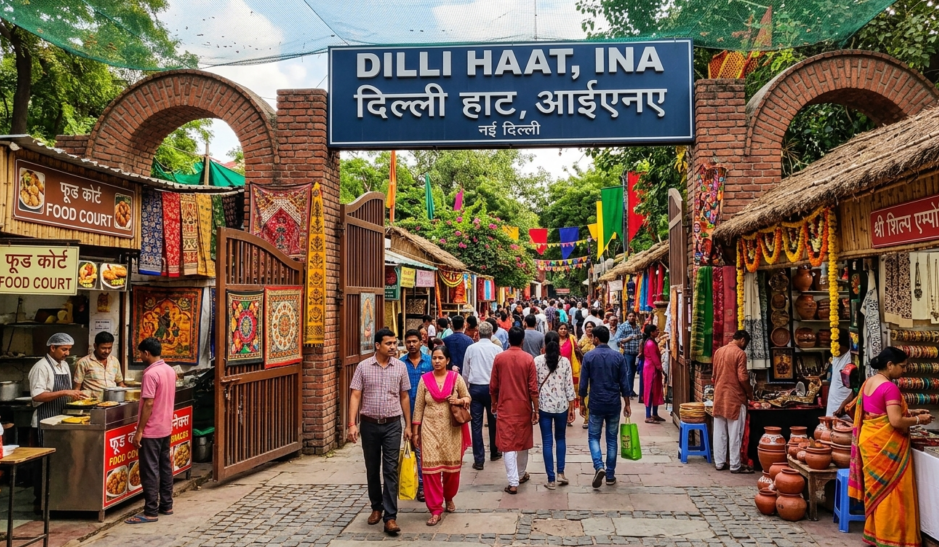
Delhi Haat, INA, New Delhi :- The Vibrant Subterranean Gateway to India’s Art, Culture, and Culinary Legacy
Nestled amid the seamless transition of historic and contemporary Delhi, Delhi Haat, INA is far more than a conventional commercial marketplace; it is a living, breathing canvas of ‘Mini India’. Diverging from the claustrophobic alleys of traditional bazaars, it offers an expansive, open-air plaza paved with red brick capillaries, the rich aroma of multi-regional cuisines, authentic handloom textiles, and a rotating assembly of master artisans. This cultural complex serves as a unique sanctuary where India’s indigenous crafts and diverse culinary heritage march in perfect synchronization.
Detailed History
The inception of Delhi Haat, INA is deeply rooted in the vision of providing India’s rural artisans with direct access to a premium urban and international demographic.
- Establishment and Mission :– The complex was established in March 1994 through the joint efforts of the Delhi Tourism (DTTDC), the Ministry of Textiles, and the Ministry of Tourism (Government of India). The core objective was to eliminate exploitative middlemen, enabling poor weavers and craftsmen from remote Indian villages to retail their creations directly to consumers.
- The Ingenious Rotation Policy :– To maintain dynamic diversity, stalls are not allotted permanently. Artisans are granted a residency slot of exactly 15 days through a strict lottery/rotational system managed by the government. This ensures that every fortnight, a fresh batch of craftsmen from different states takes over, rendering every single visit a unique experience for travelers.
- Structural Transformation :– Long before this grand heritage village was raised, the parcel of land was a marshy plot flanking a large storm-water drain. Through brilliant land reclamation and design execution, the location was transformed into a stellar eco-friendly tourist hub, establishing a highly successful blueprint for cultural tourism across India.
Detailed Architecture
The architectural layout of Delhi Haat, INA is an immaculate adaptation of a traditional North Indian rural marketplace (Haat), beautifully retrofitted with modern infrastructure.
- The Core Footprint & Interior Design :– Spanning across 6 acres of prime land, the architecture relies heavily on dressed red stone and exposed small-form bricks, mimicking the classic Lakhori brick style of the past. The retail stalls are individual thatched-roof cottages that capture a rustic, organic village vibe. The pedestrian avenues are completely step-free, gently winding through the stalls to offer smooth scannability.
- Exterior Aesthetics & Landscaping :– The complex provides a serene escape from the concrete high-rises of the capital. It is wrapped in low-hung green canopies, manicured flowering borders, and sturdy sandstone benches. The rear section unfurls into a grand, open-air food pavilion designed to offer an unhindered cross-ventilated dining experience.
- The Sunken Amphitheatre :– A dedicated open-air performance arena acts as a central focal point. The surrounding brick backdrops are frequently adorned with traditional folk murals and graffiti. This space serves as the primary stage for regional folk artists performing traditional dances and musical compositions during state festivals.
Travel Guide & Routes
To plan an organized and deeply immersive exploration through Delhi Haat, INA, follow this structured logistical travel index.
- Opening Times :–
- The cultural complex operates 365 days a year.
- The operational timings are from 11:00 AM to 10:00 PM daily.
- Ticket Prices :–
- Indian Citizens (Adults):– ₹30 per person
- Children (5 to 12 years):– ₹20 per person
- Foreign Tourists:– ₹100 per person
- How to Reach :–
- By Metro (The Absolute Best Choice) :– The complex sits directly adjacent to the Delhi Haat – INA Metro Station, a prime multi-level interchange junction connecting the Yellow Line and Pink Line. Dedicated exit gates lead tourists straight to the ticketing perimeter of the Haat.
- By Road/Bus :– Situated prominently on Sri Aurobindo Marg, it is highly accessible via app-based cabs, autos, and local DTC buses stopping at the INA bus terminal right outside.
- Photography Spots :–
- The Thatched Cottage Rows :– Capturing the vanishing points of the brick walkways flanked by vibrant Kashmiri pashminas, hanging brass lanterns, and wooden toys provides a magnificent frame.
- The Amphitheatre Mural Walls :– The artistic walls serve as a spectacular backdrop for cultural portraits and creative video reels.
- Terracotta Display Pods :– Close-up shots of intricately sculpted clay pots, traditional wind chimes, and figurines catch the rich old-world textures beautifully.
- Local Flavors (The Multi-State Food Court) :– The food arena is a legendary gastronomic paradise where officially certified state kitchens dish out authentic regional specialties:
- Nagaland Kitchen :– Celebrated across Delhi for its fiery steamed chicken/veg momos, aromatic Thukpa noodle bowls, and refreshing fruit beer.
- Rajasthan Pavilion :– Renowned for serving authentic Dal-Baati-Churma plates, crisp Pyaz Kachoris, and rich Mawa Kachoris.
- Maharashtra Stall :– The absolute go-to node for street-style Vada Pav, spicy Misal Pav, and sweet Shrikhand.
- West Bengal Kitchen :– Famous for serving traditional Maach-Bhaat (Fish Curry and Rice), Luchis paired with Alur Dom, and authentic rasgullas.
- Famous Specialized Bazaars Items to Shop :–
- Apparel & Handlooms :– Exquisite Lucknowi Chikankari dresses, Kashmiri Pashmina shawls, Madhya Pradesh Chanderi handwoven sarees, and organic Bhagalpuri tussar silk.
- Artefacts & Home Decor :– Intricately carved Saharanpur rosewood structures, Bastar tribal brass sculptures, and glazed ceramic tableware sets.
- Custom Jewelry :– Traditional handcrafted ethnic silver jewelry, organic lac bangles from Jaipur, and customized semi-precious bead necklaces.
- Footwear :– Durable hand-stitched Kolhapuri leather slippers and vibrant, embroidered Rajasthani Mojaris.
Nearby Attractions
Thanks to its strategic placement in South-Central Delhi, you can effortlessly pair your visit with these surrounding tourist spots.
- INA Market :– Situated right across the main avenue, this legendary wholesale food bazaar is widely celebrated for its exotic imported groceries, fresh sea produce, and premium Indian spices.
- Safdarjung Tomb :– Located just 1.5 kilometers away, this majestic, sandstone-and-marble mausoleum stands as one of the final grand testaments to structural Mughal garden architecture.
- Lodhi Garden :– Situated roughly 2.5 kilometers away, this expansive, beautifully landscaped historic park houses the ancient architectural tombs of the Sayyid and Lodhi dynasties.
- Sarojini Nagar Market :– Famous across the country for budget-friendly high-street fashion, export-surplus apparel, and accessories, located just one metro stop or a brief 5-minute auto ride away.
Interesting Facts
- Middlemen-Free Commerce :– Delhi Haat pioneered the direct artisan-to-consumer retail format in the national capital, ensuring that 100% of the economic proceeds flow directly back to rural artisan families.
- Eco-Centric Architecture :– The construction parameters strictly shunned high-energy structural materials, relying on vernacular architecture, natural thatch, and brick to foster a sustainable, plastic-free environment.
- A Dynamic Cultural Calendar :– The venue acts as the official staging ground for major governmental art events, such as the national ‘Aadi Mahotsav’ (Tribal Festival), alongside periodic regional heritage weeks celebrating individual Indian states.
Important Questions and Answer :-
Question 1:- Are digital payment modes like UPI or Credit Cards accepted by shopkeepers inside Delhi Haat?
Answer:– Yes, almost all established state food stalls and a large majority of artisan stalls readily accept digital wallet and UPI payments (such as Google Pay, PhonePe, and Paytm). However, since some remote craftsmen might occasionally experience connectivity issues, carrying a reasonable amount of hard cash is highly recommended.
Question 2:- What is the optimal time of day to plan a visit to Delhi Haat, INA?
Answer:– The ideal time window is during the late afternoon from 04:00 PM to 08:00 PM. As twilight sets in, the rustic warm lighting illuminates the brick pathways, the weather becomes pleasant for outdoor strolls, and you are highly likely to catch live cultural folk performances at the amphitheater.
Question 3:– Can visitors bring their own home-cooked food or external picnic baskets into the complex?
Answer:– No, bringing external cooked food meals inside the Delhi Haat perimeter is strictly prohibited. This rule ensures the cleanliness of the premises and encourages visitors to experience the extensive array of authentic culinary options available across the dedicated multi-state food pavilion.
Author’s Thoughts
In my perspective, Delhi Haat, INA is not merely a commercial marketplace or a craft bazaar; it is a profound living window that connects our urban landscapes with the deep, artistic soul of rural India. Amidst the rapid proliferation of monotone, glass-and-steel shopping malls across Delhi, this complex successfully preserves an earthy, low-impact heritage space that honors manual craftsmanship. The ultimate beauty of this venue resides in its impermanence—the fact that the face of the market alters entirely every fortnight creates a beautiful sense of discovery. When you purchase a hand-woven textile or a clay artifact here, you are not merely consuming a product; you are actively fueling the survival of an ancestral art form. It remains an absolute mandatory experience for anyone wishing to touch the true cultural pulse of India within a single city block.
S “A gorgeous open-air theater where the rustic textures of rural India meet the eclectic palates of the world—that is the timeless charm of Delhi Haat, INA.”