
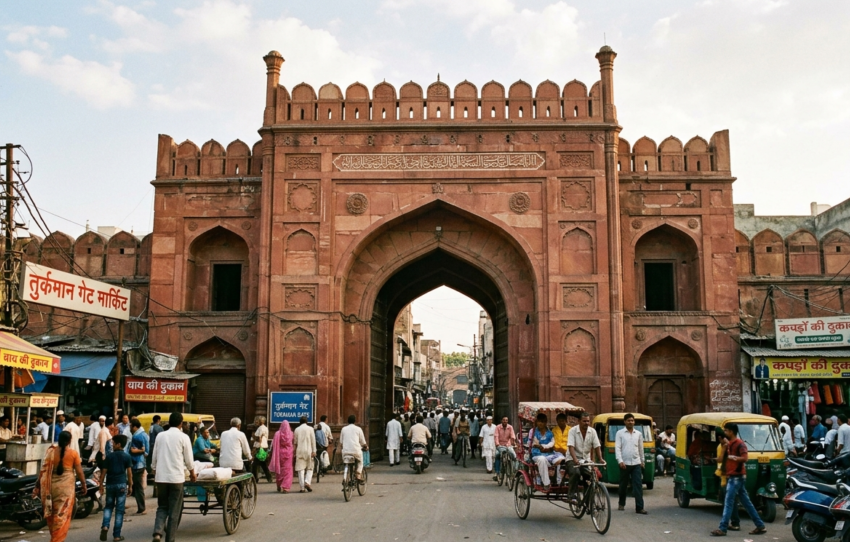
Turkman Gate, Delhi :- Complete History and Travel Guide of Shahjahanabad’s Historic Gateway
Whenever the history of Delhi is discussed, ‘Shahjahanabad‘ (Old Delhi)—the historic city established by the Mughal Emperor Shah Jahan—is always the first to be mentioned. Built to protect this historic city, the massive defensive wall featured several main entrance gates, each holding its own special significance and history. Among these prominent gateways stands Turkman Gate. This gate is not only a fine specimen of Mughal military architecture but has also been a silent witness to Delhi’s Sufi heritage and a major political milestone in modern India. Through this blog, let us dive deep into the detailed history, unique architecture, and travel insights of Turkman Gate.
Detailed History
Turkman Gate was constructed in the 17th century (around the 1650s) during the reign of the Mughal Emperor Shah Jahan. When the city of Shahjahanabad was enclosed by a tall and robust defensive wall (known as Shahrpanah) for security, 14 main gateways were built into it. Turkman Gate is one of those historic gateways that still marks a strong presence in the southern part of Old Delhi today.
The gateway was named ‘Turkman Gate‘ after the great Sufi saint Hazrat Shah Turkman Bayabani. Hazrat Shah Turkman was a renowned Turkic Sufi saint who lived in this secluded, densely forested area in the 13th century (during the Delhi Sultanate period)—long before the Mughal era and the founding of Shahjahanabad. He preferred isolation, which earned him the moniker ‘Bayabani’ (one who lives in the wilderness or forest). When Shah Jahan founded the city here centuries later, he named the prominent gateway of this zone after the saint to pay his respects. The shrine (Dargah) of this holy Sufi saint is located just near the gate today and remains one of the oldest religious sites in Delhi.
The mention of Turkman Gate in the pages of history is not limited to the Mughal era; its name is also deeply intertwined with the history of modern India. During the national Emergency imposed between 1975 and 1977, the Turkman Gate area became the epicenter of a major controversy and tragedy in April 1976. Local residents staged massive protests against slum clearance drives and forced sterilization programs. The subsequent police crackdown and firing resulted in the loss of several lives, an event recorded in history as the ‘Turkman Gate Incident.’ Thus, this gate encapsulates stories ranging from medieval grandeur to the struggles of modern India.
Detailed Architecture
The architectural design of Turkman Gate reflects the traditional military and defensive architecture of the Mughal era. This gate was strategically designed to repel enemy attacks and fortify city security.
Exterior Architecture :–
Turkman Gate is primarily built using a blend of local quartzite stones (greyish-colored stones) and red sandstones. It is flanked on both sides by two massive, semi-circular bastions. These bastions served as primary outposts for Mughal soldiers on guard duty. Specialized narrow slits or holes are carved into the upper walls of the bastions for archers and musketeers to aim at enemies. The main arched entryway is remarkably tall and wide, with its upper crest adorned with beautiful battlemented carvings in the classic Mughal style. While the surrounding defensive city walls have perished over time, this main gate still stands proudly.
Interior Architecture :–
Upon entering the inner section of the gateway, one passes through a sturdily roofed passage. Small guard rooms and arched recesses are built inside to accommodate watchmen and security personnel. The interior walls and ceilings are kept simple without any flamboyant carvings or decorations, as its primary purpose was strictly military and security-oriented. From the inside of the gate, one can get a clear view of the densely populated neighborhoods and bustling alleys of Old Delhi.
Travel Guide & Routes
If you wish to visit Turkman Gate to witness its historical significance and experience the culture of Old Delhi up close, the following guide will be highly useful.
- Tickets and Entry Fee :– Turkman Gate is a monument located on a public thoroughfare. There is no ticket required for tourists to explore it; entry is completely Free.
- Visiting Time :– The monument remains accessible 24/7. However, the ideal time to view it closely and take photographs is from 7:00 AM to 6:00 PM, when the lighting is optimal and the daytime traffic is manageable.
- Photography Spots :–
- Capturing a frame from the exterior side that includes both the massive bastions and the central archway offers a spectacular historical shot.
- Standing directly underneath the high archway to capture a close-up shot that emphasizes its scale is a favorite for heritage enthusiasts.
- Local Taste :– The area around Turkman Gate is world-famous for its delicious and traditional Mughlai non-vegetarian cuisine. Do not miss out on tasting the local Tawa Kebabs, Mutton Korma, Khamiri Roti, and Shahi Tukda. The traditional sweets sold in its narrow alleys are also highly sought after.
- Famous Markets :– Located close to Turkman Gate are Sita Ram Bazar and the commercial markets along Asaf Ali Road. Additionally, the popular markets of Chitli Qabar and Jama Masjid are within walking distance, offering traditional footwear, garments, and handicrafts.
How to Reach :–
- By Metro :– The easiest and fastest way to reach Turkman Gate is via the Delhi Metro. The nearest metro station is Delhi Gate Metro Station (Violet Line). Alternatively, you can deboard at New Delhi Metro Station (Yellow Line), from where local transport to Turkman Gate is readily available. The gate is approximately 1 to 1.5 kilometers away from both stations.
- By Road/Bus/Auto :– Turkman Gate is well-connected via Asaf Ali Road. Several DTC buses operating from different parts of Delhi halt at the nearby bus stop. From the metro stations, you can easily take an e-rickshaw or an auto-rickshaw to drop you directly near Turkman Gate.
Interesting Facts
- Older Than the City’s Name :– The gateway is named after Hazrat Shah Turkman Bayabani, a Sufi saint who lived in this region nearly 400 years before the walled city of Shahjahanabad was even built.
- The Saint’s Solitude :– The saint was called ‘Bayabani’ because he preferred to pray and meditate in the isolated wilderness (Bayaban), away from human populations.
- Witness to the Emergency :– In 1976, during the political Emergency, this gate became the center of a major civil movement and police action that significantly influenced modern Indian politics.
- Protected Heritage :– Today, this historic gateway is declared a protected national monument under the Archaeological Survey of India (ASI), preserving Delhi’s rich historical legacy.
Important Questions and Answer :-
Question 1:- Where is Turkman Gate located?
Answer:– Turkman Gate is located in Delhi near Asaf Ali Road, marking the southern boundary of the walled city of Old Delhi (Shahjahanabad).
Question 2:- Why was this gate named ‘Turkman Gate’?
Answer:– The gate was named after the famous 13th-century Sufi saint Hazrat Shah Turkman Bayabani, whose shrine (Mazar) is located right next to the gateway.
Question 3:– Who built Turkman Gate and when?
Answer:– Turkman Gate was built by the Mughal Emperor Shah Jahan during the 17th century (around 1650 AD) as part of the fortification for his new capital, Shahjahanabad.
Question 4:– Which is the nearest metro station to reach Turkman Gate?
Answer:– The nearest metro station is the ‘Delhi Gate Metro Station’ (Violet Line). The ‘New Delhi Metro Station’ (Yellow Line) is also located nearby.
Question 5:– Is there an entry fee or ticket required to see Turkman Gate?
Answer:– No, there is no entry fee or ticket required to see Turkman Gate. It is completely free and accessible to everyone.
“Enclosing within its stones the architectural splendor of the Mughals, the spiritual legacy of Sufi saints, and the political struggles of modern India, Turkman Gate stands today as an resilient witness to Delhi’s ever-changing history.”