
The Saga of Historic Jahaz Mahal :- History, Architecture, and Complete Travel Guide
Detailed History :-
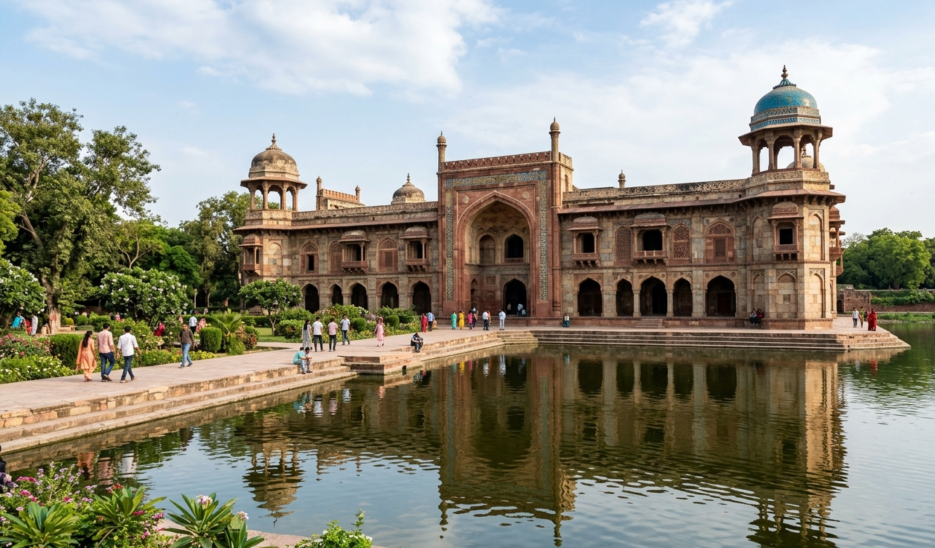
Jahaz Mahal is one of the most unique and beautiful historical monuments in Delhi, situated in the ancient southern settlement of ‘Mehrauli’. This marvelous palace was constructed during the reign of the Lodhi Dynasty of the Delhi Sultanate, between 1489 and 1517 AD. Although there is a slight divergence of opinion among historians regarding the exact Sultan who commissioned it, the majority of scholars attribute its creation to the era of Sikandar Lodhi. The palace was named ‘Jahaz Mahal’ (Ship Palace) because it was built on the eastern edge of a massive artificial reservoir known as ‘Hauz-i-Shamsi‘. Its reflection in the surrounding water gave the illusion of a grand ship floating in the lake.
The construction of this palace served two primary historical purposes. Firstly, it was utilized by the Lodhi and subsequent Mughal rulers as a refreshing ‘Royal Retreat‘ or summer pleasure resort to escape the scorching heat of Delhi. Secondly, and more significantly, it functioned as a grand ‘Sarai’ (Inn) providing comfortable transit accommodation for pilgrims and foreign traders visiting the shrines of Delhi. The historical importance of Jahaz Mahal is also deeply intertwined with Delhi’s celebrated festival, ‘Phool Walon Ki Sair’ (The Festival of Flower Sellers). This is a unique secular festival initiated during the Mughal era; even today, after offering floral fans at the Yogmaya Temple and the Dargah of Khwaja Qutbuddin Bakhtiyar Kaki, the main cultural programs of this festival are hosted inside the courtyard of Jahaz Mahal.
Detailed Architecture :-
The architecture of Jahaz Mahal presents an exceptionally graceful and well-proportioned blend of the Lodhi and early Mughal structural styles. Its design flawlessly balances simplicity with artistic finer details.
- Construction Material :– Local ‘Red Sandstone’ and grey quartzite stones were predominantly utilized in the construction of this palace. The meticulously carved stone pillars and arches remain in a highly stable condition even today.
- Exterior Architecture :– The palace is constructed on a symmetrical rectangular plan enclosing a massive, open central courtyard. The corners of the palace are fortified with square and octagonal bastions, adding to its defensive profile and aesthetic grandeur. The most striking feature of its exterior is the presence of beautiful Kiosks (Chhatris) on the roof decorated with vibrant blue glazed tiles, representing a fine synthesis of Rajput and Islamic styles. A small beautifully carved arched mosque also occupies the western wing of the palace.
- Interior Architecture :– The interiors comprise numerous well-ventilated chambers, vaulted corridors, and pillared verandas. The windows were strategically placed to allow the cool breezes arising from the Hauz-i-Shamsi lake to circulate freely, keeping the royal chambers naturally air-conditioned. The exquisite carvings on the stone pillars speak volumes about the artistic mastery of the craftsmen of that period.
Travel Guide & Routes :-
If you are planning to discover this hidden historical gem of Mehrauli and experience the tranquil ambiance of Hauz-i-Shamsi, here is a comprehensive travel guide.
- Entry Fee :– Admission to the Jahaz Mahal complex and its adjoining landscaped park is completely Free for both domestic and international tourists. There is no ticketing required for exploration or casual photography.
- Visiting Time :– Maintained under the protection of the Archaeological Survey of India (ASI), the monument remains open to visitors seven days a week from 06:00 AM to 06:00 PM. Late afternoons are considered the ideal time to visit when the heat subdues.
- How to Reach :– Being located in the historic core of Mehrauli, reaching here is highly convenient through multiple modes of transit:
- By Metro :– The nearest metro stations are ‘Mehrauli’, ‘Chhattarpur’, and ‘Qutub Minar’, all located on the Yellow Line of the Delhi Metro. Upon exiting the station, you can hire a local e-rickshaw or an auto-rickshaw for just 10-15 rupees to reach Jahaz Mahal inside Mehrauli village within 5-10 minutes.
- By Bus & Auto :– The Mehrauli Bus Terminal is situated very close to the monument, offering direct bus connectivity to all major corners of Delhi. Alternatively, you can comfortably hail an auto or a cab directly from Saket or Gurugram.
- Photography Spots :– The sweeping view of the roof Chhatris from the central courtyard, the intricately carved entrance archway, and the complete side profile of the palace captured from the banks of the Hauz-i-Shamsi reservoir are the best spots for photography. The unique architecture and peaceful atmosphere make it an ideal spot for capturing Instagram-worthy frames.
- Local Food :– The winding alleys of Mehrauli market host a variety of traditional culinary delights. You can easily sample hot kachoris, samosas, chole bhature, and local sweets. Furthermore, if you seek a luxury fine-dining or contemporary cafe experience, multiple high-end restaurants and rooftop cafes overlooking the Qutub Minar are located just a short distance away.
- Famous Markets :– The locality surrounding the monument is known as the ‘Mehrauli Main Bazaar’, which is highly popular among locals for ethnic wear, brass utensils, and wedding shopping. Additionally, the upscale ‘Malls of Saket’ and the electronics hub of Nehru Place are easily accessible from here.
Nearby Attractions :-
Mehrauli is an absolute treasure trove of heritage, allowing you to club your visit to Jahaz Mahal with these prominent nearby sightseeing landmarks.
- Qutub Minar Complex :– Located just 1.5 kilometers away, this UNESCO World Heritage Site houses the majestic Qutub Minar, the incomplete Alai Minar, and the ancient iron pillar.
- Mehrauli Archaeological Park :– Situated adjacent to Jahaz Mahal, this vast park features over 100 historical structures scattered across its greens, including the Tomb of Balban, Jamali Kamali Mosque, and Rajon ki Baoli.
- Dargah of Khwaja Qutbuddin Bakhtiyar Kaki :– The sacred shrine of one of Delhi’s most revered Sufi saints is located a walking distance from Jahaz Mahal.
- Yogmaya Temple :– One of the most ancient temples in Delhi dedicated to Goddess Yogmaya, with roots tracing back to the epic Mahabharata era.
- Hauz-i-Shamsi :– The historic water reservoir right outside the palace, originally excavated by Sultan Iltutmish.
Interesting Facts :-
- According to historical accounts, the adjacent ‘Hauz-i-Shamsi’ reservoir was constructed by Sultan Iltutmish after a divine dream where Prophet Muhammad guided him to the spot. A water spring erupted where the Prophet’s horse struck its hoof, around which the lake was developed.
- Jahaz Mahal was never utilized as a permanent residential palace for any monarch; it was strictly reserved for seasonal festivals, royal getaways, and transit stay for travelers.
- The ‘Phool Walon Ki Sair‘ festival hosted here features a joint procession by both Hindu and Muslim communities, standing as a brilliant historical symbol of communal harmony in India, with Jahaz Mahal being its focal venue.
- Traces of the brilliant blue glazed tiles can still be seen on the domes of the palace roof, bearing testimony to the vivid color palettes of medieval Indo-Islamic artwork.
Important Questions and Answer :-
Question 1:- Why was Jahaz Mahal named ‘The Ship Palace’?
Answer:- It earned the moniker ‘Jahaz Mahal‘ because of its structural positioning on the edge of the expansive Hauz-i-Shamsi lake. Its complete reflection in the water resembled a massive ship floating gracefully in the lake.
Question 2:- Where is Jahaz Mahal located and who built it?
Answer:- Jahaz Mahal is located in the Mehrauli locality of South Delhi. It was constructed during the late 15th century under the reign of the Lodhi Dynasty, specifically during the era of Sikandar Lodhi.
Question 3:– What is the connection between the ‘Phool Walon Ki Sair’ festival and Jahaz Mahal?
Answer:- ‘Phool Walon Ki Sair‘ is a famous secular cultural festival of Delhi. The primary cultural highlights of this three-day event, including classical qawwalis and traditional dances, are exclusively performed inside the courtyard of Jahaz Mahal.
Question 4:– Is there an entry ticket required to explore Jahaz Mahal?
Answer:- No, entry inside Jahaz Mahal is completely free of charge, and no tickets are required for tourists to explore the premises.
Author’s Thoughts :-
Tucked away under the towering shadow of the grand Qutub Minar, Mehrauli’s Jahaz Mahal is one of those forgotten pearls of Delhi whose intrinsic charm remains untarnished by time. Standing within its quiet courtyard and looking up at the beautiful stone Chhatris on the roof, one instantly begins to imagine that bygone era when this palace would echo with music, seasonal festivals, and royal laughter. It is a bit poignant to see that the vast reservoir in front has shrunk over the centuries, yet the architectural resilience and grace of this building remain perfectly preserved. In my view, if you wish to slip away from the urban chaos of Delhi into a quiet, crowd-free historical enclave to commune with the past, Jahaz Mahal and the surrounding historical lanes of Mehrauli will offer you a deeply poetic and soulful experience.
“Standing gracefully by the serene banks of Hauz-i-Shamsi for centuries, Jahaz Mahal continues to whisper the stories of Lodhi opulence and the timeless message of communal unity from its silent ramparts.”