Republic Day :- The Glorious History and Celebration of 26th January
Detailed History :-
26th January is India’s Republic Day, celebrated across the country with immense pride, enthusiasm, and patriotism every year. This day stands as a golden milestone in Indian history. Following independence from British rule on 15th August 1947, India required its own constitution. The Drafting Committee, chaired by Dr. Bhimrao Ambedkar, prepared the Constitution of India after relentless dedication and effort.
The Constitution of India was officially adopted on 26th November 1949, but it was implemented throughout the nation on 26th January 1950 at 10:18 AM. With this, India was declared a sovereign, democratic, and republic nation.
Significance of the 26th January Date :–
There was a specific reason for choosing this historic date. On 26th January 1930, during the Lahore Session on the banks of the Ravi River, the Indian National Congress declared ‘Purna Swaraj’ (Complete Independence) and celebrated it as Independence Day for the first time. To keep the significance of that historic date alive, our Constitution was brought into effect on 26th January 1950. On this day, the country’s first President, Dr. Rajendra Prasad, took his oath at Government House and subsequently proceeded to the Irwin Stadium (now National Stadium) to unfurl the tricolor flag for the first time.
Detailed Celebrations & Setup
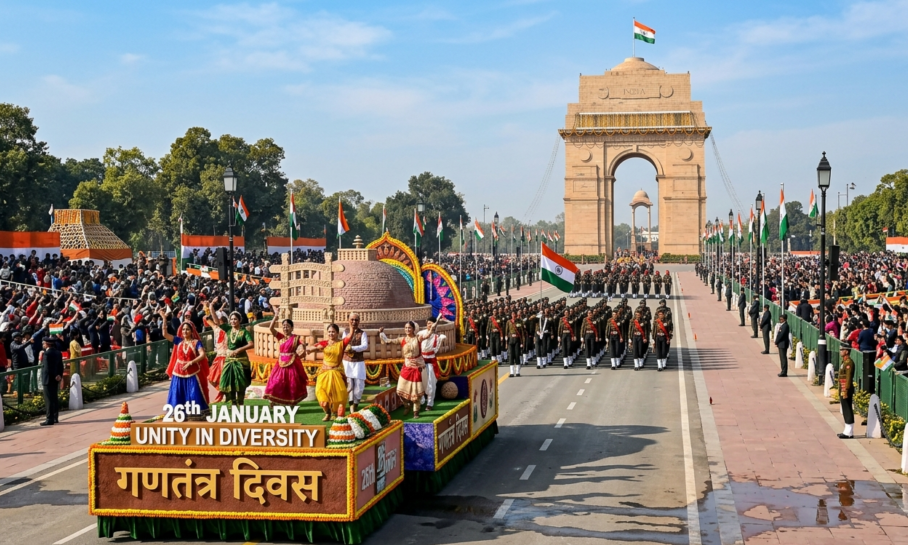
The grand layout and organization of the main Republic Day celebrations take place at the historic ‘Kartavya Path’ (formerly known as Rajpath) in Delhi. Its grandeur and security infrastructure are uniquely structured and highly planned.
Parade Route & Exterior Layout :–
The main ceremony begins at the Rashtrapati Bhavan in New Delhi and proceeds along Kartavya Path toward the historic Red Fort. This entire route is beautifully decorated with the national tricolor, magnificent flowers, and attractive electrical lighting. On both sides of Kartavya Path, massive and well-arranged enclosures are set up for spectators, where VVIPs, foreign Chief Guests, and thousands of ordinary citizens witness this splendid spectacle. The security of the event is so robust that the entire Central Delhi area is converted into a secured fortress.
Interior Event & Tableaux Details :–
The ceremony starts with the Prime Minister paying tribute to the fallen soldiers at the National War Memorial. Following this, the President of India arrives at the dais along with the Chief Guest and unfurls the national flag, which is followed by a 21-gun salute.
Then begins the majestic parade. Contingents of the Indian Army, Navy, and Air Force march past showcasing their modern weaponry, tanks, and missiles. This is followed by cultural and theme-based tableaux from various states and government departments, presenting a unique glimpse of India’s ‘Unity in Diversity’ and rich cultural heritage. The main attraction of the program is the Air Force ‘Flypast’, where fighter jets perform breathtaking maneuvers in the sky, forming the tricolor.
Travel Guide & Routes
If you want to watch the live 26th January ceremony in Delhi, please pay special attention to the following points.
- Ticket and Entry Fee :– It is mandatory to book tickets in advance to watch the Republic Day Parade. Tickets can be booked online from the second or third week of January through the Ministry of Defence’s official invitation portal (Amantran Portal). Ticket prices are ₹20, ₹100, and ₹500 (depending on the category).
- Visiting Time :– On the day of the event (26th January), spectators are permitted entry only from 6:00 AM to 8:30 AM. The parade commences between 9:30 AM and 10:00 AM. Due to security checks, you need to arrive well in advance.
- Photography Spots :– For security reasons, carrying cameras, mobile phones (except for specific pass categories), or any electronic items inside the parade venue (Kartavya Path) is strictly prohibited. However, you can photograph India Gate or the National War Memorial from a distance in the days following the parade when the decorations remain on display.
- Local Flavors :– After the ceremony, you can visit Connaught Place (CP) or Bengali Market, where you can relish Delhi’s famous chaat, golgappe, chole bhature, and piping hot jalebis.
- Famous Markets :– For shopping, you can visit Connaught Place, Janpath Market, or Khan Market, which are located right in the heart of New Delhi.
- Nearby Attractions :– Situated right next to the event venue are India Gate, the National War Memorial, Rashtrapati Bhavan, the New Parliament House, and the National Museum. You can visit these historical sites after the parade or on the following day.
How to Reach :–
- By Metro :– Due to security arrangements on 26th January, metro stations closest to Kartavya Path (such as Central Secretariat and Udyog Bhawan) remain closed during the morning hours. You can deboard at ‘Mandi House’, ‘Barakhamba Road’, or ‘Rajiv Chowk’ metro stations and reach the designated entry gates either on foot or via auto.
- By Road :– Most roads in New Delhi and Central Delhi are closed to general vehicles on the morning of 26th January. Therefore, using the metro service is the best and most convenient route on this day.
Interesting Facts
- On 26th January 1950, the country’s first President, Dr. Rajendra Prasad, traveled to the parade venue in a traditional horse-drawn carriage (buggy).
- The Republic Day celebrations do not end on 26th January itself; they conclude on the evening of 29th January with the grand ‘Beating Retreat’ ceremony.
- During the parade, a famous Christian hymn tune titled ‘Abide With Me‘, which was a favorite of Mahatma Gandhi, used to be played; it has now been replaced by the tune of ‘Aye Mere Watan Ke Logo‘.
- Every year, there is a global diplomatic tradition of inviting a head of state from another country as the Chief Guest for the Republic Day celebrations.
Important Questions and Answer :-
Question 1:- What is the difference between flag hoisting on 15th August and flag unfurling on 26th January?
Answer:- On 15th August (Independence Day), the flag is pulled up from the bottom of the pole with a rope and then hoisted by the Prime Minister at the Red Fort, which is called ‘Flag Hoisting’. On 26th January (Republic Day), the flag remains tied at the top of the pole and is opened and unfurled by the President, which is called ‘Flag Unfurling’.
Question 2:– How is the best tableau selected in the Republic Day Parade?
Answer:- A committee of experts appointed by the Ministry of Defence evaluates the tableaux from different states and departments based on their art, presentation, music, and theme, and the best tableau is awarded.
Question 3:- Can general citizens watch the parade on Kartavya Path without a ticket?
Answer:- No, due to security measures and limited seating capacity, no individual is permitted entry into the spectator enclosures of Kartavya Path without a valid ticket or an Invitation Pass.
Author’s Thoughts :-
The 26th of January is not merely a national holiday or a day to watch a parade; it is a festival that awakens the inner pride of being an Indian. This day reminds us of the immense sacrifices made to secure our democracy and constitution. The patriotic tunes echoing across Kartavya Path infuse a renewed sense of nationalism into the heart of every citizen.
“The pride and glory of the tricolor, combined with respect for the Constitution, defines the true identity of our sovereign India.”