
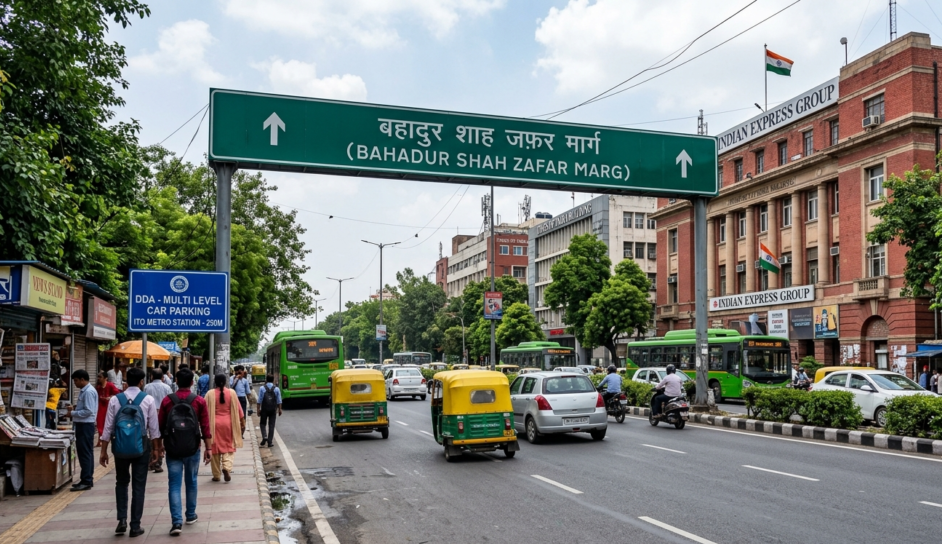
Bahadur Shah Zafar Marg, Delhi :- The Backbone of Indian Media and Witness to History
Detailed History
Bahadur Shah Zafar Marg (BSZM) is an exceptionally vital and bustling arterial road in New Delhi, historically and proudly referred to as the “Fleet Street of India”. Named after the last Mughal Emperor and the poignant symbol of the 1857 Uprising, Bahadur Shah Zafar, this prominent avenue bridges the historic boundary between Old Delhi (Shahjahanabad) and the pristine layouts of Lutyens’ Delhi.
Historically, this stretch of road served as the absolute mecca of journalism in post-independence India. Following 1947, the country’s premier national newspaper groups established their flagship headquarters and massive printing presses along this avenue. Iconic titles such as The Times of India, The Economic Times, Navbharat Times, The Indian Express, The Statesman, and the National Herald set up their legacy offices here. From guarding press freedoms during the turbulent days of the Emergency to transitioning into the relentless era of 24/7 digital newsrooms, this singular road has stood as a front-row witness to the turning points of modern Indian history.
Detailed Architecture :-
The architectural profile of Bahadur Shah Zafar Marg stands as a classic representation of post-independence institutional design and Modern Functionalist styling.
- Exterior Architecture :– The expansive four-lane road is lined with multi-story concrete and glass structures built predominantly between the 1950s and 1970s. These buildings bear the distinctive imprint of Nehruvian-era civic architecture—favoring stark geometric lines, structural strength, and raw utility. Legacy structures like the Express Building and Times House feature robust concrete grid works and broad windows, custom-designed to accommodate massive, heavy-duty rotary printing presses in their lower levels alongside expansive administrative offices.
- Interior Architecture :– Stepping inside these heritage media complexes reveals a fascinating intersection of eras. The older wings feature sprawling high-ceilinged corridors and classic wooden editorial cabins that once resonated with the clatter of typewriters and the rumble of printing machinery from the basement. Today, most of these spaces have been meticulously overhauled into hyper-modern, open-plan digital newsrooms outfitted with real-time broadcast monitors, state-of-the-art computer arrays, and dynamic, collaborative creative workstations.
Travel Guide & Routes :-
As a bustling commercial and institutional nerve center in Central Delhi, traversing Bahadur Shah Zafar Marg is straightforward. Here is your comprehensive guide to visiting the area.
- Entry Ticket :– There is no fee or entry ticket required to access this public avenue. (It is completely free, though entry inside the individual media houses, newsrooms, and press facilities is strictly restricted to employees and authorized professionals due to corporate security protocols).
- Visiting Timings :– The ideal window to observe the pulse of this media district is between 09:00 AM and 07:00 PM on standard weekdays. As a premier commercial zone, it experiences high operational activity and vibrant office crowds during these hours.
- How to Reach :–
- By Metro :– The most convenient gateway is the ‘ITO’ Metro Station, situated on the Violet Line of the Delhi Metro network. Several designated exit gates step out directly onto Bahadur Shah Zafar Marg. Alternatively, ‘Mandi House’ and ‘Supreme Court’ (Pragati Maidan) metro stations on the Blue Line are within comfortable walking distance.
- By Bus :– Positioned strategically between ITO and Delhi Gate, the avenue is serviced by an extensive web of DTC buses arriving from all corners of the capital (including Anand vihar and Kashmiri Gate). The ‘ITO‘ and ‘Express Building‘ bus stops are centrally located on the stretch.
- By Auto/Cab :– Positioned in the geographical heart of Central Delhi, app-based cabs and local auto-rickshaws are readily accessible from any part of the National Capital Region (NCR).
Nearby Attractions :-
- Feroz Shah Kotla Fort :– Located immediately adjacent to the avenue, this 14th-century fortress houses historic Tughlaq-era masonry, secret chambers, and the iconic, ancient polished sandstone Ashokan Pillar.
- Arun Jaitley Stadium (Kotla Ground) :– A legendary landmark for sports fans, this historic cricket stadium sits right along the marg and has hosted countless historic international cricket matches.
- Khooni Darwaza (Bloody Gate) :– A standalone, historic Mughal gateway situated at the junction of the road, preserving dark tales from the Mughal succession wars and the Rebellion of 1857.
- Raj Ghat & Shantivan :– The serene, beautifully landscaped memorial grounds dedicated to Mahatma Gandhi and other founding leaders of independent India sit just a short drive away along the Yamuna riverbank.
- Pragati Maidan & Bharat Mandapam :– The country’s premier international exhibition complex, featuring the world-class Bharat Mandapam convention center, is situated in close proximity.
Photography Spots, Local Taste, and Famous Markets :-
- Photography Spots :– The imposing stone architecture of Khooni Darwaza, the rustic, weathered structures inside the Feroz Shah Kotla Fort, and the dynamic vehicle light trails slicing through the busy ITO intersection at twilight offer fantastic frames for urban and travel photographers.
- Local Taste :– The avenue is highly popular for its vibrant street food catering to thousands of busy corporate professionals. Local carts serving hot kachori-sabzi, crispy bread pakoras, flavorful chole-chawal, and intense cutting chai are daily staples here. For fine dining, the nearby cultural hub of Mandi House offers excellent open-air cafes and heritage bakeries.
- Famous Markets :– Located just a brief distance away, the famous Sunday Daryaganj Book Market is a paradise for vintage and rare book collectors. The legendary markets of Old Delhi, including Chandni Chowk and Meena Bazaar, are also easily accessible within a few kilometers.
Interesting Facts :-
- Mirroring the historical role of London’s Fleet Street, Bahadur Shah Zafar Marg earned its title because it consolidated the print machinery that actively shaped public opinion and national discourse across independent India.
- The iconic ‘Express Building’ on this street was the personal fort of pioneering freedom fighter and media baron Ramnath Goenka, who famously utilized his publication to fiercely defy government censorship during the 1975 Emergency.
- The subterranean Violet Line of the Delhi Metro running beneath this zone is colloquially termed the ‘Heritage Line’ due to its seamless connectivity to Delhi’s deepest historical nodes.
- Before the advent of real-time digital news, the street would witness massive logistical symphony every single night, with hundreds of transport trucks lining up to distribute freshly printed ink-and-paper news across India before dawn.
Important Questions and Answer :-
Question 1:– Why is Bahadur Shah Zafar Marg famously called the “Fleet Street of India”?
Answer:- It is named after London’s iconic Fleet Street because it became the central geographic hub where the headquarters and printing facilities of almost all major national daily newspapers of India were concentrated.
Question 2:– Which metro station provides the most direct access to this media hub?
Answer:- The ‘ITO’ Metro Station on the Violet Line is the most direct and convenient station, dropping commuters right onto the main pavement of the avenue.
Question 3:– Can tourists request a casual tour inside the active newsrooms on this street?
Answer:- No, casual entry for general tourists inside the live newsrooms or press floors is strictly prohibited to ensure operational security, confidentiality, and data integrity. Entrance requires official business credentials or pre-arranged institutional invitations.
Author’s Thoughts :-
Bahadur Shah Zafar Marg is far more than just another heavily trafficked asphalt corridor in Central Delhi; it represents the intellectual spine and the unyielding democratic conscience of independent India. Walking past these heavy, stoic concrete facades, one can almost feel the historic weight of the headlines crafted within their walls—words that have altered governments and recorded the birth of modern India. Though the digital wave has transformed how we consume information, the air along this timeless street still hums with the romance of old-school investigative journalism and the raw pursuit of truth.
“Bahadur Shah Zafar Marg remains the inkwell of Indian democracy, mapping the nation’s evolving history onto the pages of time.”