
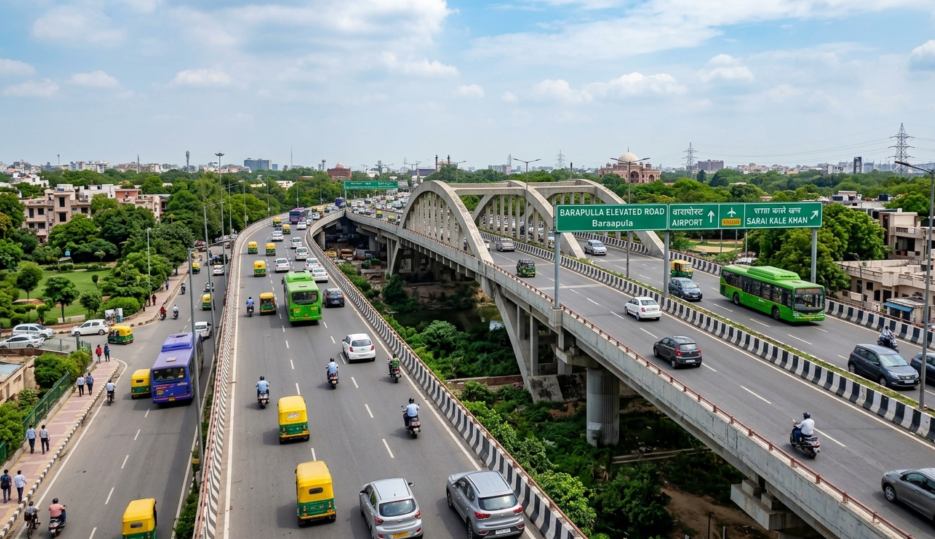
Barapullah, Delhi :- The Historic Mughal Bridge and Lifeline of Modern Commute
Detailed History
Delhi’s ‘Barapullah’ stands as a symbol of a unique intersection between history and modernity. Today, most Delhiites know it as a bustling, state-of-the-art ‘Elevated Corridor‘ that seamlessly connects South Delhi to East Delhi. However, this modern transit route is actually named after a historic Mughal-era structure—the ‘Barapullah Bridge’—which still stands today near the Hazrat Nizamuddin Railway Station.
The historic Barapullah Bridge was constructed in the year 1628 during the reign of the Mughal Emperor Jahangir by his loyal courtier, Minhas Sultan. Some historians also associate its completion with Shah Jahan’s era. During that period, this bridge was a critical component of the imperial highway (Grand Trunk Road) connecting Delhi (Shahjahanabad) to Agra. Whenever the Mughal emperors and their grand royal entourages traveled to visit Humayun’s Tomb or pay respects at the Nizamuddin Dargah, they crossed this very bridge. It was originally engineered to span a major tributary of the Yamuna River (which has unfortunately transformed into a large urban drain today).
Detailed Architecture
The architectural landscape of Barapullah must be viewed through two entirely distinct lenses: the 400-year-old Mughal stone bridge on one side, and the 21st-century elevated flyover on the other.
- Historical Bridge Architecture :– The original Barapullah Bridge is a spectacular specimen of Mughal engineering. As the name explicitly implies—‘Barapullah’ translates to a bridge of twelve piers or arches. The structure features 11 soaring arched waterways supported by 12 massive stone piers. It was constructed using locally quarried red sandstone, kankar-lime mortar, and traditional Lakhori bricks. Robust stone parapet walls run along both sides for safety. The ancient domed minarets and bastions framing the bridge ends highlight its regal, imperial design.
- Modern Elevated Corridor Architecture :– In sharp contrast, the newly engineered Barapullah Elevated Corridor (Barapullah Flyover) is a marvel of contemporary civil engineering. Built primarily for the 2010 Commonwealth Games to ensure seamless, high-speed transit from the Games Village to various stadiums, it was constructed using pre-stressed concrete girders and advanced single-pillar technology. It stands as one of Delhi’s longest and smoothest signal-free elevated corridors.
Travel Guide & Routes
If you wish to explore the historic Mughal bridge or experience a drive along the modern elevated corridor, here is your essential guide.
- Entry Ticket :– There is no admission fee or entry ticket required to access either the historic bridge or the modern elevated route. It is completely free and open to the public.
- Visiting Timings :– The ideal time to visually appreciate the historic bridge is between 07:00 AM and 10:00 AM, when the morning light is perfect and crowds are minimal. The modern flyover remains operational 24/7.
- How to Reach :–
- By Metro :– To reach the historic Barapullah Bridge, the closest metro gateways are the ‘Jawaharlal Nehru Stadium’ (JLN Stadium) and ‘Jangpura’ stations, both located on the Violet Line. From there, local e-rickshaws or auto-rickshaws can drop you near the old structure located past the railway tracks.
- By Rail :– The ancient bridge is situated within short walking distance from the western side of the Hazrat Nizamuddin Railway Station.
- By Auto/Cab :– To experience a drive on the modern Barapullah Flyover, you can take a direct cab or auto-rickshaw entering the corridor from INA, Sarai Kale Khan, or Mayur Vihar.
Nearby Attractions :-
- Hazrat Nizamuddin Aulia Dargah :– Located right next to the historic bridge, this world-renowned Sufi shrine is highly celebrated for its soulful evening Qawwali sessions.
- Humayun’s Tomb :– A magnificent UNESCO World Heritage Site showcasing the absolute peak of early Mughal garden architecture, located just 1.5 kilometers away.
- Tomb of Abdul Rahim Khan-i-Khanan :– The beautifully restored mausoleum of the legendary court poet and Mughal general Rahim, situated within the same immediate zone.
- Sunder Nursery :– A breathtaking heritage park, micro-habitat, and botanical garden located nearby—perfect for a peaceful stroll.
- Jawaharlal Nehru Stadium :– A massive, world-class sports and cultural arena situated at the western terminus of the Barapullah transit route.
Photography, Local Taste, and Famous Markets :-
- Photography Spots :– Capturing the silhouettes of the old Barapullah arches against a setting sun offers a vintage frame, while long-exposure photography of vehicle light trails from the modern elevated corridor provides incredible futuristic urban landscape shots.
- Local Taste :– The historic Nizamuddin Basti adjoining the old bridge is a paradise for authentic Mughlai cuisine, world-famous for its succulent seekh kebabs, rich mutton korma, fluffy khameeri rotis, and creamy phirni. Additionally, the nearby Bhogal area is famous for its spicy local Chole Bhature.
- Famous Markets :– The highly popular Lajpat Nagar Central Market (renowned for traditional clothing, textiles, and footwear) and Khan Market (celebrated for its high-end global brand boutiques and premium cafes) are located just a short distance from the corridor exits.
Interesting Facts :-
- William Finch, a celebrated British traveler who visited India during the reign of Emperor Jahangir, documented this specific Barapullah Bridge in his personal travelogues, describing it as one of the finest bridges in Delhi.
- Due to natural shifts in the course of the Yamuna River over centuries and rapid urban sprawl, the water body the bridge originally crossed has turned into a seasonal stormwater drain, causing severe environmental strain to this heritage structure.
- The modern Barapullah Elevated Corridor has been officially renamed ‘Baba Banda Singh Bahadur Setu’ to honor the legendary warrior, though it continues to be universally known as Barapullah in everyday commute language.
- The construction of this modern corridor drastically reduced commute times for millions traveling between Noida/East Delhi and South Delhi (like AIIMS and INA), cutting down a tedious 1-hour traffic battle to a smooth 10 to 15-minute signal-free breeze.
Important Questions and Answer :-
Question 1:– What does the name ‘Barapullah’ literally mean and who built it?
Answer:- ‘Barapullah’ literally translates to a ‘bridge with twelve piers’. This historic bridge was constructed during the Mughal era (1628 AD) under the administrative rule of Emperor Jahangir.
Question 2:- Which two major sectors of Delhi does the modern Barapullah Flyover connect?
Answer:- The modern Barapullah Elevated Route directly connects Sarai Kale Khan (East Delhi/Ring Road) with INA and the JLN Stadium in South Delhi, extending further out toward Mayur Vihar via the Vikas Marg extension.
Question 3:– Is the original, ancient Barapullah Bridge still visible and accessible to the public?
Answer:- Yes, the ancient structure stands firm near the western perimeter of the Hazrat Nizamuddin Railway Station heading into Nizamuddin Basti, though it currently faces structural wear due to rapid urban neglect.
Author’s Thoughts :-
Barapullah beautifully encapsulates the true split personality of Delhi. When you are cruising along its modern elevated corridor at 80 km/h, you feel the raw speed, infrastructure, and forward momentum of 21st-century India. But the moment you step underneath into the labyrinthine alleys of Nizamuddin to confront the original 400-year-old stone arches, time instantly stands still. It is mesmerizing to realize that the exact path where thousands of eco-friendly cars now glide was once trodden by royal Mughal elephants and cavalry. Barapullah serves as a gentle reminder that in our frantic race toward development, we must never let the historic pages of our past slide into oblivion.
“Barapullah is Delhi’s ultimate time-travel corridor, seamlessly charting a path from the grand majesty of the Mughal era to the lightning speed of modern India.”