
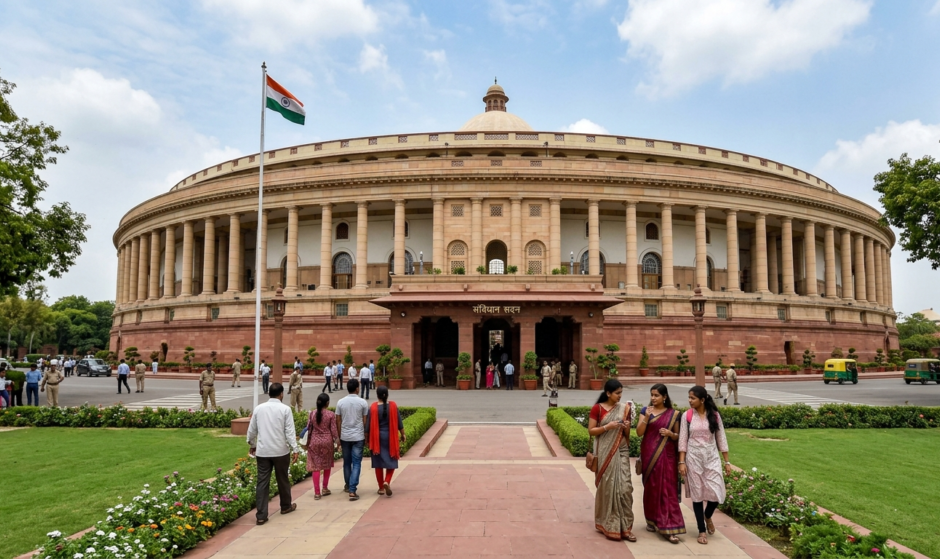
Old Parliament House (Samvidhan Sadan), Delhi :- The Historic Cradle of Independent India and the Temple of Democracy
Detailed History
Situated in the absolute epicenter of New Delhi’s Lutyens’ zone, the ‘Old Parliament House’ (now officially renamed ‘Samvidhan Sadan’) is far more than a magnificent colonial structure; it stands as the ultimate living archive of the birth, struggles, triumphs, and democratic journey of modern India. The foundation stone of this monumental building was laid on February 12, 1921, by the Duke of Connaught, and it took nearly six years of intensive craftsmanship to complete. This grand edifice was formally inaugurated on January 18, 1927, by the then Viceroy of India, Lord Irwin. Originally known during the British Raj as the ‘Council House’, it was masterfully co-designed by the legendary British architects Sir Edwin Lutyens and Sir Herbert Baker.
On the midnight of August 15, 1947, as India stepped into independence, the historic transition of power took place within the iconic ‘Central Hall‘ of this very building, where Pandit Jawaharlal Nehru delivered his world-famous “Tryst with Destiny” speech. Within these historic walls, the greatest visionary minds and founding fathers of the nation debated and labored for 2 years, 11 months, and 18 days to draft the holy manuscript of the Constitution of India. From 1950 until September 2023, this building functioned as the supreme Parliament of India, witnessing the enactment of monumental legislations that shaped the fate of a billion lives. In September 2023, as legislative operations transitioned to the New Parliament building, Prime Minister Narendra Modi honorably proposed and designated this historic structure as ‘Samvidhan Sadan’ (Constitution House).
Detailed Architecture :-
The architectural profile of the Old Parliament House remains one of the most celebrated and visually distinctive designs in the world. Its layout displays a grand synthesis of classical European symmetry and traditional Indian structural philosophy. Historians and travelers widely note that its unique circular design bears an unmistakable resemblance to the 11th-century ‘Chausath Yogini Temple’ located in Mitawali (Morena, Madhya Pradesh).
- Exterior Architecture :– The entire building features a perfectly circular layout, measuring 560 feet in diameter and sprawling across an expansive six-acre landscape. The defining structural signature of the exterior is a continuous colonnade of 144 massive granite pillars that frame the outer circular verandah. These pillars give the structure an enduring, classical, and stately presence. The external facade is sculpted out of premium red and creamy yellow Dhaulpur sandstone. Manicured lawns, expansive walkways, and historic stone fountains surround the perimeter, enhancing its majestic aesthetic.
- Interior Architecture :– At the geometric center of this circular layout lies the world-famous ‘Central Hall’, crowned by a soaring, magnificent structural dome. This hall forms the absolute epicenter of modern Indian political history. Branching out symmetrically from the Central Hall are three large, semi-circular chambers that historically housed the Lok Sabha, the Rajya Sabha, and the grand Parliament Library. The interior walls feature delicate stone screens (Jali work) and brackets inspired by classical Hindu and Mughal design motifs. Polished marble floors, rich teak-wood acoustic panels, and life-sized historic portraits of national leaders adorn the corridors, reflecting its monumental legacy.
Travel Guide & Routes :-
The Old Parliament House (Samvidhan Sadan) is situated along Parliament Street within the hyper-secure, high-profile institutional heart of Central Delhi. Here is your essential transit and visitor layout:
- Entry Ticket & Admission::– Due to extreme national security protocols, direct walk-in entry inside the active historical legislative chambers of Samvidhan Sadan is restricted for general tourists. However, visitors can access the highly interactive and educational Parliament Museum located within the library complex by purchasing a standard entry ticket. Entering the main complex generally requires an official Visitor Pass, issued through a Member of Parliament (MP) or specialized institutional clearance. The grand exterior architecture can be visually appreciated and photographed from the public perimeters of Parliament Street and Vijay Chowk free of charge.
- Visiting Timings :– Exploring the external perimeters and adjoined historic avenues is best done between 09:00 AM and 05:00 PM daily. The Parliament Museum remains open on scheduled weekdays but is closed on Mondays and national public holidays.
- How to Reach :–
- By Metro :– The absolute closest and most practical metro transit terminal is the ‘Central Secretariat’ Metro Station, which serves as a major multi-line interchange hub for the Yellow and Violet Lines. Additionally, the ‘Udyog Bhawan’ and ‘Patel Chowk’ stations are within short walking distance. The building is a brief 5 to 10-minute walk from these exits.
- By Bus :– Central Delhi buses navigating toward Rashtrapati Bhavan, Krishi Bhawan, or Connaught Place stop directly at the designated ‘Parliament House’ bus bays.
- By Auto/Cab :– Positioned centrally, the complex is barely a 10-minute drive from Connaught Place, India Gate, or the New Delhi Railway Station (NDLS) via app-based cabs or local auto-rickshaws.
Nearby Attractions :-
- New Parliament House :– Located immediately adjacent to the old structure, this newly inaugurated, state-of-the-art triangular fortress stands as the architectural symbol of modern, tech-driven 21st-century India.
- Rashtrapati Bhavan :– The official palatial residence of the President of India, showcasing unparalleled architectural scale, located just 1 kilometer down the road at Raisina Hill.
- India Gate & Kartavya Path :– India’s iconic national war memorial and the grand ceremonial boulevard—perfect for an evening stroll and heritage photography.
- National Museum :– One of India’s largest repositories of ancient artifacts, rare Indus Valley treasures, and historical sculptures, situated close by on Janpath Road.
- Jantar Mantar :– A fascinating, historic open-air astronomical observatory constructed by Maharaja Jai Singh II, located further down Parliament Street.
Photography Spots, Local Taste, and Famous Markets :-
- Photography Spots :– Capturing the wide, sweeping circular facade of the 144 pillars from the open expanses of Vijay Chowk or the primary gates of Parliament Street provides an iconic, patriotic frame. (Note: This is a high-surveillance VIP zone; ensure strict compliance with security personnel. Photography near sensitive entry check-points and fortified gates is strictly prohibited).
- Local Taste :– The institutional streets surrounding the secretariats are famous for roadside stalls serving hot cardamom tea, fresh samosas, and quick snacks. For a wholesome culinary journey, visitors often explore the famous state house canteens (like Andhra Bhavan) nearby or check out premium fine-dining restaurants in Connaught Place.
- Famous Markets :– The historic shopping arcades of Connaught Place, Janpath Market, and the underground Palika Bazar are located just a few minutes away, offering endless retail options for traditional handlooms, books, and artifacts.
Interesting Facts :-
- While British records credit Lutyens and Baker for the architectural blueprints, structural design experts emphasize that the layout is an exact mirror-image of the circular Chausath Yogini Temple in Madhya Pradesh, suggesting a deep, unacknowledged indigenous architectural inspiration.
- A famous quirk of the Central Hall’s interior design is its ceiling fans. Due to the immense height of the dome ceilings, the giant fans were uniquely mounted on tall, floor-standing iron pillars but installed upside down to push the breeze upward and outward—a mechanical layout preserved to this day.
- On December 13, 2001, this supreme institution was the target of a brazen terrorist attack. The core structural integrity of the democracy was defended by the ultimate sacrifices of brave security personnel who neutralized the threat before the inner doors could be breached.
- The extensive Parliament Library housed within the complex ranks as the second-largest library repository in India. It carefully preserves the original, masterfully handwritten and illustrated copies of the Constitution of India within customized, helium-filled protective cases.
Important Questions and Answer :-
Question 1:- What is the official new name of the Old Parliament House?
Answer:- The Old Parliament House was officially renamed ‘Samvidhan Sadan’ (Constitution House) in September 2023, honoring the historic chambers where India’s constitution was formulated.
Question 2:– Who were the principal architects behind the design of this circular landmark?
Answer:- The building was envisioned and designed by celebrated British master architects Sir Edwin Lutyens and Sir Herbert Baker during the planning of New Delhi in the 1920s.
Question 3:– Can an international or local tourist explore the inside of the main legislative halls?
Answer:- General walk-in access into the operational chambers is restricted due to high-level security. However, travelers can explore the exceptional Parliament Museum inside the campus to view replicas and interactive historical displays.
Author’s Thoughts :-
Standing before the monumental facade of Samvidhan Sadan feels like standing before a giant mirror of India’s destiny. As you look past the continuous curve of its 144 granite pillars, you can almost hear the historic echoes of Gandhi, Nehru, Patel, and Ambedkar debating the foundational ideals of our freedom. This is the very ground where a colonized nation broke its chains, took its first sovereign breath, and wrote its own future. While modern governance has rightfully transitioned into a sleek new triangular home next door, the poetic majesty and historical romance of this circular structure remain unmatched. It is the root system of our democracy, and its stones will forever tell the story of how a young nation rose to become the world’s largest democratic powerhouse.
“Samvidhan Sadan remains the timeless cornerstone of Indian democracy, a magnificent stone archive that gently guided a newly independent nation into its glorious sovereign future.”