
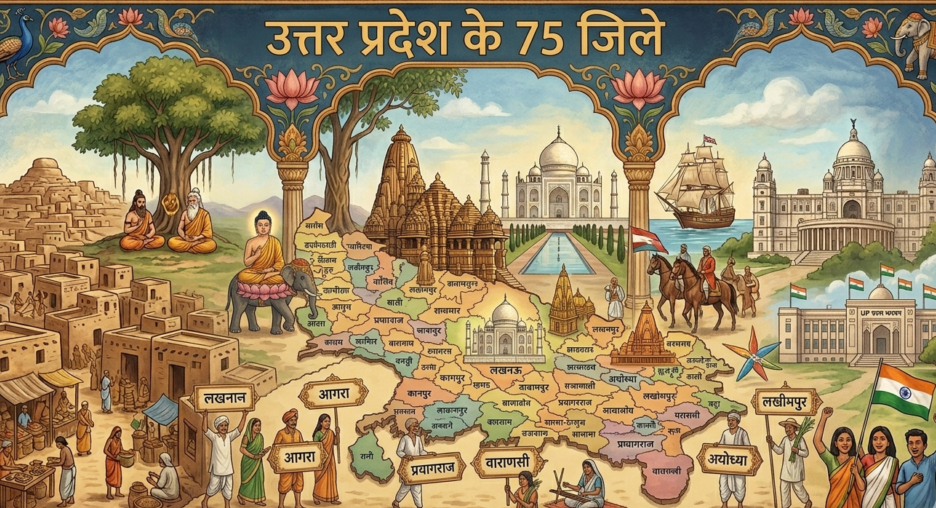
75 Districts of Uttar Pradesh :- The Confluence of History, Culture, and Modernity
Detailed History
Uttar Pradesh is the heart of India, historically known as ‘Madhyadesh‘. It is the sacred land where Vedas and Puranas were composed. Nestled in the lap of the Ganga and Yamuna, this state has witnessed the rise and fall of the Maurya, Gupta, Mughal, and Maratha empires. The first sparks of the 1857 revolution were ignited here. Today, with 75 districts, it is India’s largest administrative system, leading in sectors ranging from religious tourism to heavy industries.
Detailed Architecture :-
The architecture here is the result of centuries of evolution. In Varanasi, you will see ancient Hindu temple styles where stone carvings and high spires reflect spirituality. The Taj Mahal in Agra and the Imambaras of Lucknow are excellent examples of Indo-Islamic architecture. Western UP, particularly Noida and Greater Noida, features skyscrapers and modern infrastructure, representing global urban designs.
Detailed Guide to All 75 Districts :-
1. Agra :– Famous worldwide for the Taj Mahal. It houses the Agra Fort and Fatehpur Sikri. Known for its leather industry and Petha sweets.
2. Aligarh :– Known as the ‘City of Locks‘ and home to the prestigious Aligarh Muslim University (AMU).
3. Prayagraj :– The ‘King of Pilgrimages‘ where the confluence (Sangam) of Ganga, Yamuna, and Saraswati takes place. Home to the Kumbh Mela.
4. Ambedkar Nagar :– Famous for the Tanda weaving industry and the shrine of Sufi saint Makhdoom Ashraf.
5. Amethi :– Emerging industrial hub known for modern ordnance factories and agro-based trade.
6. Amroha :– Renowned for the manufacturing of Dholaks (musical instruments) and lush mango orchards.
7. Auraiya :– Historically famous for the trade of pure Desi Ghee and housing the GAIL industrial unit.
8. Ayodhya :– The birthplace of Lord Shri Ram and a major center of Hindu faith with the grand Ram Mandir.
9. Azamgarh :– Known as the land of scholars and world-famous for its artistic ‘Black Pottery’.
10. Badaun :– The land of Sufi saints, featuring the magnificent ancient Jama Masjid architecture.
11. Baghpat :– Historically significant as ‘Lakshagriha’ in Mahabharata; now a leader in sugarcane production.
12. Bahraich :– Located near the Nepal border, famous for Katarniaghat Wildlife Sanctuary and the shrine of Dargah Sharif.
13. Ballia :– Known as ‘Rebel Ballia’ (Baaghi Ballia) for its role in the 1942 movement. Birthplace of Mangal Pandey.
14. Balrampur :– Home to the Devi Patan Shaktipeeth and closely located to the Buddhist site of Shravasti.
15. Banda :– Famous for the rare ‘Shajar Stone’ of the Ken river and the invincible Kalinjar Fort.
16. Barabanki :– Known for the Deva Sharif shrine of Waris Ali Shah and opium production.
17. Bareilly :– Called ‘Jhumka City‘, famous for cane furniture and Surma (kohl) industry.
18. Basti :– Ancient penance site of Sage Vashistha, known for its sugar mills and cultural richness.
19. Bhadohi :– Known as the ‘Carpet City’, exporting exquisite handmade carpets globally.
20. Bijnor :– Located along the Ganges, known for its forest resources and the industrial area of Najibabad.
21. Bulandshahr :– Famous for the ‘Ceramic’ art of Khurja and the Narora Atomic Power Station.
22. Chandauli :– Called the ‘Rice Bowl of Eastern UP’, famous for Chandraprabha Wildlife Sanctuary.
23. Chitrakoot :– The sacred place where Lord Ram spent 11 years of exile on the banks of the Mandakini river.
24. Deoria :– Part of the ancient Malla Republic, currently a leading agricultural district for sugarcane.
25. Etah :– Famous for the manufacturing of bells (Ghungru/Ghanti) and the ancient Jaleshwar Temple.
26. Etawah :– Known for the Lion Safari and the historic Victoria Memorial Hall along the Yamuna.
27. Farrukhabad :– Famous for ‘Zardozi’ hand embroidery and large-scale potato production.
28. Fatehpur :– Situated between Ganga and Yamuna, home to the historic ‘Bawan Imli’ martyr site.
29. Firozabad :– The ‘Glass City’ (Suhag Nagari), famous for its world-class glass bangles and artifacts.
30. Gautam Buddha Nagar (Noida) :– The modern face of UP, a global hub for IT, electronics, and industrial investment.
31. Ghaziabad :– The ‘Gateway to UP’, a massive industrial city known for engineering and manufacturing.
32. Ghazipur :– Known as the ‘City of Waves’ and home to the tomb of Lord Cornwallis and a government opium factory.
33. Gonda :– An agricultural hub near the foothills of the Himalayas, part of the Devi Patan division.
34. Gorakhpur :– The city of Baba Gorakhnath, famous for Gita Press, the world’s largest publisher of religious texts.
35. Hamirpur :– Located at the confluence of Betwa and Yamuna, known for granite mining and ancient temples.
36. Hapur :– Houses North India’s largest grain market and the holy pilgrimage site of Garhmukteshwar.
37. Hardoi :– Associated with the legend of Hiranyakashyap, home to the Sandi Bird Sanctuary.
38. Hathras :– Famous for its Asafoetida (Hing) trade and its tradition of humorous poetry.
39. Jalaun :– Historically significant for Kalpi, the birthplace of Sage Ved Vyas.
40. Jaunpur :– Known as ‘Shiraz-e-Hind‘, famous for the Atala Masjid, Shahi Bridge, and its perfumes.
41. Jhansi :– The city of Rani Lakshmibai’s sacrifice, a must-visit for its historic fort and museum.
42. Amroha (J.P. Nagar) :– Known for its agricultural development and small-scale handicraft industries.
43. Kannauj :– The ‘Perfume City‘ (Itr Nagari), where the fragrance of flowers is exported worldwide.
44. Kanpur Dehat :– Part of the industrial corridor, preserving its rural folk traditions.
45. Kanpur Nagar :– The ‘Manchester of the East‘, a major center for the leather industry, textiles, and IIT Kanpur.
46. Kasganj :– Known for the sacred ‘Soron‘ region, the incarnation site of Lord Varaha.
47. Kaushambi :– An ancient Buddhist and Jain center with profound archaeological remains.
48. Kushinagar :– The Mahaparinirvana site of Lord Buddha, a major global pilgrimage center.
49. Lakhimpur Kheri :– The largest district in UP by area, home to the Dudhwa National Park (Tigers and Swamp Deer).
50. Lalitpur :– Known for the Dashavatar Temple and Deogarh Jain temples; rich in minerals and dams.
51. Lucknow :– The capital city and city of Nawabs, famous for its Imambara, Chikankari embroidery, and Kebabs.
52. Maharajganj :– A border district with Nepal, part of the Terai region known for the Sohagi Barwa Wildlife Division.
53. Mahoba :– Famous for the bravery of Alha-Udal and the cultivation of premium Betel leaves (Paan).
54. Mainpuri :– Renowned for ‘Tarkashi‘ (brass inlay on wood) and the Saman Bird Sanctuary.
55. Mathura :– Birthplace of Lord Krishna, famous for the temples of Vrindavan, Govardhan, and Barsana’s Holi.
56. Mau :– A hub of weavers, famous for its sari and textile industry.
57. Meerut :– The ‘City of Revolution’ (1857) and a global hub for sports goods and the scissors industry.
58. Mirzapur :– Famous for the Vindhyavasini Temple, the carpet industry, and brass utensils.
59. Moradabad :– The ‘Brass City‘, exporting exquisite brass handicrafts to the USA and Europe.
60. Muzaffarnagar :– The ‘Sugar Bowl of India‘, hosting Asia’s largest market for Jaggery (Gur).
61. Pilibhit :– The ‘Flute City’ (Bansuri Nagari), home to the Pilibhit Tiger Reserve.
62. Pratapgarh :– Famous as the ‘Amla City‘, sending gooseberry products across India; home of poet Harivansh Rai Bachchan.
63. Raebareli :– Known for the Modern Rail Coach Factory and premier institutes like AIIMS.
64. Rampur :– Famous for the ‘Rampuri Knife‘ and the Raza Library’s collection of ancient manuscripts.
65. Saharanpur :– World-renowned for its wood carving and the Shakumbhari Devi Temple.
66. Sambhal :– Unique for its ‘Horn Craft‘ (handicrafts made from horns) and the ancient Kalki Temple.
67. Sant Kabir Nagar :– Home to Maghar, the salvation site of Saint Kabir, and the brass utensil industry.
68. Shahjahanpur :– The ‘City of Martyrs‘, associated with revolutionaries like Bismil and Ashfaqulla Khan.
69. Shamli :– A hub for the iron rim and axle industry and high-yield sugarcane cultivation.
70. Shravasti :– Buddha’s favorite city for sermons, featuring international monasteries and the Jetavana Vihara.
71. Siddharthnagar :– Features Kapilvastu (Buddha’s childhood home) and the fragrant ‘Kala Namak Rice’.
72. Sitapur :– Famous for the Naimisharanya pilgrimage and its handloom durries and sugar industry.
73. Sonbhadra :– The ‘Energy Capital of India‘ with coal mines and thermal power plants like Rihand.
74. Sultanpur :– The ancient ‘Kushbhawanpur‘ on the banks of Gomti, famous for the Vijethua Mahaviran temple.
75. Sambhal :– Balancing its historic identity with modern agricultural and handicraft development.
Travel Guide & Routes :-
- Rail/Road :– UP has the densest rail network and world-class expressways (Yamuna, Purvanchal).
- Air :– Connected via international airports in Lucknow, Varanasi, Ayodhya, and the upcoming Jewar Airport.
- Photography :– Taj Mahal (Agra), Ghats of Varanasi, Imambaras (Lucknow), and the Holi of Mathura.
“A magnificent confluence of ancient glory and modern development—that is Uttar Pradesh.”