
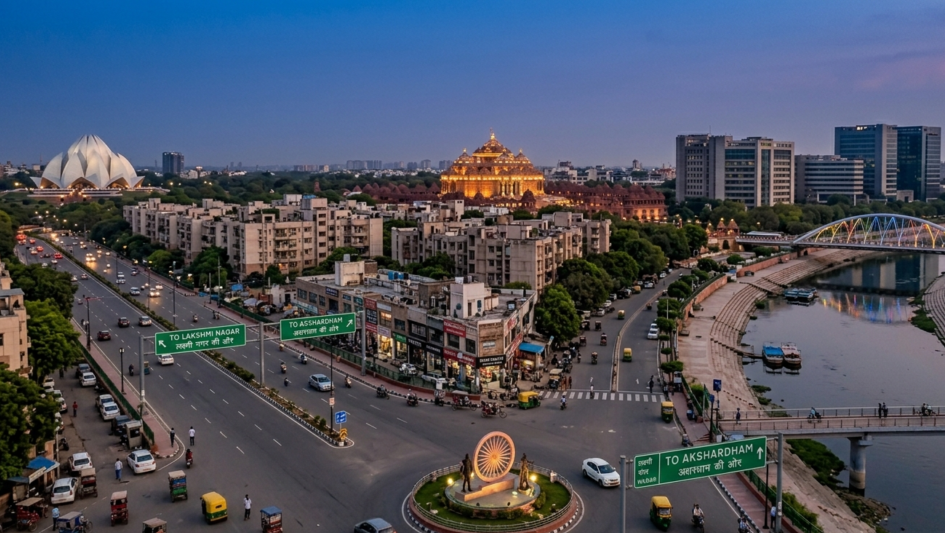
East Delhi :- The Gateway of Culture, Vibrant Communes, and Commercial Growth
East Delhi, often affectionately designated as the ‘Trans-Yamuna‘ region, is a pivotal sector of India’s capital located across the banks of the Yamuna River. Characterized by its high demographic density, buzzing commercial centers, and rapid urban transformation, this region offers a striking contrast of environments. While it proudly hosts ‘Akshardham‘, one of the world’s most monumental Hindu temple complexes, it simultaneously thrives as a massive wholesale trading hub and a vital transit gateway connecting Delhi with the state of Uttar Pradesh.
Detailed History :-
The historical evolution of East Delhi is fundamentally linked with the modern expansion and post-independence growth of the National Capital Territory. Historically, the land stretching east of the Yamuna was predominantly composed of agricultural fields, small agrarian villages, and floodplains. During the Mughal and British periods, the urban epicenter of Delhi remained strictly confined to the western banks (Old and New Delhi).
The actual urbanization of East Delhi commenced in the late 1970s and 1980s to accommodate the city’s exploding population. The government initiated systemic residential layouts, establishing well-planned multi-story cooperative housing clusters in sub-cities like Mayur Vihar, Preet Vihar, and Patparganj. Post-2000, the expansion of the Delhi Metro network combined with the monumental construction of the Akshardham Temple completely reinvented East Delhi’s public profile, upgrading it into a major cultural and economic powerhouse.
Detailed Architecture :-
The architectural layout of East Delhi presents a fascinating juxtaposition of magnificent ancient Indian temple craftsmanship and contemporary high-density commercial and residential structures.
- Swaminarayan Akshardham Temple :– The crowning architectural achievement of East Delhi, this sprawling 100-acre complex is a masterclass in traditional Hindu temple architecture, drawing inspiration from ancient Vastu Shastra and scriptural texts. Constructed entirely from pink Rajasthani sandstone and Italian Carrara marble, it features no structural steel or concrete support. The outer walls, domes, and pillars are heavily adorned with hand-carved depictions of flora, fauna, dancers, and deities. At its base rests the ‘Gajendra Pith’, featuring 148 life-sized carved stone elephants celebrating the animal’s significance in Indian heritage.
- Modern Residential Complexes & Commercial Hubs :– Sectors like Patparganj and Mayur Vihar display structured apartment complexes (Group Housing Societies). In contrast, the commercial high-rises of Karkardooma and Laxmi Nagar feature sleek glass-and-concrete architectures housing corporate offices, the District Court Complex, and contemporary retail centers like the V3S Mall.
Travel Guide & Routes :-
- Tickets & Entry Fees :– Entry into the main Akshardham Temple grounds is entirely free of charge. However, specific tickets must be purchased to view the multi-media Exhibitions and the signature Musical Fountain/Water Show, costing approximately ₹170 to ₹250 for adult visitors. Entry into local recreational zones like Sanjay Lake is either free or carries a nominal charge of ₹10.
- Visiting Time :– The Akshardham Temple is open to the public from 10:00 AM to 06:30 PM, remaining closed on Mondays. The primary commercial retail markets and lifestyle malls across East Delhi remain active from 11:00 AM to 09:30 PM.
- How to Reach :–
- By Metro :– The Delhi Metro’s ‘Blue Line’ and ‘Pink Line’ serve as the principal transit arteries connecting East Delhi to the rest of the capital. Key stations include ‘Akshardham’, ‘Laxmi Nagar’, ‘Preet Vihar’, and ‘Anand Vihar’.
- By Rail & Road :– Anand Vihar Terminal (ANVT) is a massive state-of-the-art railway station and Inter-State Bus Terminus (ISBT), operating as the primary gateway for millions of commuters traveling to and from Eastern Uttar Pradesh, Bihar, and Uttarakhand. National Highway 24 (NH-24) provides excellent vehicular connectivity to Noida and Ghaziabad.
- Photography Spots :– The majestic outer panoramic views of the Akshardham Temple complex (note: electronic devices and cameras are strictly prohibited inside the inner temple boundaries), the sunset reflections across ‘Sanjay Lake’ in Mayur Vihar, and the sweeping flyovers along Vikas Marg are premium photography locations.
- Local Flavors :– Laxmi Nagar is widely celebrated among the student community for its highly affordable and delicious street food options, including crispy Kachoris, Chhole Bhature, and tangy Chaats. Conversely, Preet Vihar and Nirman Vihar house premium multi-cuisine restaurants specializing in authentic North Indian and Indo-Chinese dining.
- Famous Markets :– ‘Laxmi Nagar Market’ (renowned for consumer electronics, educational books, and apparel), ‘Lalita Park’, and ‘Gandhi Nagar Market’ (celebrated as Asia’s single largest wholesale hub for readymade garments).
Interesting Facts :-
- The ‘Gandhi Nagar Market‘ in East Delhi functions as Asia’s primary wholesale textile and readymade clothing manufacturing hub, distributing apparel to retail markets across the globe.
- ‘Sanjay Lake‘ in Mayur Vihar is a massive man-made reservoir covering nearly 170 acres. During the winter season, it serves as a crucial habitat for a diverse variety of migratory birds.
- The Akshardham Temple complex was officially verified and listed by the Guinness Book of World Records as the World’s Largest Comprehensive Hindu Temple.
Important Questions and Answer :-
Question 1:– How much time is required to tour the Akshardham Temple, and what are the security rules?
Answer:- Visitors require a minimum of 3 to 4 hours to thoroughly explore the sprawling complex, attend the immersive exhibitions, and watch the evening water show. Due to high security, all electronic items (including mobile phones, cameras, power banks, and USB drives) and large bags are strictly prohibited inside. A large, free-of-cost cloakroom facility is available at the entrance.
Question 2:- Why is Anand Vihar considered a vital sector of East Delhi?
Answer:- Anand Vihar functions as East Delhi’s ultimate multi-modal transport hub. It integrates a major Indian Railways terminal, a Delhi Metro interchange station, and a massive Inter-State Bus Terminus (ISBT) under one localized grid, making regional travel seamless.
Question 3:– Which neighborhood in East Delhi is highly populated by students, and why?
Answer:- Laxmi Nagar is the premier student neighborhood in East Delhi. It serves as a national coaching hub for Chartered Accountancy (CA), corporate banking, and public competitive examinations, attracting a vast student population looking for budget housing and libraries.
Author’s Thoughts :-
From my perspective, East Delhi is a compelling testament to human industry, collective community living, and rapid modernization. The Trans-Yamuna area has brilliantly carved out a distinct and powerful identity for itself over the last few decades. While the absolute architectural serenity of Akshardham Temple offers a spiritual escape for the soul, the fast-paced life on the streets of Laxmi Nagar and Anand Vihar reveals the raw, resilient energy of Delhi’s working class. It is the perfect destination for travelers who wish to experience the synergy of commercial ambition and cultural heritage running hand-in-hand.
“Flanked by the historic Yamuna, East Delhi stands as a dynamic urban saga where the grandeur of ancient faith effortlessly harmonizes with modern commercial aspirations.”