
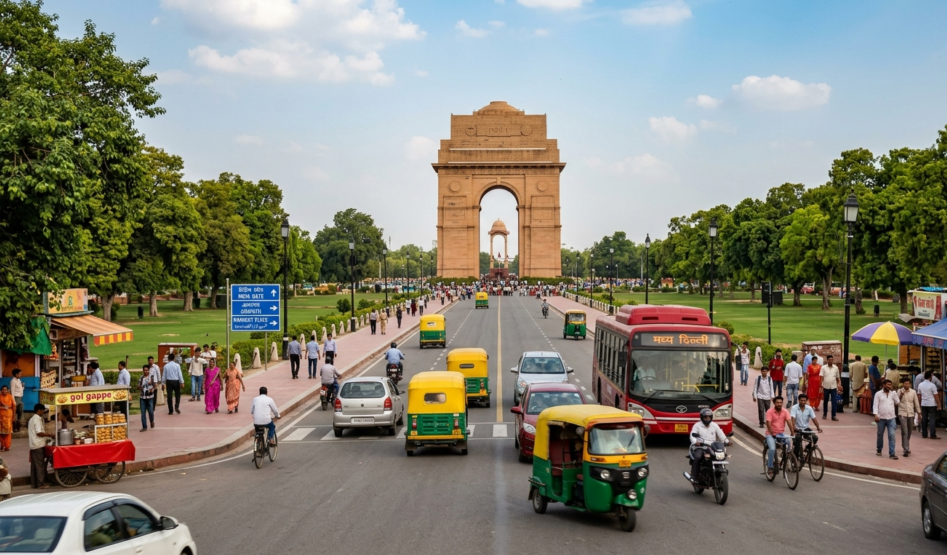
Central Delhi :- The Epicentre of Power, Architectural Grandeur, and the Beating Heart of India
Central Delhi is far more than an administrative sector of the capital city—it is the definitive geographical, cultural, and political pulse of the Indian nation. This district is a brilliant stage where India’s profound historical milestones, its monumental present-day governance, and its global future run side-by-side. Featuring the bustling, high-density remnants of ancient empires on one side and the imperial expanses of Lutyens’ Delhi on the other, this region commands the state’s highest concentration of administrative power, premium retail high-streets, and international tourism.
Detailed History :-
The historical blueprint of Central Delhi reads like an authentic index of India’s changing regimes. Chronologically, its foundational roots run deep into the era of the Mughal Empire when Emperor Shah Jahan shifted the imperial seat from Agra to Delhi in 1638, constructing the fortified city of ‘Shahjahanabad’—pockets of which border the northern edges of this modern district.
However, the definitive structural metamorphosis of Central Delhi commenced in 1911, when British King George V officially decreed the relocation of the imperial capital from Calcutta to Delhi. The task of engineering this massive administrative acropolis was entrusted to legendary British architects Sir Edwin Lutyens and Sir Herbert Baker. They laid out a breathtaking network of sprawling bungalows, radial avenues, and classical civic monuments, creating the elite landscape globally known as ‘Lutyens‘ Delhi’. Post-independence, the Republic of India seamlessly adopted this enclave as its sovereign seat of power, recently adding a historic chapter through the realization of the state-of-the-art New Parliament House under the Central Vista Redevelopment Project.
Detailed Architecture :-
The architectural landscape of Central Delhi represents a magnificent intersection of different classical styles, neo-traditional sensibilities, and avant-garde civic engineering.
- Lutyens’ Delhi & Indo-Saracenic Legacy :– The Rashtrapati Bhavan (President’s Estate), the North and South Blocks (Central Secretariat), and the old Parliament building display a brilliant synthesis of classical Western orders combined with traditional Indian motifs (such as the Buddhist Stupa domes, chhatris, and carved Mughal jaalis). The extensive use of Dholpur red and buff sandstone defines this imperial identity.
- The New Parliament House (Central Vista) :– Standing as a modern architectural icon of the sovereign republic, this state-of-the-art triangular structure balances high-tech smart systems with traditional artisanal craftsmanship. Its interior chambers draw aesthetic inspiration from the national bird (Peacock) for the Lok Sabha and the national flower (Lotus) for the Rajya Sabha.
- Connaught Place (CP) :– Designed under the strict principles of Georgian Architecture, this commercial matrix consists of two massive, concentric colonnaded rings. Its stark white, Palladian arches and soaring Tuscan pillars create an imposing, highly organized commercial street-grid that serves as the premium high street of the capital.
Travel Guide & Routes :-
- Tickets & Entry Fees :– Entry into the immediate common areas of India Gate, Connaught Place, and the solemn National War Memorial is completely free of charge. Access to the interiors of the New and Old Parliament Houses is strictly restricted to authorized passes and diplomatic tours. Public tours of selected wings of Rashtrapati Bhavan and its famed Amrit Udyan (Mughal Gardens) require advanced digital registration on their official portal (nominal handling fee of ₹50). Entry into the National Museum requires an admission ticket of ₹20.
- Visiting Time :– India Gate and the National War Memorial remain accessible around the clock, though the prime visiting hours are from 06:00 PM to 10:00 PM when the monuments are beautifully illuminated. Connaught Place showrooms traditionally operate from 11:00 AM to 10:00 PM. The Amrit Udyan is opened exclusively to the general public during the spring bloom period (February to March).
- How to Reach :–
- By Metro :– Central Delhi features the highest density of underground metro junctions in the capital. ‘Rajiv Chowk Metro Station’ (Blue Line/Yellow Line interchange hub) rests directly beneath the center of Connaught Place. For India Gate and the Central Vista corridor, the ‘Central Secretariat’ and ‘Khan Market’ stations offer immediate access.
- By Road :– The iconic New Delhi Railway Station (NDLS) borders the northern boundary of this district. A comprehensive network of DTC public transit buses connects Connaught Place to every corner of Delhi-NCR. Due to the wide, grid-like avenue design, hailing app-based cabs or auto-rickshaws is exceptionally smooth.
- Photography Spots :– The classic symmetrical axis of India Gate with the National War Memorial, the majestic vista along the newly named Kartavya Path, the Inner Circle of Connaught Place framed by the colossal national flag, and the high-security imperial gates of Rashtrapati Bhavan.
- Local Flavors :– Do not miss the legendary, thick artisan milkshakes at Keventers in CP, the legacy baked goods at the Wenger’s pastry shop, and the highly coveted, traditional South Indian thalis served at the famous Andhra Bhavan canteen. Additionally, the premium street chaat and Chhole Bhature at Bengali Market, and the gourmet charcoal-grilled kebabs of Khan Market are highly rated by international food connoisseurs.
- Famous Markets :– ‘Connaught Place’ (for global luxury brand flagships and elite boutiques), ‘Janpath Market’ (renowned for brass handicrafts, silver tribal jewelry, and handloom textiles), and ‘Khan Market’ (ranked consistently among India’s most expensive, high-end retail lifestyle enclaves).
Interesting Facts :-
- The circular planning of Connaught Place was loosely inspired by the historic Royal Crescent architecture in Bath, England, yet its fully enclosed, multi-tier concentric loop system makes it globally unique.
- The Rashtrapati Bhavan stands proud as the second-largest official residence of any democratic head of state globally, encompassing an incredible network of 340 grand rooms and state galleries.
- The architectural columns of India Gate are etched with the individual names of over 13,000 Indian soldiers who laid down their lives during the First World War and the Anglo-Afghan campaigns.
Important Questions and Answer :-
Question 1:– What is the core objective behind the Central Vista Redevelopment Project?
Answer:- The Central Vista Project is an ambitious urban renewal master plan executed by the Government of India to modernize the nation’s primary governance corridor. It successfully delivers a structurally advanced, highly secure triangular Parliament House, introduces automated green common secretariats, and revamps the public landscape along Kartavya Path to meet contemporary eco-standards.
Question 2:– What makes Janpath Market a specialized shopping destination?
Answer:- Janpath Market is highly celebrated for its curated collection of authentic Indian folk crafts, hand-woven Pashmina shawls, antique artifacts, and silver jewelry sourced from nomadic artisans. It offers excellent value for international travelers, provided one employs polite but firm bargaining skills.
Question 3:– How is the National War Memorial structured for visitors?
Answer:- Located just east of India Gate, the National War Memorial is a solemn modern shrine honoring the martyred soldiers of post-independence conflicts. It is systematically engineered in four concentric subterranean circles representing deep concepts of military valor: the Amar Chakra (Circle of Immortality), Veer Chakra (Circle of Bravery), Tyag Chakra (Circle of Sacrifice), and Rakshak Chakra (Circle of Protection).
Author’s Thoughts :-
From my perspective, Central Delhi is an awe-inspiring urban sanctuary where the movement of time feels beautifully suspended. Walking along the manicured lawns of Kartavya Path under the majestic evening shadow of India Gate evoke an intense feeling of national pride and historical awareness. This district does not merely serve as the engine of political administration – it embodies the true sophisticated spirit of Delhi, gracefully holding both its imperial memories and modern democratic aspirations. Sitting among the iconic pillars of Connaught Place with a warm cup of coffee or enjoying an evening ice cream near India Gate are quintessential Delhi traditions that stitch generations of citizens together.
“Central Delhi stands as a magnificent monument to India’s sovereign identity, where the structural echoes of an imperial past seamlessly house the high-tech innovations of a rising superpower.”