
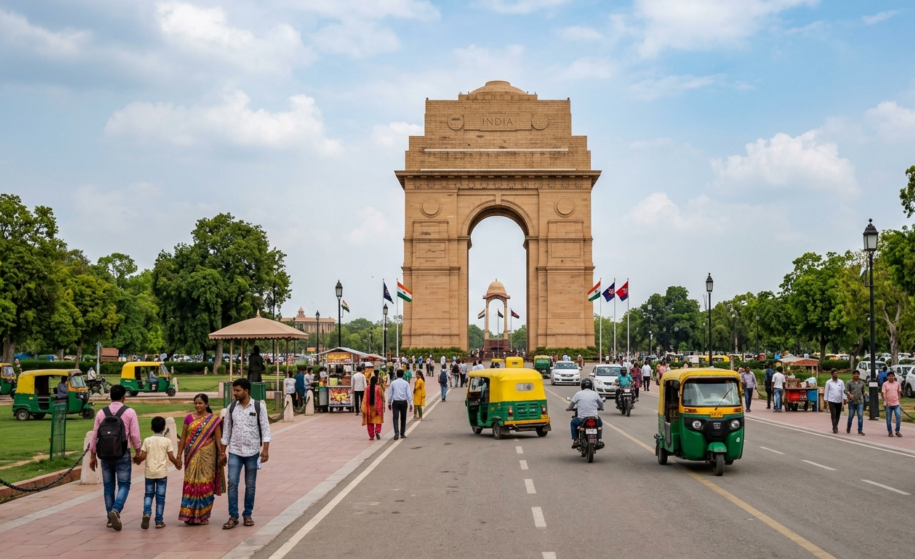
The India Gate :- The Monument of Eternal Valour and Delhi’s Architectural Jewel
Standing proudly at the eastern terminus of the ceremonial boulevard ‘Kartavya Path‘ (formerly Rajpath) in the heart of New Delhi, the ‘India Gate’ is far more than a historical landmark; it is the physical manifestation of national reverence, ultimate sacrifice, and the indomitable spirit of the Indian soldier. This monumental archway invokes an immediate surge of patriotism in the heart of every visitor. In this comprehensive blog, we will journey through the gripping history, structural aesthetics, the adjacent National War Memorial, and the complete practical travel itinerary of this timeless national monument.
Detailed History
The historical lineage of India Gate is profoundly linked with the global battlefields of the early 20th century and the monumental sacrifices of the Indian subcontinent’s soldiers.
- Historical Background :– The monument was conceptualized by the Imperial War Graves Commission to honor the foundational memory of over 84,000 soldiers of the British Indian Army who laid down their lives during the First World War (1914–1918) and the Third Anglo-Afghan War. These brave souls fought across the rugged landscapes of Europe, the Middle East, and Africa.
- Foundation and Inauguration :– The foundation stone of this grand triumphal arch was laid on February 10, 1921, by the Duke of Connaught. The intensive stone masonry spanned a decade, leading to its formal inauguration on February 12, 1931, by the then Viceroy, Lord Irwin. It was originally designated as the ‘All India War Memorial’.
- Amar Jawan Jyoti :– In the wake of the 1971 Indo-Pakistani War (which culminated in the liberation of Bangladesh), a sacred memorial structure featuring an inverted rifle capped by a soldier’s helmet along with four eternal flames—the ‘Amar Jawan Jyoti’ (Flame of the Immortal Soldier)—was instituted under the main arch. It was dedicated to the nation on January 26, 1972, by the then Prime Minister Indira Gandhi. (Note: In January 2022, this eternal flame was merged with the main flame at the newly constructed National War Memorial with full military honors).
Detailed Architecture :-
The design of India Gate is globally celebrated for its structural balance, clean classical geometries, and sheer scale. The entire layout was designed by the master British architect Sir Edwin Lutyens.
- Exterior Architecture :– Drawing strong design inspirations from the famous ‘Arc de Triomphe’ in Paris, Lutyens engineered a grand 42-meter-high (approximately 138 feet) triumphal arch. The monument is clad in a premium combination of red and pink Dholpur sandstones shipped directly from Rajasthan. The entire surface of the archway is meticulously inscribed with the names of over 13,000 individual soldiers who died serving the nation on distant battlefronts. A solemn commemorative dedication is carved into the topmost molding on both sides of the arch.
- The Surrounding Precinct :– Set a short distance to the east of the arch is a magnificent, domed stone Canopy, modeled after the 6th-century pavilions of Mahabalipuram, which originally housed a marble statue of King George V. Today, this canopy proudly cradles a majestic, 28-foot-tall monolithic black granite statue of the legendary freedom fighter, Netaji Subhas Chandra Bose. The arch is encircled by sprawling public lawns, radial tree avenues, and ornamental fountains.
The National War Memorial :-
Positioned roughly 400 meters behind the India Gate complex is the state-of-the-art National War Memorial, formally dedicated to the nation in February 2019. This contemporary spiritual sanctum honors over 26,000 personnel of the Indian Armed Forces who made the supreme sacrifice in post-independence conflicts, counter-insurgency operations, and UN peacekeeping missions. The memorial is laid out in four concentric landscape circles representing military virtues—Amar Chakra (Circle of Immortality), Veerta Chakra (Circle of Bravery), Tyag Chakra (Circle of Sacrifice), and Rakshak Chakra (Circle of Protection)—with the eternal flame burning bright at the central obelisk.
Travel Guide & Routes
For travelers, history buffs, and families planning a visit to India’s most celebrated public plaza, the complete sequential travel map is laid out below.
- Ticket :– Entering the India Gate plaza, walking along the sprawling green lawns, and visiting the National War Memorial is completely Free of charge. No tickets are required.
- Visiting Time :– India Gate remains open to the public 24 hours a day, 7 days a week (24/7). However, the absolute best window to visit is between 06:00 PM and 10:00 PM when the entire sandstone arch is dramatically illuminated, and visitors can witness the solemn ‘Next-of-Kin’ ceremomy or the ‘Change of Guard’ ritual at sunset at the War Memorial.
- Opening & Closing Time :– While the lawns are accessible through the night, security cordons restrict movement immediately under the main stone arch after 11:00 PM.
- How to Reach :–
- By Metro :– The most reliable transit options are the ‘Central Secretariat’ Metro Station (interchange for Yellow and Violet lines) and the ‘Supreme Court’ Metro Station (Blue Line). Exiting at Central Secretariat allows a beautiful walk down the newly stylized Kartavya Path directly to the monument. ‘Khan Market’ station is also nearby.
- By Bus :– Central Delhi is thoroughly connected via DTC buses. Any bus terminating or passing through ‘India Gate Circle’, ‘Patiala House Court’, or ‘Shahjahan Road’ will drop you within walking distance.
- By Road/Cab :– Visitors can arrive via app-based cabs or personal vehicles directly to the India Gate roundabout. Ample public parking facilities are provisioned along Shahjahan Road and Mansingh Road, from where the monument is accessible via well-lit pedestrian underpasses.
Photography Spots, Local Flavors, and Famous Markets
- Photography Spots :–
- The central perspective from the newly renovated lawns of Kartavya Path, capturing the complete, unobstructed symmetry of the sandstone arch.
- The classic framing from behind the historic stone Canopy, aligning the granite silhouette of Netaji Subhas Chandra Bose perfectly within the India Gate archway.
- The spectacular night shots when advanced architectural LED projection systems light up the entire structure in the vibrant saffron, white, and green of the Indian Tricolor.
- The serene, poignant frames near the glass cases and murals of the National War Memorial during the golden hour.
- Local Flavors :– The atmosphere surrounding the India Gate lawns in the evening is delightfully vibrant. Visitors can indulge in Delhi’s iconic street food cultures right along the designated vending zones—including spicy bhel puri, tangly aloo chaat, chilled chuski (ice golas), cotton candy, and traditional ice cream carts. For premium dining, the legendary multi-cuisine restaurants and non-vegetarian food hubs at Pandara Road are located just a short distance away.
- Famous Market :– Located barely 5 minutes away is ‘Khan Market’, consistently ranked as one of Delhi’s most premium retail and upscale cafe destinations. For travelers interested in collecting traditional regional handicrafts, handlooms, and souvenirs, the bustling lanes of ‘Janpath Market’ and ‘Connaught Place’ are easily accessible.
Nearby Attractions
Maximize your central Delhi experience by clubbing your visit to India Gate with these nearby landmarks.
- Kartavya Path :– The newly overhauled, tree-lined national promenade that stretches majestically from India Gate up to the gates of Rashtrapati Bhavan.
- The New Parliament House & Secretariat :– The contemporary architectural marvel of Indian democracy and the historic North-South blocks at the crest of Raisina Hill.
- National Gallery of Modern Art (NGMA) :– A world-class art repository housed inside the former palace of the Maharaja of Jaipur, located at the India Gate hexagon.
- Purana Qila (Old Fort) :– Located 2 kilometers eastward, this 16th-century fortress hosts an immersive evening light and sound show documenting Delhi’s ancient history.
Interesting Facts :-
- The stone walls of the India Gate do not solely bear Indian names; they also immortalize several British officers and soldiers who died serving alongside the Indian regiments on the same frontiers.
- The entire monument was assembled using sophisticated interlocking stone masonry techniques, meaning the massive blocks of sandstone were fitted together primarily through structural balance and manual craft without relying heavily on modern overhead cranes.
- Every year on January 26th, India’s grand Republic Day Parade moves down Kartavya Path, passing directly in front of India Gate, showcasing the nation’s cutting-edge military hardware and rich cultural tableaux to the world.
Important Questions and Answer :-
Question 1:- Is there an advance booking system or entry fee for the National War Memorial?
Answer:- No, both India Gate and the National War Memorial are public spaces open to all domestic and international visitors completely free of charge. No advance booking pass is required.
Question 2:– Why was the flame of the Amar Jawan Jyoti shifted from under the India Gate arch?
Answer:- The flame was merged with the eternal flame at the National War Memorial in January 2022 to centralize the nation’s tribute to all fallen heroes under a single comprehensive military monument.
Question 3:- What is the total height of the India Gate and who designed it?
Answer:- The India Gate stands at an imposing height of 42 meters (138 feet) and was designed by the celebrated British master architect Sir Edwin Lutyens.
Author’s Perspective :-
From my perspective, India Gate is not simply a magnificent piece of heritage stone architecture; it is the physical altar of India’s collective gratitude and sovereignty. Witnessing the massive structure transition from a glowing golden monument at sunset to a brilliant tricolor icon under the night sky is an experience that genuinely triggers goosebumps. Walking through the quiet, geometric rings of the adjacent National War Memorial and reading the thousands of names of our soldiers serves as a profound reminder of the price paid for our freedom. It remains an absolute, non-negotiable pilgrimage for anyone seeking to understand the deep patriotic pulse of India.
S“Standing as a timeless sentinel along the ceremonial avenue, this grand sandstone arch serves as the eternal altar of Indian heroism and the proud anchor of the republic’s sovereign heart.”