
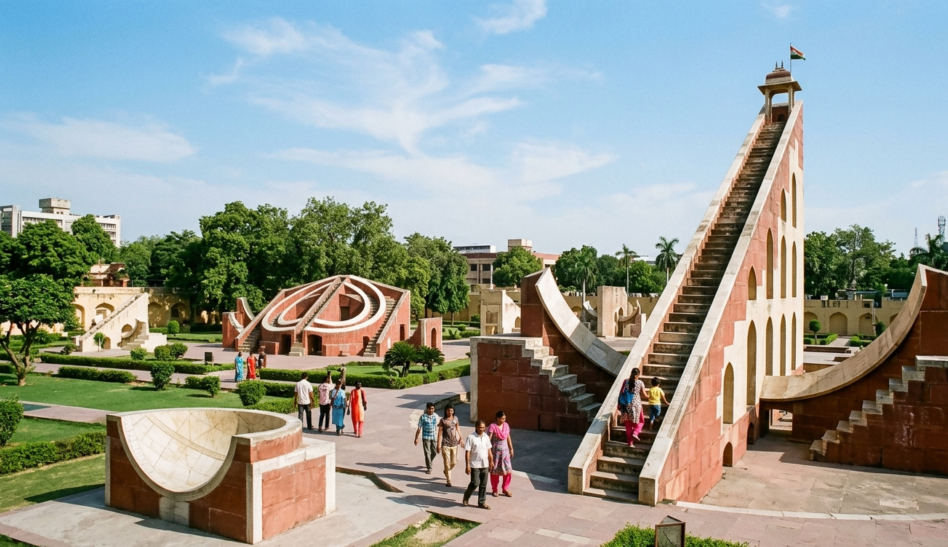
Jantar Mantar Delhi :- The Monumental Observatory and Zenith of Ancient Indian Astronomy
Strategically located on Parliament Street, right adjacent to the bustling commercial high-streets of Connaught Place in New Delhi, ‘Jantar Mantar’ stands as a profound monumental testament to ancient India’s highly evolved scientific temperament. These striking red and ochre geometric brick-and-stone structures are not mere static walls or abstract artistic sculptures; they are highly sophisticated astronomical instruments. Built to unlock cosmic movements, trace planetary trajectories, and compute time down to seconds, this open-air observatory bridges ancient calculus with structural grandeur. In this comprehensive blog, we will explore the glorious history, complex geometric design, and complete visitor map of Delhi’s Jantar Mantar.
Detailed History
The foundation of Jantar Mantar in Delhi is deeply connected to the early 18th century and the insatiable scientific curiosity of a visionary Rajput ruler.
- Historical Genesis & Construction :– This magnificent observatory was commissioned by the polymath ruler of Jaipur, Maharaja Sawai Jai Singh II. He was an exceptionally skilled mathematician, astronomer, and structural designer. Finding the existing brass and metal astronomical tables highly inaccurate due to wear and misalignment, Mughal Emperor Muhammad Shah tasked him with rectifying the astronomical data and calendars. To achieve this monumental precision, Maharaja Jai Singh II completed this first open-air masonry observatory in Delhi in 1724.
- Etymological Meaning :– The name ‘Jantar Mantar‘ is derived directly from the classic Sanskrit terms ‘Yantra Mantra’. ‘Jantar‘ (Yantra) translates to ‘an instrument or machine’, while ‘Mantar’ (Mantra) signifies ‘calculation, counsel, or formula’. Hence, the name literally embodies ‘The Instrument of Cosmic Calculations’.
- The Network of Observatories :– The Delhi complex was the pioneering prototype of five massive observatories constructed by the Maharaja across North India. Following this success, he erected even larger variants in Jaipur, Ujjain, Varanasi, and Mathura (the Mathura structure was later destroyed), with the Jaipur location currently standing as the largest and most well-preserved.
Detailed Architecture :-
The structural planning of Jantar Mantar is so advanced that it continues to mesmerize modern civil engineers, architects, and astrophysicists globally. Built out of locally sourced brick, stone rubble, and finished with a smooth lime plaster coat, each instrument serves a unique mathematical function.
- Exterior & Interior Design :– Designed as an expansive, landscaped park, the site houses large geometric masonry structures strategically aligned to specific coordinates to leverage the sun’s shadow and starlight. Four primary instruments (yantras) dominate the interior landscape of the Delhi complex:
- The Samrat Yantra (The Supreme Instrument) :– Towering nearly 70 feet high, this massive structure is essentially an equitable giant sun-dial. Its central triangular wall is inclined at an angle equal to Delhi’s latitude and points precisely to the North Pole. As the sun moves, its shadow falls symmetrically onto the adjoining curved quadrants, calculating local time with a remarkable accuracy of up to two seconds.
- The Ram Yantra :– Consisting of a twin pair of cylindrical, open-top hollow structures with a central pillar, these structures are complementary to one another. Used to measure the altitude and azimuth angles of stars and the sun, their interior stone walls and floor planks are precisely incised with vertical and horizontal degree markings.
- The Jai Prakash Yantra :– Comprising two inverted, semi-spherical bowls excavated directly into the ground, these instruments are cross-mapped with precise celestial coordinate lines. Maharaja Jai Singh II considered this specific layout his most versatile design to map stellar coordinates during the night.
- The Mishra Yantra (The Mixed Instrument) :– A striking unique composition of five distinct instruments fused into a single structural frame at the front of the complex. Famously, it featured specialized walls angled to indicate the exact noon-time across four distinct global meridians (including Zurich, Greenwich, and Samarkand) simultaneously from Delhi.
Travel Guide & Routes :-
For international tourists, heritage walkers, and student groups planning an itinerary to explore this ancient scientific marvel, the complete practical travel sequence is detailed below:
- Ticket :– Entry fees are highly economical. The ticket price for Indian domestic citizens is approximately ₹25 to ₹30, while the entry fee for international tourists is ₹300. (Booking tickets digitally via the official ASI portal or scanning onsite QR codes often yields a small discount). Entry for children under the age of 15 remains entirely free.
- Visiting Time :– Jantar Mantar remains accessible daily from 09:00 AM to 06:00 PM (closing precisely at sunset). The absolute best window to visit is between late morning and early afternoon, as bright, direct sunlight ensures that the shadows cast by the sun-dials are clearly defined, allowing you to visually see how the time is calculated.
- Opening & Closing Days :– The monument is open throughout the week (Monday to Sunday). A complete educational tour of the grounds takes about 1 to 1.5 hours.
- How to Reach :–
- By Metro :– The absolute closest transit option is the ‘Patel Chowk’ Metro Station on the Yellow Line, located a brief 5-minute walk from the main gate. Alternatively, ‘Rajiv Chowk’ (Blue/Yellow Line interchange) and ‘Janpath’ (Violet Line) metro stations are also within close walking distance.
- By Bus :– Given its central location, any DTC bus heading towards Connaught Place, Parliament Street, or Kasturba Gandhi Marg drops passengers directly at the Jantar Mantar bus stop.
- By Road/Cab :– Visitors can easily book app-based cabs or auto-rickshaws directly to ‘Jantar Mantar, Parliament Street’. Dedicated public car and two-wheeler parking spaces are available along the approach road.
Photography Spots, Local Flavors, and Famous Markets
- Photography Spots :–
- In front of the Mishra Yantra :– Its distinct heart-shaped, symmetrical geometric architecture provides an exceptionally graphic backdrop for structural and portrait photography.
- The Flanks of Samrat Yantra :– The towering, clean lines of the giant sun-dial wall create a spectacular sense of scale for creative Instagram frames.
- Inside the Ram Yantra structures :– Capturing the interplay of light and deep geometric shadows slicing through the structural stone columns offers fantastic abstract visuals.
- Local Flavors :– Being right next to Connaught Place, the immediate vicinity offers some of Delhi’s best-known food junctions. The famous ‘Jain Chawal Wale’ at Shivaji Stadium is globally renowned for its iconic North Indian street style Rajma Chawal and Chole Bhature. For a more relaxed setting, the state-run ‘Coffee Home’ on Baba Kharak Singh Marg serves excellent authentic South Indian dosas and freshly brewed filter coffee.
- Famous Market :– Sharing its physical boundaries with the observatory is the legendary ‘Janpath Market’. This bustling bazaar is Delhi’s ultimate hotspot for procuring ethnic handloom garments, Kashmiri pashminas, authentic Tibetan artifacts, brass curios, and inexpensive souvenirs at highly bargainable prices.
Nearby Attractions :-
You can seamlessly package your visit to Jantar Mantar with these iconic central Delhi highlights.
- Connaught Place (CP) :– Delhi’s signature British-era colonial colonnaded shopping and financial hub.
- Gurudwara Bangla Sahib :– The most prominent and peaceful Sikh shrine in Central Delhi, located barely 1 kilometer away.
- The Ancient Hanuman Temple :– Situated on Baba Kharak Singh Marg, one of India’s oldest historical temples holding a Guinness World Record for continuous chanting.
- The New Parliament House & India Gate :– Moving further down Parliament Street connects you directly to the grand democratic structures and the sprawling lawns of Kartavya Path.
Interesting Facts :-
- Despite being over 300 years old, the core calibration of the Samrat Yantra remains so accurate that it can calculate New Delhi’s local solar time to an astonishing precision of 2 seconds.
- These masonry structures were engineered to predict the exact dates of solar and lunar eclipses, map monsoon arrivals, and track the entry of planets into different zodiac signs months in advance.
- Beyond its astronomical and historical value, in modern Indian socio-political history, the outer street of Delhi’s Jantar Mantar served as the official designated national site for peaceful public protests and civic demonstrations for decades.
Important Questions and Answer :-
Question 1:– Do the brick-and-mortar instruments at Jantar Mantar still function accurately today?
Answer:- Yes, the vast majority of the instruments remain perfectly functional. However, due to heavy urban smog, pollution, and the construction of massive high-rise commercial towers around Connaught Place, direct sunlight paths are partially altered, causing minor deviations in reading solar coordinates.
Question 2:– Where are the other Jantar Mantars located across India?
Answer:- Apart from New Delhi, the observatories are located in Jaipur, Ujjain, and Varanasi. The Mathura site disintegrated over time. The Jaipur Jantar Mantar is currently the largest and is inscribed as a UNESCO World Heritage Site.
Question 3:- Who was the historical architect behind the Jantar Mantar of Delhi?
Answer:- It was conceptualized and engineered under the direct mathematical supervision of Maharaja Sawai Jai Singh II of Jaipur in the year 1724.
Author’s Perspective :-
From my perspective, Delhi’s Jantar Mantar is far more than a recreational park containing red sandstone ruins; it is an undeniable proof of ancient India’s logical and scientific supremacy. Long before the West fully institutionalized modern celestial tracking, Indian kings and astronomers were casting cosmic maps permanently into brick and mortar. Standing amidst these giant shadows with modern glass skyscrapers towering in the background offers a profound temporal contrast. If you are exploring New Delhi, skip the standard concrete malls for an hour and walk through these mathematical arches—it will completely expand your appreciation for India’s scientific heritage.
“Standing as a silent geometric sanctuary amidst modern high-rises, this red sandstone complex remains the immortal blueprint of ancient Indian science and celestial mastery.”