
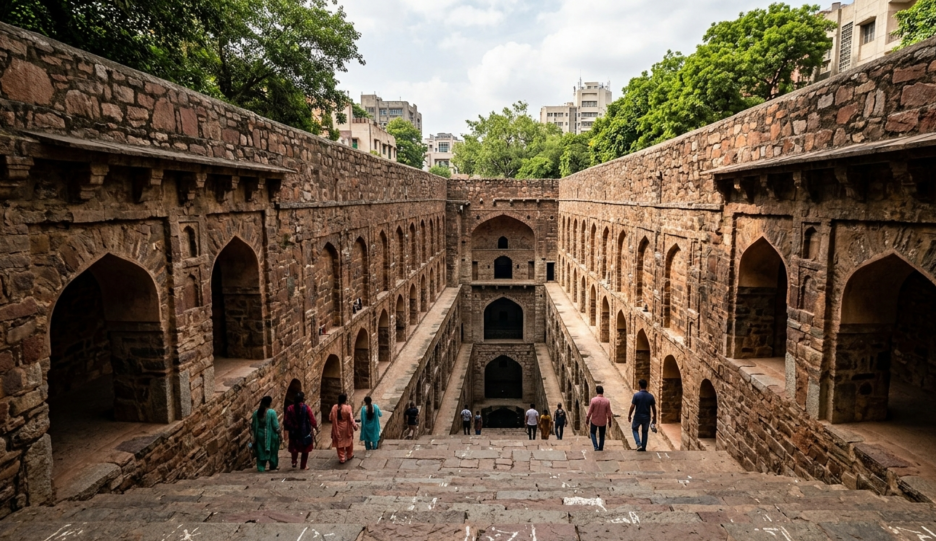
Agrasen ki Baoli :- The Hidden Stepwell, Architectural Enigma, and Silent Sanctuary of Delhi
Tucked away inconspicuously down a narrow, leafy lane amidst the towering glass skyscrapers, commercial financial hubs, and roaring traffic of central Delhi near Connaught Place, ‘Agrasen ki Baoli’ stands as a profound subterranean structural marvel. This multi-layered, red sandstone stepwell drops dramatically into the earth, offering a breathtaking escape where time feels permanently suspended. Celebrated across the globe for its precise symmetrical engineering, haunting urban legends, and numerous appearances in Bollywood cinema, it remains one of the most enigmatic heritage landmarks of the capital. In this comprehensive blog, we will journey through its history, layout, mystical legends, and complete visitor roadmap.
Detailed History
The historical origins of Agrasen ki Baoli are cloaked in a beautiful blend of ancient mythology and medieval restoration, making it a captivating subject for historians.
- Mythological and Ancient Lineage :– According to long-standing local folklore and community traditions, the structural foundation of this stepwell was originally laid during the epic Mahabharata era by the legendary Solar Dynasty ruler, Maharaja Agrasen – the revered ancestral patriarch of the Agrawal community. However, definitive contemporary lithic inscriptions validating this period remain absent.
- Medieval Reconstruction :– Architectural analysis conducted by archaeologists indicates that the present standing framework, brick masonry, and pointed Islamic arches were reconstructed either during the Tughlaq Dynasty (14th century) or the Lodi Dynasty (15th century). In ancient India, stepwells were built not just to secure water storage but to serve as cool communal retreats for weary caravans during blazing tropical summers.
- Heritage Protection :– Today, this magnificent ancient engineering site is strictly protected and maintained by the Archaeological Survey of India (ASI) under the Ancient Monuments and Archaeological Sites and Remains Act, 1958.
Detailed Architecture :-
The layout of Agrasen ki Baoli is an exceptional masterpiece of ancient Indian hydraulic and civil engineering. Unlike standard monuments that rise toward the clouds, this stepwell descends deeply into the earth.
- Exterior & Interior Structural Design :–
- The stepwell measures approximately 60 meters in length and 15 meters in width. The entire inner lining is meticulously built out of dressed local red sandstones and robust rubble masonry.
- A grand central flight of 103 stone steps cuts steeply downwards, systematically guiding the visitor deep toward the bottom-most dry well shaft.
- The subterranean fortress is neatly split across three distinct structural levels or tiers. Each level features symmetric rows of deep, arched cloisters, vaulted chambers, and small alcoves on both flanking walls, designed historically to serve as cool resting platforms.
- At the far western edge lies a deep circular well shaft, connected via underground channels to the main reservoir chamber. Adjacent to the upper tier of the well are the structural remnants of a small medieval mosque, featuring unique whale-back carved stone roofs and detailed pillars.
Mysteries & Haunted Legends :-
Apart from its structural brilliance, Agrasen ki Baoli has garnered considerable fame for its supernatural folklore and paranormal tales:
- The Myth of the Hypnotic Black Water :– Local urban legends historically asserted that the bottom well was filled with a mystical, ink-black water that possessed hypnotic powers. It was rumored that the water whispered to lone travelers, compelling them to jump to their deaths. However, this is pure fiction; the well has remained completely dry for decades.
- The Sound of Silence :– As one descends further down the 103 steps, the roaring city traffic completely fades out, replaced by an eerie silence punctuated only by the sudden ruffling of hundreds of resident pigeons and bats nesting inside the stone crevices. This acoustic isolation has led thrill-seekers to classify it among Delhi’s top ‘haunted’ locations, though it is scientifically nothing more than a masterclass in ancient acoustics.
Travel Guide & Routes :-
For international heritage travelers, content creators, and casual strollers planning a visit to this underground sanctuary, the sequential travel map is laid out below:
- Ticket :– Entry into Agrasen ki Baoli is completely Free of charge. No advance electronic booking passes or entry tickets are required.
- Visiting Time :– The gates remain open to the public from 09:00 AM to 05:30 PM daily. The optimal time to explore is late morning or mid-afternoon, when the sun aligns directly overhead, illuminating the deep steps beautifully for architectural photography.
- Opening & Closing Days :– The monument remains accessible throughout the week (Monday to Sunday). A thorough exploration of the stepwell takes around 45 minutes to 1 hour.
- How to Reach :–
- By Metro :– The absolute closest transit option is the ‘Barakhamba Road’ Metro Station on the Blue Line. Upon exiting, the stepwell is a brief 5 to 7-minute walk via Hailey Road. Alternatively, ‘Mandi House’ and ‘Jantar Mantar’ metro stations are also within walking distance.
- By Bus :– Any central Delhi DTC bus traveling along Tolstoy Marg, Kasturba Gandhi Marg, or Connaught Place will drop you within walking distance of the Hailey Road intersection.
- By Road/Cab :– Visitors can seamlessly book app-based cabs or auto-rickshaws directly to ‘Agrasen ki Baoli, Hailey Road’. Since Hailey Road is a premium, quiet residential zone, public parking spaces are highly limited along the curbside.
Photography Spots, Local Flavors, and Famous Markets
- Photography Spots :–
- The Top Step Perspective :– Standing right at the main upper platform offers a breathtaking, symmetrical wide-angle view of the 103 steps dropping into the depths between the ancient arched corridors. (This is the iconic cinematic frame made famous by Aamir Khan in the film PK).
- The Arched Galleries :– Sitting within the stone arches on the mid-tiers allows photographers to perfectly capture the dramatic interplay of direct light and deep shadows (Chiaroscuro effect).
- The Temporal Contrast Frame :– Shooting from the deepest accessible step looking upward frames the centuries-old red sandstone masonry juxtaposed directly against New Delhi’s sleek modern high-rises in the background.
- Local Flavors :– There are no commercial stalls right outside the heritage gates to maintain cleanliness. However, a short 10-minute walk leads you to the famous Bengali Market, renowned across Delhi for its premium quality sweet meats, authentic golgappas, kachoris, and classic North Indian street foods.
- Famous Market :– The monument sits at the edge of ‘Connaught Place’ (CP) and the highly popular ‘Janpath Market’. Janpath is globally celebrated for bargaining on regional handicrafts, junk jewelry, embroidered textiles, and souvenirs.
Nearby Attractions :-
Maximize your central Delhi exploration by pairing your visit to the stepwell with these iconic nearby highlights.
- Jantar Mantar :– Maharaja Sawai Jai Singh’s grand 1724 masonry astronomical observatory, located barely 1 kilometer away.
- Mandi House Cultural Hub :– The epicentre of Delhi’s art and theater movement, housing the National School of Drama (NSD) and numerous cultural galleries.
- Gurudwara Bangla Sahib :– The peaceful, gold-domed Sikh shrine holding a massive holy pool, located just a few minutes away by auto-rickshaw.
- India Gate :– A quick 10-minute drive down the central avenues brings you directly to the grand war memorial and the rolling lawns of Kartavya Path.
Interesting Facts :-
- Agrasen ki Baoli is arguably Bollywood’s most beloved stepwell shooting location. It played a central role in Aamir Khan’s sci-fi hit ‘PK’, Salman Khan’s sports-drama ‘Sultan’, and critical scenes in ‘Bajrangi Bhaijaan’ and Sridevi’s ‘Mom’.
- The clever structural design of the stepwell ensures that it remains completely hidden from the outside world until you are right at its threshold. This subterranean layout was an ancient military tactic designed to protect vital water reservoirs from being discovered or poisoned by invading enemy forces.
Important Questions and Answer :-
Question 1:- Does the well at the bottom of Agrasen ki Baoli still contain any fresh water?
Answer:- No, the stepwell well shaft has run completely dry over the decades due to urbanization and changes in the local water table. Only during exceptionally heavy monsoonal downpours does a small pool of rainwater temporarily accumulate on the lowest steps.
Question 2:– Is Agrasen ki Baoli genuinely haunted?
Answer:- No, there is absolutely no scientific or official validation for any paranormal activity. The deep architectural descent isolates the site from city noises, and the echoes of resident pigeons simply create an eerie atmosphere that has fueled creative urban legends. It is perfectly safe and highly popular during daylight hours.
Question 3:– Do international tourists have to pay an entry fee to visit?
Answer:- No, entry is completely free for all domestic as well as international tourists, making it one of the finest free-to-visit heritage spots in New Delhi.
Author’s Perspective :-
From my perspective, Agrasen ki Baoli is a mesmerizing historical wormhole right in the center of modern Delhi. Sitting on its ancient steps while gazing up presents a profound visual anomaly—your feet are resting on 14th-century hand-carved stone while your eyes look up at multi-story corporate towers piercing the sky. It serves as a gentle reminder that beneath the hyper-paced lifestyle of New Delhi lies an old, artistic soul that refuses to fade away. If you want to take a break from the commercial malls and experience architectural serenity wrapped in an aura of mystery, this hidden stepwell on Hailey Road should be right at the top of your Delhi itinerary.
S “Resting quietly in the deep shadows of modern skyscrapers, this subterranean sandstone marvel stands as a stunning testament to ancient hydraulic craft and the enduring mysteries of Delhi’s past.”