
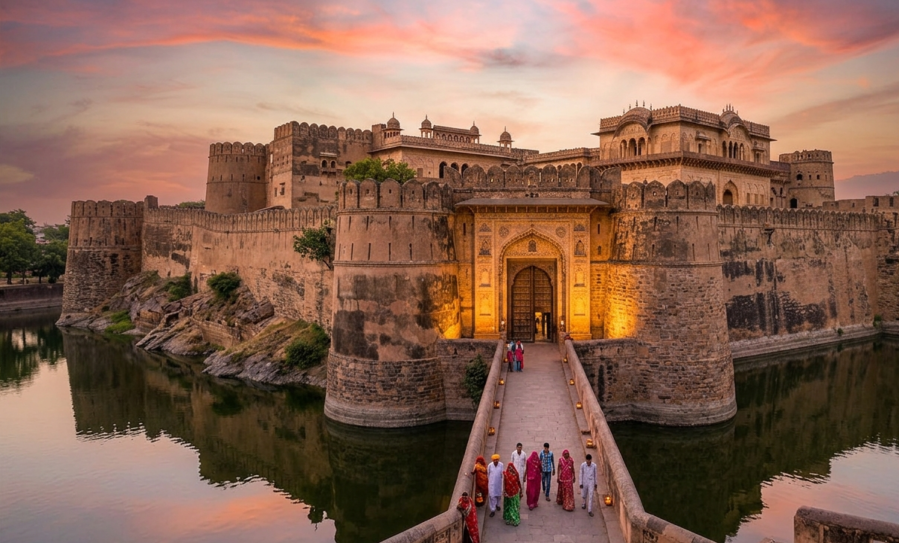
Lohagarh Fort, Bharatpur
Following the enigmatic and acoustically advanced granite ruins of Hyderabad’s Golconda Fort, let us now direct our travel journey toward the state of Rajasthan to explore an unparalleled citadel—the only fortress in Indian history that no foreign or domestic invader could ever conquer. Situated in the historic city of Bharatpur, often hailed as the ‘Eastern Gateway to Rajasthan’, Lohagarh Fort (The Iron Fort) stands proud as the sole indomitable and invincible fort in India. Engineered with a revolutionary defensive mud rampart, this fortress effectively neutralized the combined military might of the Mughals and the British East India Company, proving completely impenetrable to the most advanced artillery of the time.
Detailed History :-
The lineage of Lohagarh Fort is a glorious saga of the undaunted courage, military genius, and strategic vision of the Jat peasantry and its royal house. The foundation of this monumental stronghold was laid on February 19, 1733, by the legendary Jat sovereign, Maharaja Suraj Mal. Often described by historians as the ‘Plato of the Jat tribe’ due to his immense intellect and political acumen, Maharaja Suraj Mal realized that traditional high-rising stone forts were highly vulnerable to heavy European and Mughal siege cannons. He systematically conceptualized a design that utilized compacted desert earth to create an elastic barrier capable of absorbing ballistic impacts.
The fort faced its ultimate trial by fire during the Anglo-Jat War of 1805. British General Lord Lake, fresh from successful campaigns across Northern India, laid a massive, high-intensity siege to Lohagarh Fort that lasted for over four grueling months. The British army launched five successive, heavy infantry onslaughts backed by non-stop cannon bombardments. However, every single cannonball fired simply buried itself deep inside the soft, thick mud ramparts, losing its explosive energy without causing a single crack in the inner stone structures. After suffering immense casualties and structural humiliation, General Lake was forced to retreat and sign a peace treaty with Maharaja Ranjit Singh. A popular regional folklore celebrating this resilience still echoes today: “Aath Firangi, Nau Gore, Lade Jat ke Do Chhore!”
Detailed Architecture :-
The structural planning of Lohagarh Fort defies conventional medieval engineering. Constructed completely on flat plains rather than an elevated mountain top, the fort achieved its invincibility through an innovative Two-Tier Security System.
- The Mud Fortification (Dhoolkot) :– The core stone fort is entirely wrapped inside a colossal outer wall composed of compacted mud and clay, locally known as ‘Dhoolkot‘. When enemy forces fired heavy iron projectiles or explosive bombs at the fort, the thick mud padding safely absorbed the shock and extinguished the sparks, leaving the main stone ramparts completely unscathed.
- The Deep Moat and Sujan Ganga Canal :– Enclosing this mud barrier is a massive, deep perimeter moat called the ‘Sujan Ganga Canal’. Fed systematically by the waters of the nearby Moti Jheel, this wide canal was historically teeming with hundreds of crocodiles. During active military sieges, the drawbridges were raised, making it physically impossible for enemy horses, infantry, or mine-layers to approach the walls.
- The Historical Gateways :– The fort features two primary structural gates. Facing north is the iconic ‘Ashtadhatu Gate’ (Eight-Metal Gate). This legendary door originally belonged to the Chittorgarh Fort, from where it was plundered by Alauddin Khilji and installed at Delhi’s Red Fort. In 1765, following a victorious assault on Delhi, Maharaja Jawahar Singh dismantled this prized door and brought it to Bharatpur as a trophy of war. The southern entrance is secured by the ‘Lohiya Gate‘.
- Jawahar Burj and Fateh Burj :– Two major victory towers punctuate the inner walls. Jawahar Burj was raised by Maharaja Jawahar Singh to commemorate his triumphant campaign against the Mughals in Delhi, and it historically served as the venue for the coronation ceremonies of the Bharatpur rulers. Conversely, Fateh Burj stands as a proud monument celebrating the retreat of the British forces in 1805.
- The Royal Palaces and Government Museum :– The interior compound features grand royal chambers including Kamra Khas, Badan Singh Palace, and Kishori Mahal. Today, the central palace wing has been beautifully conserved as the Government Museum, showcasing an extraordinary collection of antique weaponry, ancient inscriptions, rare coins, and heavy battle artillery used by the Jat forces.
Travel Guide & Routes :-
Tickets & Entry :–
- Fort Ground Entry :– Since the outer areas function as an open civic zone, exploring the ramparts, historic gates, and general compound is completely free of charge.
- Government Museum Ticket :– A nominal fee of ₹20 for Indian Citizens and ₹100 for Foreign Nationals. Special concessions are applicable for students carrying valid IDs.
- Camera Fee :– Photography via personal mobile smartphones is completely free. Carrying professional DSLR equipment inside the museum halls may attract a minor regulatory fee.
Timings :–
- Museum Operational Hours :– Open from 09:45 AM to 05:15 PM.
- Weekly Closure :– The museum remains strictly closed to the public on Mondays and designated public holidays. The fort ramparts and general paths remain open 24/7.
How to Reach :–
- By Railway :– Bharatpur Junction is situated along the main Delhi-Mumbai broad-gauge railway trunk line, ensuring excellent rail connectivity with major Indian metros. The fort is located just 3 kilometers from the station exit, with plenty of auto-rickshaws available.
- By Road/E-rikshaw :– Bharatpur is perfectly accessible via National Highway 11 (NH-11), located just 55 km from Agra and 180 km from Jaipur. Local e-rickshaws and auto-rickshaws ply continuously from the central Bharatpur Bus Stand to the Ashtadhatu Gate at highly affordable rates.
- By Air :– The closest domestic airport is located at Agra (Kheria Airport), roughly 56 kilometers away. For international travelers, New Delhi’s Indira Gandhi International Airport (200 km) offers the smoothest transit gateway.
Photography Spots :–
- The Sujan Ganga Canal Bridge :– Capturing the wide angle of the reflecting waters of the moat juxtaposed against the massive, historic Ashtadhatu Gate offers a highly dramatic architectural shot.
- The Ramparts of Jawahar Burj :– Ideal for capturing authentic vintage frames featuring ancient defense cannons overlooking the city limits.
- The Carved Corridors of the Museum :– The red sandstone columns, multi-foliated arches, and naturally lit corridors offer textured framing perfect for portraits.
Local Food & Shopping :–
- Local Cuisines :– Trying the local breakfast specialty, ‘Bedhai-Kachori’ served with an ultra-spicy, rich potato gravy, is highly recommended. Traditional Rajasthani royal platters featuring Dal-Baati-Churma, and winter specialties like Til-Gajak (sesame brittle) and fresh hot Jalebis, are local favorites.
- Famous Markets :– The old street bazaars encircling the fort, such as Laxman Mandir Bazar, Chauburja Bazar, and Ganga Mandir Bazar, are vibrant shopping hubs. Visitors can shop for Bharatpur’s famous cold-pressed mustard oil, ethnic Rajasthani leather Juttis, local wooden handicrafts, and fine marble artifacts.
Interesting Facts :-
- The Shield of Silt :– Lohagarh is the premier structural marvel where raw earth proved far superior to solid stone. Dubbed globally by military historians as a premier ‘Mud Fort’, its earthen walls remain a classic case study in dynamic defense designs.
- The Humiliation of Lord Lake :– General Lord Lake, who enjoyed an unblemished record of conquering vast Indian territories, suffered his most severe career setback at Bharatpur. The failure was intensely debated in the British Parliament, as his heavy artillery proved completely useless against the earthen walls.
- The Trophies of Delhi :– The heavy eight-metal gate locking the northern entry point is a historical relic of the Jat sack of Delhi, reminding visitors of the era when regional powers marched into the Mughal capital and carried back structural spoils.
Important Questions and Answer :-
Question 1:– Why is Lohagarh universally designated as the ‘Invincible Fort’ of India?
Answer:- The title stems from the historical reality that no external military power-be it the Mughals or the British East India Company-ever succeeded in capturing this fort through active warfare. The innovative mud-wall design completely absorbed all incoming heavy artillery, leaving the enemy structurally defeated.
Question 2:- What other notable historical monuments can be toured near the fort area?
Answer:- Right outside the inner gates lie the historic, grand stone complexes of the Laxman Mandir and Ganga Mandir. Additionally, the globally famous Keoladeo National Park (Bharatpur Bird Sanctuary), a premier UNESCO World Heritage Site hosting thousands of rare migratory birds, is situated just 5 kilometers from the fort.
Question 3:– Which season offers the most comfortable experience for planning a tour here?
Answer:- Given the intense heat of the Rajasthani summer, the winter window between October and March is considered the absolute best time to visit. The pleasant, cool climate makes open-air sightseeing highly enjoyable and coincides with the peak nesting season at the nearby bird sanctuary.
“Enclosed within an impenetrable armor of compacted earth on the flat plains of Marwar, Lohagarh Fort stands as a glorious monument to Jat defiance, where British iron and Mughal ambitions were permanently buried in the dust.”