
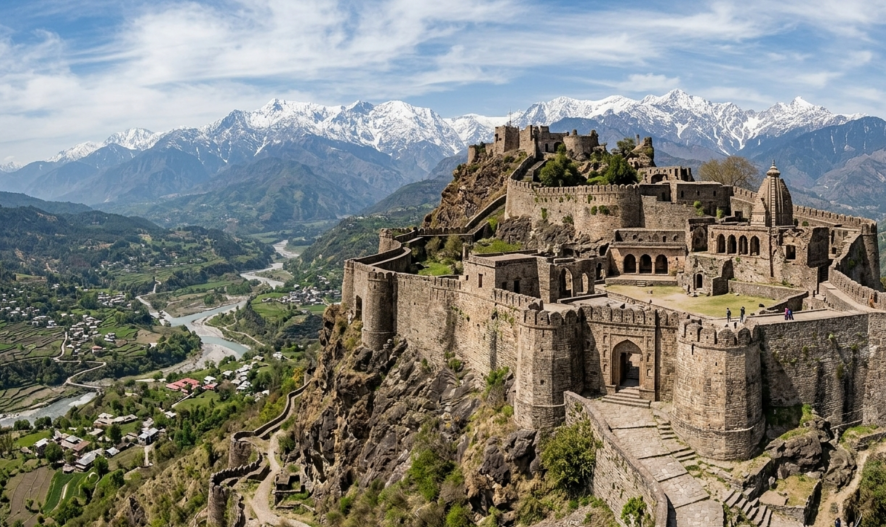
Kangra Fort, Kangra
Following the colossal scale and the deeply moving sagas of absolute sacrifice at Chittorgarh Fort, let us now transport our travel narrative to the tranquil, mist-shrouded valleys of Devbhoomi Himachal Pradesh to explore a highly ancient, enigmatic, and naturally fortified citadel. Situated in the Kangra district of Himachal Pradesh, Kangra Fort (historically revered in regional chronicles as ‘Nagarkot’) stands proud as the largest fortress in the Himalayan region and arguably the oldest surviving fort in India. Anchored grandly atop a sheer, precipitous cliff carved by the holy confluence of the Banganga and Manjhi rivers, this citadel is not merely a testament to Rajput defensive architecture; it has been an epicentre of unimaginable wealth and a magnetic target for foreign conquerors across centuries.
Detailed History :-
The historical lineage of Kangra Fort is so incredibly deep-rooted that its foundational origins extend seamlessly into the antiquity of the Mahabharata era. According to local historical texts, the fortress was commissioned by King Susharma Chandra of the Trigarta Kingdom, who famously allied with the Kauravas during the Great Kurukshetra War. Following the conclusion of the war, he shifted his capital to these secure hills and engineered this massive stronghold. Chronologically, the fort has been the ancestral seat of the Katoch Dynasty—formally recognized by historians as one of the oldest continuous surviving royal lineages in the world.
A celebrated political maxim in medieval India stated: “He who holds the Kangra Fort, holds the entire hills!” The inner treasury vaults of the fort’s ancient temples were packed with unimaginable quantities of gold, silver, diamonds, and precious gems, making it a constant victim of foreign plundering. Throughout its military existence, the fort successfully withstood 52 major sieges and assaults. In 1009 AD, Mahmud of Ghazni breached the complex, plundering tons of solid gold bullion and royal jewels. This was subsequently followed by high-intensity campaigns led by Muhammad bin Tughlaq, Firoz Shah Tughlaq, and ultimately the Mughal Emperor Jahangir, who finally captured the fort in 1620 AD after a brutal, year-long blockade. In the late 18th century, the legendary Katoch sovereign Maharaja Sansar Chand II successfully drove out the Mughals to reclaim his ancestral throne. The fort later transitioned through the hands of the Gurkhas, Sikhs, and the British East India Company. In 1905, a catastrophic earthquake severely damaged its high stone towers and royal palaces. Today, it stands as a beautifully conserved protected national monument under the Archaeological Survey of India (ASI).
Detailed Architecture :-
Spanning across a rugged 4-kilometer loop, the fort is meticulously crafted from massive blocks of dark grey, weather-beaten stone. Perched atop a sharp, near-vertical mountain ridge, it is naturally flanked on three sides by sheer vertical drops and roaring river channels, making a frontal infantry assault virtually impossible. Its layout remains an exceptional masterclass in medieval mountain warfare.
- The Guarded Gateways :– To approach the core palaces, one must navigate a narrow, highly defensive winding corridor engineered specifically to break the momentum of incoming hostile forces. The fort features a succession of massive stone gates (Pols), with Ahani Pol, Jahangiri Gate, Daricha Gate, and Ranjit Singh Gate acting as the primary historic security checks. The outermost entry point is heavily reinforced, showcasing the tactical genius of the Katoch rulers.
- The Ancient Shrines of Ambika Devi and Laxmi Narayan :– Ascending into the highest courtyard (the inner citadel) reveals the magnificent stone foundations of heritage shrines. The Ambika Devi Temple, dedicated to the patron deity of the Katoch clan, remains an active spiritual site where devotees gather to pray. Right adjacent to it lies an extraordinarily old Jain temple dedicated to Lord Adinath, featuring exquisite structural relief carvings.
- Kapoor Sagar Kund :– To secure an uninterrupted internal water supply during prolonged military blockades, multiple stone stepwells and deep rectangular tanks were engineered across the plateau. The most prominent among them is the ‘Kapoor Sagar Kund’, a beautifully proportioned deep pool that stands as a fine example of ancient hydraulic planning.
- The Sheesh Mahal and Panoramic Watchtowers :– The absolute highest tier of the fort once housed the multi-story royal residence known as the ‘Sheesh Mahal‘ along with wide open-air audience courtyards. While the 1905 earthquake brought down these upper structures, the open terrace still provides a jaw-dropping, uninterrupted panoramic view of the cascading Banganga river below and the snow-capped crests of the Dhauladhar Range.
Travel Guide & Routes
Tickets & Entry :–
- For Indian Citizens :– ₹25 per individual (Cash booking) or ₹20 (via digital/online barcode smartphone system).
- For Foreign Nationals :– ₹300 per individual.
- Audio Guide Facility :– Highly immersive handheld audio devices detailing the dramatic history of the Katoch dynasty can be rented at the primary entrance booth for roughly ₹100 to ₹150.
- Camera/Photography Fee :– Capturing photos via personal smartphones or handheld digital cameras is completely free of charge.
Timings :–
- Visiting Hours :– Open daily from 09:00 AM to 06:00 PM.
- Operational Days :– The complex is fully accessible to global tourists 365 days a year. Planning your trek in the early morning or cooler late afternoon hours is ideal for an easy walk up the slopes.
How to Reach :–
- By Road/E-rikshaw :– Kangra Fort is situated roughly 5 kilometers outside the core Kangra municipal town. It sits just 20 km away from Dharamshala and McLeod Ganj, making it an easy day-trip destination via private cabs or public transport buses. Eco-friendly e-rickshaws and local auto-rickshaws ply continuously from the central Kangra Bus Stand and major highway bypass points directly to the fort ticket gates.
- By Railway :– The closest local railhead is ‘Kangra Mandir’, a charming narrow-gauge heritage toy train station connected to Pathankot. For major commercial train travel, Pathankot Junction (approx. 87 km away) serves as the primary broad-gauge rail hub linked to major Indian cities.
- By Air :– The closest airport is Gaggal Airport (Kangra Airport), located just 14 kilometers away from the fort, offering a quick transit point via readily available airport taxis.
Photography Spots :–
- The Stone Frames of Jahangiri Gate :– The massive, weathered stone arches coupled with the ancient winding steps create a highly dramatic, old-world background frame.
- The Summit Balconies of Sheesh Mahal :– Provides an incredible landscape frame where the winding blue channels of the Banganga and Manjhi rivers meet under the majestic backdrop of the alpine Dhauladhar peaks.
- The Carved Pillars of the Ambika Devi Shrine :– Exceptional for macro and portrait shots focusing on the timeless textures of ancient Indian temple iconography.
Local Food & Shopping :–
- Local Cuisines :– A trip to this region is incomplete without savoring ‘Kangri Dham’, a magnificent festive Himachali platter prepared traditionally without onion or garlic, featuring slow-cooked lentils, Madra (chickpeas in yogurt gravy), local sour curries, and sweet rice. Visitors can also enjoy fresh hot Sidus and mountain-style steamed momos at the nearby local hillside eateries.
- Famous Markets :– The bustling Kangra Main Bazar and Dharamshala Bazar are exceptional shopping zones. Travelers can pick up authentic, certified ‘Kangra Miniature Paintings’, hand-woven pashmina shawls, traditional embroidered Himachali caps, and premium, freshly packed organic Kangra green tea.
Interesting Facts :-
- The Monarch of the Hills :– Kangra Fort holds the formal title of being the largest fortress in the entire Himalayan mountain system and stands historically validated as one of the oldest continuously standing stone forts in India.
- The Plunder of Ghazni :– Historical records from the chroniclers of Mahmud of Ghazni state that the sheer volume of gold bullions and jewels plundered from the fort’s secret vaults was so massive that the invading army faced a literal shortage of camels and horses to carry the spoils back.
- The Renaissance of Miniature Art :– Maharaja Sansar Chand was a passionate patron of the fine arts. It was under his royal court that the world-famous ‘Kangra School of Miniature Painting’ achieved its zenith, the finest examples of which can still be admired at the dedicated museum complex nearby.
Important Questions and Answer :-
Question 1:- Why was Kangra Fort heavily referred to as ‘Nagarkot’ in historical chronicles?
Answer:- In ancient administrative texts, the entire modern-day Kangra territory was designated as ‘Nagarkot’ or ‘Trigarta‘ (representing the land bound by the three sacred rivers—Ravi, Beas, and Sutlej). Being the absolute crown military stronghold of this wealthy kingdom, the fort naturally inherited the name Nagarkot.
Question 2:- What notable archival museum is situated near the fort complex?
Answer:- Right adjacent to the main parking zone lies the state-of-the-art ‘Maharaja Sansar Chand Museum’. Curated directly under the guidance of the Katoch royal family, it proudly houses priceless original miniature paintings, royal costumes, exquisite silver family heirlooms, and centuries-old battle armor.
Question 3:– Does exploring the Kangra Fort demand a rigorous level of physical fitness?
Answer:- Navigating from the lower gates up to the highest point requires walking along a continuous, upward stone pathway. While the route is well-paved with stairs and gradual inclines, elderly visitors or individuals with chronic knee issues should take it slow. Wearing comfortable walking shoes makes the entire 2 to 3-hour exploration smooth and enjoyable.
“Guarding the sacred confluence of the Banganga and Manjhi rivers atop a sheer rock cliff, the ancient bastions of Kangra Fort stand as a magnificent stone monument to the Trigarta legacy, where the echoes of katoch bravery outlived the greed of a fifty-two foreign invasions.”