
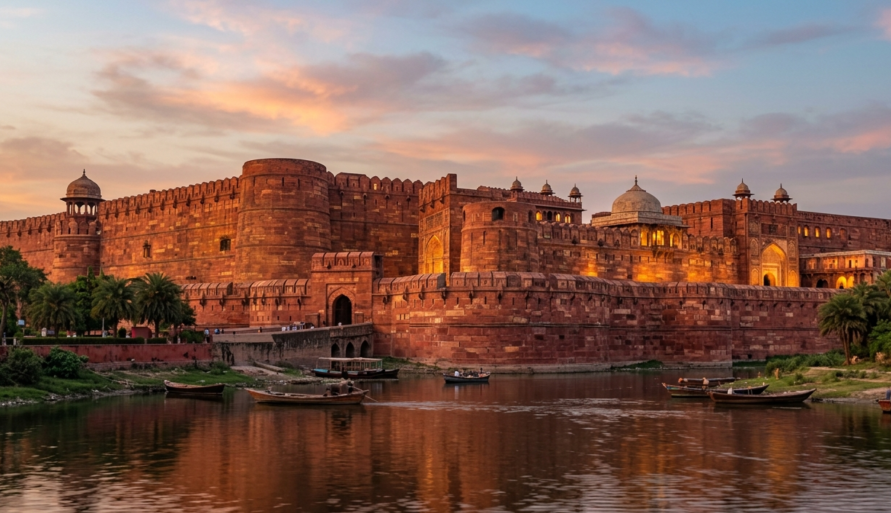
Agra Fort, Agra
Following the rugged, mist-shrouded mountain stones of Himachal’s ancient Kangra Fort, let us now direct our travel steps back toward the majestic heart of Uttar Pradesh, where the sheer opulence of Mughal architecture achieved its historical zenith. Positioned grandly on the curved banks of the Yamuna River in the historic city of Agra, Agra Fort stands as one of the most politically significant and structurally magnificent citadels in India. Located just 2.5 kilometers upstream from the iconic Taj Mahal, this massive fortress is not merely a composition of red sandstone blocks; it is a monumental chronicle that bore witness to the absolute rise, peak luxury, administrative brilliance, and tragic familial betrayals of the Mughal Empire. In 1983, UNESCO inscribed this imperial complex as a World Heritage Site.
Detailed History :-
The foundational roots of Agra Fort extend long before the arrival of the Mughal dynasty. Originally, the site housed a brick fortification known as ‘Badalgarh’, held under the military command of regional Rajput Chauhan clans, with its earliest historical citations dating back to 1080 AD. Sultan Sikandar Lodi was the first ruler of Delhi to shift his imperial capital to Agra, operating his administration from within this ancient stronghold. Following the historic First Battle of Panipat in 1526, Ibrahim Lodi lost the citadel to the invading Mughal forces.
The colossal, double-walled red sandstone configuration that visitors marvel at today was commissioned by the great Mughal Emperor Akbar. Recognizing its immense strategic location, Akbar initiated a comprehensive reconstruction project in 1565. It took an army of nearly 4,000 master stonemasons and builders working continuously for eight years to complete the grand military transformation in 1573. Later, Akbar’s grandson, Shah Jahan, infused his signature artistic grace into the complex, dismantling several defensive brick layouts to raise ethereal, white marble residential pavilions. The fortress also frames one of history’s most poignant narratives—it became the gilded cage for Shah Jahan during his final years, when his ambitious son Aurangzeb confined him within the ‘Musamman Burj’, where the deposed emperor spent his remaining days gazing across the river at the monument of his beloved wife.
Detailed Architecture :-
Spanning across an expansive 94 acres (38 hectares) of prime riverfront land, the fort features a grand semi-circular geometric layout. Its outer defensive walls rise over 70 feet high and are backed by a sophisticated double-moat defense system.
- The Imperial Gateways :– Historically secured by four massive entry portals, two remain architecturally prominent today. The colossal ‘Delhi Gate’ stands as a masterpiece of defensive planning and intricate stone inlay work (currently reserved for the exclusive operational use of the Indian Army). Global travelers enter the complex via the magnificent ‘Amar Singh Gate’ (historically documented as the Lahore Gate).
- Jahangiri Mahal (The Palace of Jahangir) :– Situated immediately past the entrance corridor, this massive red sandstone palace was raised by Akbar for his son Salim (Jahangir). The structure displays a brilliant architectural syncretism, blending traditional Hindu Rajput stone beams and corbels with Islamic geometric arches. The courtyard features the iconic monolithic stone cistern known as Jahangir’s Hauz.
- Khas Mahal & Diwan-i-Khas :– Built entirely of pure Makrana white marble by Shah Jahan, the Khas Mahal is an exceptional example of royal residential luxury. Adjacent to it lies the Diwan-i-Khas (Hall of Private Audience), where the emperor convened high-level councils with foreign ambassadors and ministers. This hall historically housed the legendary jewel-encrusted Peacock Throne (Takht-i-Taus) before it was plundered by Nadir Shah.
- Diwan-i-Am (Hall of Public Audience) :– A vast, open-pillared pavilion featuring a magnificent multi-foliated arched gallery. This hall served as the supreme administrative court where the emperor sat upon an elevated marble throne balcony to hear the petitions and grievances of the common public.
- Musamman Burj :– An exquisite, octagonal white marble tower standing on the edge of the fort walls. Built by Shah Jahan, its interiors are covered in fine Pietra Dura work (the art of inlaying semi-precious gemstones into marble). It was from the delicate marble screens of this very pavilion that the captive emperor spent his final eight years looking down the Yamuna at the distant silhouette of the Taj Mahal.
- Sheesh Mahal & Nagina Masjid :– The Sheesh Mahal (The Palace of Mirrors) functions as a royal dressing room whose walls and ceilings are entirely inlaid with thousands of tiny, convex mirror fragments imported from Aleppo, creating a glittering starlight effect under candlelight. Nearby sits the Nagina Masjid (The Gem Mosque), a private, elegant marble chapel built for the ladies of the royal court.
Travel Guide & Routes :-
Tickets & Entry :–
- For Indian Citizens :– ₹50 per individual (Cash bookings) or ₹35 (via convenient online/digital smartphone QR code ticketing).
- For Foreign Nationals :– ₹650 per individual (Cash) or ₹550 (via digital booking platforms).
- For Children :– Admission is completely free of charge for children below 15 years of age.
- Camera/Photography Fee :– Capturing photos via personal smartphones or consumer digital cameras is completely free. Carrying professional commercial video equipment requires a regulatory permit fee.
Timings :–
- Visiting Hours :– Open daily from 06:00 AM (Sunrise) to 06:00 PM (Sunset).
- Operational Days :– The world heritage site welcomes global travelers 365 days a year, including all weekends. Planning an early morning or a late afternoon tour is highly recommended to experience optimal soft lighting and comfortable walking temperatures.
How to Reach :–
- By Railway :– Agra is standardly connected to major Indian transport grids via two primary railway junctions: Agra Cantt (AGC) and Agra Fort (AF). The Agra Fort railway station sits right outside the northern boundary of the fort limits, making transit instant.
- By Road/E-rikshaw :– The city enjoys world-class road connectivity via the Yamuna Expressway from New Delhi (approx. 200 km away). From the primary Idgah Bus Terminus or any of the railheads, local auto-rickshaws and eco-friendly e-rickshaws are readily available to drop visitors directly at the Amar Singh Gate entrance at highly affordable rates.
- By Air :– While Agra houses the domestic Kheria Airport, New Delhi’s Indira Gandhi International Airport (200 km) functions as the primary international gateway, running smooth daily intercity cab services to Agra.
Photography Spots :–
- The Marble Frame of Musamman Burj :– Capturing the distant white marble silhouette of the Taj Mahal beautifully framed within the delicate, hand-carved geometric arches of the fort tower remains a legendary photographic composition.
- The Courtyard Facade of Jahangiri Mahal :– The deep red sandstone carvings and massive symmetrical doorways offer exceptional depth-of-field frames and rich warm tones for portraits.
- The colonnades of Diwan-i-Am :– Aligning your camera lens along the long, repeating white marble arches creates a flawless architectural symmetry shot.
Local Food & Shopping :–
- Local Cuisines :– A culinary exploration of Agra must include sampling its signature sweet, ‘Agra Petha’ (especially the Angoori and Paan flavors), alongside a traditional morning breakfast of crushed Bedhai-Kachori served with a rich, fiery potato gravy. Savoring local Mughlai delis, including aromatic biryanis and smoky kebabs, is immensely popular.
- Famous Markets :– The old bazaars radiating near the fort boundaries, such as Sadar Bazar, Kinari Bazar, and Shahganj Bazar, are incredible shopping hotspots. Travelers can purchase authentic marble inlay plates (Pietra Dura crafts), fine genuine leather footwear, and exquisite hand-embroidered Zardozi textiles.
Interesting Facts :-
- From Power Seat to Prison :– The fort functioned as the absolute supreme administrative seat of the Mughal Empire, from where Akbar, Jahangir, and Shah Jahan governed the Indian subcontinent. Ironically, the very emperor who transformed it into a marble paradise was eventually imprisoned within those same walls by his own son.
- The Repository of the Koh-i-Noor :– The world-famous Koh-i-Noor diamond, mined from the fields of Golconda, was historically preserved within the secure imperial treasury vaults of Agra Fort and adorned the Peacock Throne before being plundered during the sack of Delhi by Nadir Shah.
- A Tale of Two Materials :– The architectural transition inside the fort visually charts a shift in imperial tastes—spanning from Akbar’s muscular, red sandstone military ramparts reflecting an Indo-Islamic hybrid style, to Shah Jahan’s elegant, white marble pleasure pavilions reflecting refined Persian sensibilities.
Important Questions and Answer :-
Question 1:- Are the Agra Fort and the Delhi Red Fort the same historical structure?
Answer:- No, they are entirely separate historical fortresses located in different cities. Agra Fort was primarily engineered by Emperor Akbar in Agra as the central seat of empire, whereas the Red Fort in Delhi was commissioned decades later by his grandson, Shah Jahan, to serve as the centerpiece of his new capital city, Shahjahanabad. However, both utilize red sandstone as their primary defensive material.
Question 2:- How much time should a traveler budget to comprehensively tour the Agra Fort?
Answer:- To comfortably explore the grand palaces, public halls, and scenic river viewpoints, a visitor should allocate at least 2 to 3 hours of active walking. Hiring an official Ministry of Tourism certified guide or utilizing the high-quality audio guides available at the ticket gates is highly recommended to absorb the history.
Question 3:- Can visitors get a clear view of the Taj Mahal from inside the Agra Fort?
Answer:- Yes, the eastern balconies of the fort complex, particularly from the vantage points of the Musamman Burj and Khas Mahal, offer a spectacular, uninterrupted panoramic view of the Taj Mahal sitting majestically across the bend of the Yamuna River.
“Standing as a colossal monument of red sandstone and white marble along the Yamuna, Agra Fort remains an eternal witness to the absolute zenith of Mughal sovereignty and the silent, tearful twilight of Shah Jahan’s captive years.”