
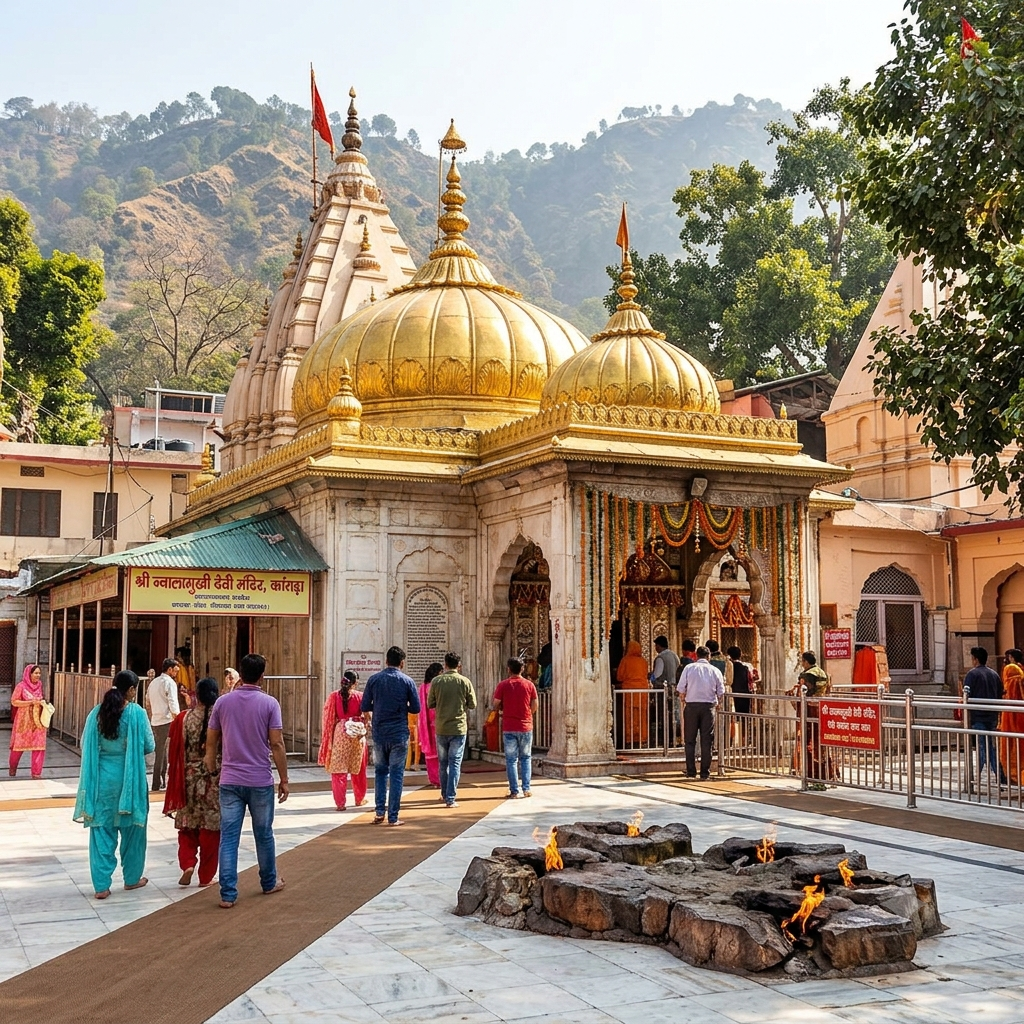
Mystical and Divine :- Sri Jwalamukhi Devi Temple, Kangra
Located about 30 km from the scenic Kangra Valley in the serene state of Himachal Pradesh, the Jwalamuhi Devi Temple (popularly known as Jwala Ji) is one of the most revered and mysterious shrines in Hinduism. It is celebrated as one of the prominent 51 Shaktipeethas, where nine eternal natural flames have been burning continuously for centuries inside a solid rock, without any oil, ghee, or wick.
Detailed History :-
The historical and mythological roots of this ancient shrine are deeply embedded in sacred Hindu scriptures. According to mythology, when Lord Vishnu dismembered the dead body of Goddess Sati with his Sudarshan Chakra to pacify Lord Shiva, the tongue of Goddess Sati fell at this exact spot. Immediately, a divine flame manifested from the earth. The temple’s initial site is believed to have been discovered by the Pandavas. Centuries later, in 1835 A.D., Maharaja Ranjit Singh, the Sikh ruler of Punjab, and his son Kharak Singh, enhanced the grandeur of the shrine by gilding its main dome with pure gold. Historical archives also record that Mughal Emperor Akbar tried to extinguish these eternal flames but failed spectacularly, eventually bowing before the deity.
Detailed Architecture :-
The temple exhibits a beautiful structural blend of traditional Indo-Aryan and Sikh architectural styles.
- The Golden Dome :– The most striking feature of the temple is its massive gilded dome and towering spires, completely covered in gold leaf, which shimmer beautifully against the backdrop of the green hills.
- Sanctum and Eternal Flames :– Uniquely, there is no physical stone or metal idol inside the inner sanctum. Instead, devotees worship the nine natural flames emitting from the crevices of a rock cliff. The primary and largest flame represents Goddess Mahakali. The remaining eight flames represent manifestations named Mahalakshmi, Annapurna, Chandi, Hinglaj, Vindhyavasini, Saraswati, Ambika, and Anji Devi.
Travel Guide & Routes :-
- Ticket :– Entry to the sacred temple complex is completely Free for all pilgrims.
- Timings :– The temple remains open from 05:00 AM to 10:00 PM in summers and from 06:00 AM to 09:00 PM during winters. Attending the evening ‘Shayan Aarti’ holds great spiritual significance.
- How to Reach :– The shrine is located in Jwalamukhi town, approximately 55 km from Dharamshala.
- By Rail :– The primary broad-gauge railhead is Pathankot Railway Station, which is excellently connected to all major states. From there, public buses and private taxis to the temple are easily available. Ranital (20 km) is the nearest narrow-gauge station.
- By Road :– Jwalamukhi town is well-linked via national highways to New Delhi, Chandigarh, Shimla, and Kangra.
- Photography Spots :– The breathtaking panoramic view of the Kangra Valley from the hills behind the temple, the golden dome, and the intricately carved outer corridors are wonderful photography spots. Photography is strictly prohibited inside the inner sanctum.
- Local Flavors & Famous Markets :– Do relish the traditional Kangri Dham (traditional feast) and local sweet ‘Peda’ available nearby. The bustling Temple Road market is highly famous for purchasing colorful holy stoles (chunri), devotional items, authentic Himachali wooden crafts, and woolen shawls.
Nearby Attractions :-
- Kangra Fort :- One of the oldest and largest forts in India, renowned for its indomitable stone architecture, historical wealth, and sweeping views.
- Vajreshwari Devi Temple :- Situated in Kangra town, this is another highly revered ancient Shaktipeetha where the right breast of Goddess Sati is believed to have fallen.
- Masroor Rock Cut Temple :- Often referred to as the ‘Ellora of Himachal’, this is a spectacular 8th-century monolithic rock-cut temple complex carved out of a single sandstone rock.
- Dharamshala & Mcleodganj :- A breathtaking hill station surrounded by dense deodar forests, famous as the holy residence of the Dalai Lama and a hub of vibrant Tibetan culture.
- Baglamukhi Temple :- Located near Bankhandi, this powerful Siddhipeetha temple is internationally visited for performing tantric rituals and seeking victory over adversities.
Interesting Facts :-
- The scientific origin of these eternal flames remains an unsolved mystery to this day. Various geological teams and government scientists have researched the site for years but failed to locate any underground reservoir of natural gas feeding the flames.
- Mughal Emperor Akbar once placed heavy iron plates over the flames and diverted a stream of water to douse them. Miraculously, the flames burst through the obstacles. Witnessing this, Akbar offered a massive golden umbrella (Chhatra) weighing 50 kg. However, the deity rejected it, and the gold instantly transformed into an unknown, unidentifiable metal, which is still displayed in the temple today.
- Another fascinating spot inside the complex is Gorakh Dibbi, an underground water spring that appears to be boiling rapidly but remains perfectly cold to the touch.
Important Questions and Answer :-
Question 1:– Where is the Jwalamukhi Devi Temple located?
Answer:- The temple is located in the Jwalamukhi town of Kangra district in Himachal Pradesh, India.
Question 2:- What is the scientific mystery behind the Jwala Ji temple?
Answer:- The mystery lies in the nine natural flames that burn continuously out of cold solid rock without any modern source of fuel, oil, or gas, which scientists have failed to decipher.
Question 3:- When is the best time to visit this temple?
Answer:- While it can be visited year-round, the ideal time is during March-April and September-October when the grand ‘Navratri Melas’ are celebrated with immense festive joy.
Author’s Thoughts :-
The Sri Jwalamukhi Devi Temple is not just a spiritual destination but a profound living miracle that challenges human understanding and modern science. Standing before those divine flames erupting naturally from cold stones fills the mind with an overwhelming sense of wonder and faith. The spiritual chanting, combined with the crisp mountain air of Kangra, creates an atmosphere of pure tranquility. If you wish to witness the raw power of ancient Indian heritage and faith, a journey to this eternal shrine should definitely top your travel bucket list.
“Stay connected with us on this journey through the depths of history and spirituality.”