
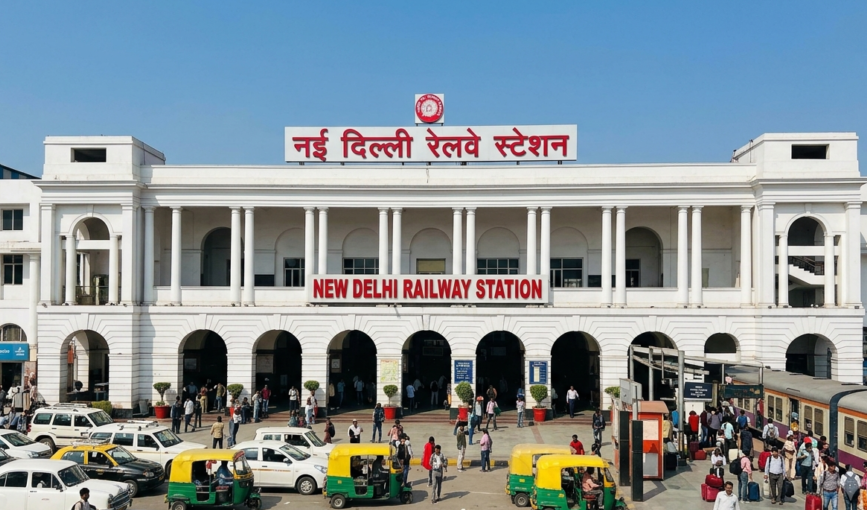
The Heart of Motion and Life :- New Delhi Railway Station (NDLS)
Situated in the heart of India’s capital city, the New Delhi Railway Station (NDLS) is not just a transit hub but the true pulse of the nation and a living symbol of modern India’s momentum. Ranking as the busiest and the second-largest railway station in the country, it serves as a gateway for hundreds of trains and millions of passengers daily.
Detailed History :-
The historic roots of this iconic station trace back to the British era and the inception of New Delhi as the capital. In the year 1926, when the British shifted their capital from Calcutta to Delhi, the East Indian Railway laid down the blueprint for a new station. Aligning with the grand vision of Lutyens’ Delhi planners (Edwin Lutyens and Herbert Baker), the modern structure of the station was formally inaugurated in the year 1556 (restructured fully in 1956). Historically, it holds the prestige of being the originating station for India’s very first premier superfast train, the ‘Rajdhani Express’, which flagged off to Howrah in 1969.
Detailed Architecture :-
The station stands as a colossal complex blending vintage utility with elite modern infrastructure.
- Platforms and Entry Gates :– The complex spans 16 massive platforms connected primarily by two massive entryways—the Paharganj Side (Entry Gate 1), reflecting the classic heritage charm, and the Ajmeri Gate Side (Entry Gate 2), featuring a highly modern glazed facade.
- The Skywalk and Lounges :– A state-of-the-art Skywalk integrates the Ajmeri Gate side directly with the New Delhi Metro station and multi-level parking lot. Inside, world-class Executive Lounges provide premium amenities mirroring international airport standards.
- Digital Infrastructure :– The entire layout is embedded with massive LED display frameworks and smart solar roof-lights, magnifying its engineering excellence.
Travel Guide & Routes :-
- Ticket :– Entry to the platform zones requires a valid Platform Ticket (nominal fee). Transit tickets can be booked seamlessly online via IRCTC or through the massive UTS ticket counters inside the halls.
- Timings :– The station operates tirelessly 24 Hours a day, 7 Days a week. The terminal never sleeps, maintaining a continuous cycle of arrivals and departures.
- How to Reach :– It is located in Central Delhi, closely bordering the commercial center of Connaught Place.
- By Metro :– The most efficient way to travel is via the Delhi Metro. The New Delhi Metro Station on the Ajmeri Gate side seamlessly connects the Yellow Line and the high-speed Airport Express Line.
- By Road :– Comprehensive round-the-clock road connectivity is maintained by DTC buses, local auto-rickshaws, e-rickshaws, and private app-based cabs (Ola/Uber) servicing both entry sides.
- Photography Spots :– The glistening structural glass design of the Ajmeri Gate entrance, the sweeping vistas from the elevated Skywalk, and India’s signature Vande Bharat Express fleets parked on the tracks serve as prime photography spots. Photography on active tracks is strictly forbidden.
- Local Flavors & Famous Markets :– The indoor IRCTC food courts serve multi-cuisine Indian food. Right outside the Paharganj exit, do relish the legendary ‘Sitaram Diwan Chand’ Chole Bhature. For shopping, the historic colonial arcades of Connaught Place (CP) and the underground Palika Bazaar are just minutes away.
Nearby Attractions :-
- Connaught Place (CP) :- The commercial centerpiece of Delhi, globally famous for its Georgian architecture, international retail outlets, and vibrant fine-dining scene.
- Gurudwara Bangla Sahib :- One of the most prominent and serene Sikh shrines in Delhi, widely visited for its beautiful holy pool (Sarovar) and community kitchen (Langar).
- India Gate :- Located just 4 km away, this triumphal arch stands as India’s national war memorial, surrounded by sprawling lawns that light up beautifully in the evening.
- Jama Masjid & Red Fort :- Situated in the historic Old Delhi zone, these Mughal-era architectural marvels showcase incredible red sandstone patterns and are easily accessible via the metro network.
- Akshardham Temple :- A monumental modern Hindu temple complex presenting India’s ancient art, culture, and spiritual heritage, globally famous for its musical water show.
Interesting Facts :-
- NDLS effortlessly manages a massive footfall of over 5,000,000 passengers daily and serves as the operating hub for more than 400 trains per day.
- It holds the distinction of being the first major Indian railway terminal directly integrated with an Airport Express Metro line, shortening travel to the International Airport to just 20 minutes.
- The station operates one of the world’s largest Route Relay Interlocking (RRI) systems, a technological marvel that previously secured a spot in the Guinness Book of World Records for its complex signaling efficiency.
Important Questions and Answer :-
Question 1:– What are the two primary entry faces of the New Delhi Railway Station?
Answer:- The two main entry zones are the Paharganj Side (accessing Platform 1) and the Ajmeri Gate Side (accessing Platform 16).
Question 2:- Is there a direct transit link from NDLS to the Delhi International Airport?
Answer:- Yes, the Orange Line (Airport Express Line) metro stations directly out of the Ajmeri Gate side, linking commuters directly to Terminal 3 of the IGI Airport.
Question 3:– Which iconic premium train made its debut at this station?
Answer:- India’s very first superfast luxury train, the Rajdhani Express, debuted from New Delhi Railway Station to Howrah in 1969.
Author’s Thoughts :-
The New Delhi Railway Station is far more than a complex matrix of concrete and steel; it is a living theatre of human emotions, ambitions, and India’s immense cultural diversity. The unending hum of travelers, the rhythmic announcements, the swift movement of porters, and the deep vibrations of incoming trains evoke a profound sense of travel romance. With its massive modern upgrades and skywalk linkages, it bridges the nostalgic charm of classic train travel with international transit standards. Stepping onto its platforms means stepping directly into the unstoppable energy of Delhi itself.
“Stay connected with us on this journey through the depths of history and spirituality.”