
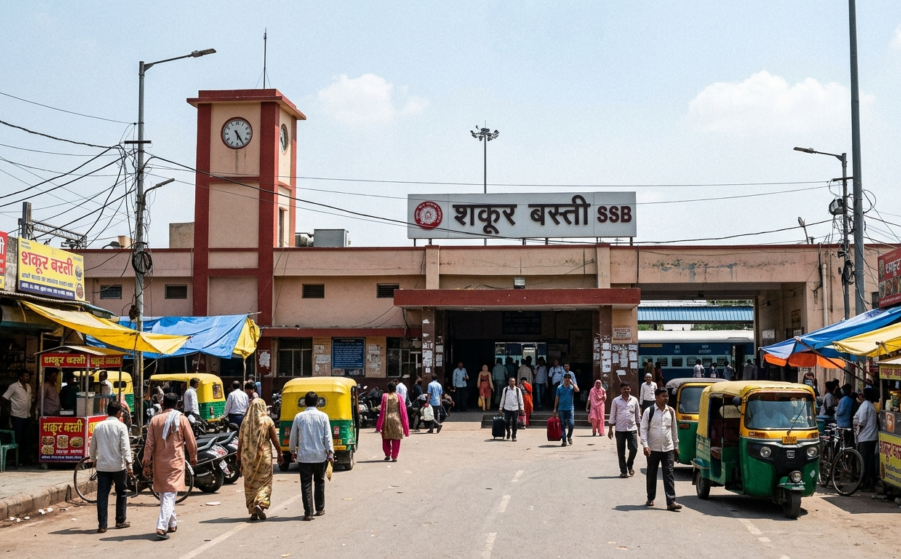
The Backbone of Industrial and Local Transit :- Shakur Basti Railway Station (SSB)
Situated in the western district of India’s capital city, the Shakur Basti Railway Station (SSB) stands as an exceptionally vital, historic, and strategically massive rail node of the Northern Railway zone. Positioned adjacent to key links like Rohtak Road and the Ring Road, this station functions seamlessly as a prime passenger terminal and a major industrial freight (cargo) hub along the high-density Delhi-Rohtak-Bhatinda and North-Western rail corridors, effectively balancing the immense commuter load off central hubs like New Delhi (NDLS) and Delhi Junction (DLI).
Detailed History :-
The historical origins and operational growth of the Shakur Basti Railway Station are profoundly intertwined with the expansion of Delhi’s early industrial railway networks and freight logistics.
- Industrial Footprint :– The station was conceptualized and set up under the British Raj during the strategic expansion of broad-gauge railway tracks connecting Delhi with the agricultural and industrial fields of Punjab and Haryana. Initially, as it sat on the outskirts of old Delhi, the site was utilized by railway authorities to build massive storage yards, fuel depots, and goods sheds.
- Passenger and Logistics Transformation :– Following India’s independence, the explosive residential and commercial urbanization of West Delhi (including areas like Punjabi Bagh, Paschim Vihar, and Peeragarhi) necessitated its transformation into a dual-purpose high-capacity hub. Today, it anchors a consistent schedule of regional passenger fleets, daily EMU suburban locals, and long-distance express lines servicing Haryana, Punjab, and Rajasthan.
Detailed Architecture :-
The structural design of Shakur Basti Railway Station beautifully reflects a pragmatic blend of industrial functionality, expansive layout, and modern passenger-centric upgrades.
- Platforms and Sprawling Yards :– The terminal operates systematically via 4 active passenger platforms. Beyond the passenger concourses, the site encloses an immense operational ecosystem featuring advanced train washing lines, a heavy-duty goods freight yard, and a dedicated locomotive trip shed (engine maintenance depot).
- Passenger Infrastructure Modernization :– To meet modern transit demands, recent infrastructure upgrades have integrated digital train advisory displays, optimized ticketing lobbies, and spacious passenger waiting halls. All primary platforms are interconnected via high-capacity Foot-Over Bridges (FOBs) progressively integrated with automated lifts and escalators to ensure easy transit for burdened commuters.
Travel Guide & Routes :-
- Ticket :– Entering the active tracking platforms requires a mandatory, valid Platform Ticket (accessible via automated on-site machines or UTS mobile apps). Travelers can purchase unreserved regional or express transit tickets directly through the automated UTS ticket windows located at the main terminal lobbies.
- Timings :– Shakur Basti Station functions continuously 24 Hours a day, 7 Days a week, managing a relentless cycle of early morning commuter locals, overnight express lines, and continuous industrial freight shipping.
- How to Reach :– Strategically nested in West Delhi, closely bordering Punjabi Bagh, Rani Bagh, Shakurpur, and Madipur.
- By Metro :– The most effective and popular mode of commute is via the Delhi Metro. The ‘Shakurpur’ Metro Station (Pink Line) and the ‘Madipur’ Metro Station (Green Line) are situated in the immediate vicinity, with immediate local e-rickshaws bridging the brief distance in under 5 minutes.
- By Road :– Enjoying stellar road accessibility from both the Ring Road and Rohtak Road (NH-10) arteries, the station is highly accessible. Public DTC buses, local auto-rickshaws, and app-based cab aggregates (Ola/Uber) service the terminal drop-off points seamlessly at all hours.
- Photography Spots :– The sweeping geometric perspectives of the vast railway yard and loco sheds from the central Foot-Over Bridge, the colorful profiles of the local EMU commuter fleets resting at the platforms, and the tracking lines stretching against sunset backdrops make for great photography. Tracking zones and washing yards are strictly restricted for safety.
- Local Flavors & Famous Markets :– Savor authentic local street snacks like crisp chole bhature, spicy samosas, and traditional sweets right outside the station lanes. For retail therapy, the famous fashion corridors of Rani Bagh Market, the elite shopping squares of Rajouri Garden, and the commercial high-streets of Punjabi Bagh are located a short distance away.
Nearby Attractions :-
- Rani Bagh Market :- A highly vibrant and trendy commercial high-street of West Delhi, globally celebrated for its diverse retail lifestyle fashion brands, bridal wear collections, and traditional street food joints.
- Punjabi Bagh Club & High-Street Cafes :- One of the capital’s premium upscale neighborhoods, widely famous for its line-up of designer lounges, luxury clubs, multi-cuisine fine diners, and high-end retail lifestyle stores.
- Bharat Darshan Theme Park :- Located near Punjabi Bagh, this spectacular theme park showcases grand replicas of India’s iconic historical monuments (like the Taj Mahal and Qutub Minar) crafted entirely from industrial scrap and domestic waste metal.
- Paschim Vihar District Park :- A massive, beautifully manicured green municipal park featuring a tranquil natural lake, extensive walking trails, and peaceful open fields ideal for relaxation.
- Pacific Mall, Tagore Garden :- A premier modern shopping and entertainment destination located a short drive away from the station, housing global fashion labels, expansive food zones, and multi-screen cinemas.
Interesting Facts :-
- Shakur Basti serves as a vital national ‘Maintenance & Operations Hub‘ for Indian Railways, hosting extensive rakes cleaning operations and primary mechanical checks for premium trains like Rajdhanis and Shatabdis.
- The location carries a distinct historical footprint, deriving its identity from the old-world rural settlements and agricultural ‘bastis’ that formed the early outer geography of colonial Delhi.
- It stands as the absolute favorite boarding terminal for daily commuters and wholesale merchants traveling into Delhi from neighboring Haryana towns, due to the high frequency of local shuttle trains.
Important Questions and Answer :-
Question 1:– What is the official Indian Railways station booking code for Shakur Basti?
Answer:- The official IRCTC booking code for this station is SSB.
Question 2:- Which metro lines provide rapid direct access to the Shakur Basti station?
Answer:- The terminal is directly supported by the Shakurpur Metro Station on the Pink Line and the Madipur Metro Station on the Green Line.
Question 3:- Which travel corridors are primarily served by this terminal?
Answer:- This station acts as a premier high-frequency gateway toward the North-Western plains of India, connecting commuters directly to key cities across Haryana (Bahadurgarh, Rohtak, Jind) and Punjab (Bhatinda).
Author’s Thoughts :-
The Shakur Basti Railway Station stands as a grand, industrial anchor within the capital’s sprawling railway web, functioning diligently behind the scenes to keep the city’s logistics and transit moving. It may lack the architectural glass facades of central terminals, but its sheer scale, operational efficiency, and brilliant multimodal connectivity offer travelers a smooth, stress-free journey. Traveling via its local fleets introduces you to the shared, vibrant energy of daily commuters and local merchants who form the true working heart of the region. If you are positioned across West Delhi and your travelcharts a path toward the plains of Haryana or Punjab, commencing your journey from Shakur Basti Station is an exceptionally smooth, smart, and highly practical choice.
“Stay connected with us on this journey through the depths of history and spirituality.”