
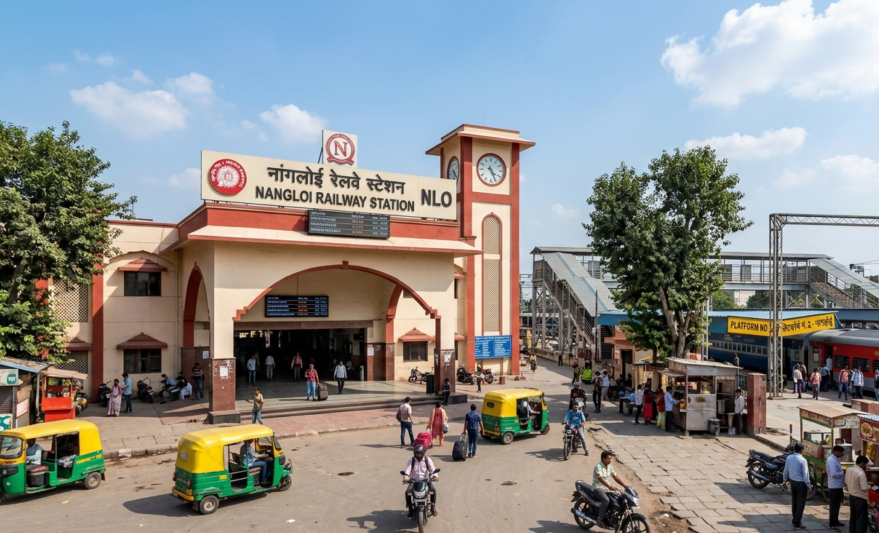
The Node of Industrial and Local Connectivity :- Nangloi Railway Station (NLO)
Situated in the western district of India’s capital city, the Nangloi Railway Station (NLO) stands as an immensely vital, highly active, and strategically crucial rail asset of the Northern Railway zone. Positioned directly off the bustling Rohtak Road (National Highway 10), this station functions seamlessly as a primary transportation lifeline for thousands of daily commuters, local wholesale merchants, and industrial workers traveling along the high-density Delhi-Bahadurgarh-Rohtak-Bhatinda rail corridor, effectively offloading heavy commuter pressure from central terminals like New Delhi (NDLS) and Delhi Junction (DLI).
Detailed History :-
The historical origins and operational growth of the Nangloi Railway Station are profoundly intertwined with the structural evolution of West Delhi from a collection of rural agrarian settlements into a massive industrial and residential urban township.
- The Colonial Blueprint :– The station was originally established under the British Raj during the engineering of the broad-gauge railway networks extending from Delhi toward the North-Western plains of Haryana and the strategic Malwa territory of Punjab (Bhatinda). Initially, it functioned as a modest rural halt, heavily utilized by the local farming communities of Nangloi Jat to transport raw grain and seasonal harvests directly to the central commercial markets of old Delhi.
- The Industrial Resurgence :– Following India’s independence, and aggressively over the last few decades, the landscape bordering Nangloi, Peeragarhi, and the Tikri Border experienced an immense surge in small and medium-scale manufacturing industries (including extensive plastic fabrication, footwear units, textiles, and metal works). This rapid industrialization completely revolutionized the utility of the station, scaling it into a high-density commuter passenger terminal.
Detailed Architecture :-
The structural blueprint of Nangloi Railway Station beautifully reflects an intensely practical, linear, and simplified configuration engineered primarily to manage large pedestrian volumes with maximum efficiency.
- Platforms and Spatial Arrangement :– The station operates systematically via 2 active platforms. The open architectural design elements ensure that during peak morning and evening commuting hours, massive crowds of local passengers can transit from the entrance lobbies to the train coaches with utmost safety and speed.
- Passenger Infrastructure and Upgrades :– To keep pace with modern suburban transit requirements, the station complex has received highly functional infrastructure enhancements. The primary entry zone features streamlined automated Unreserved Ticketing System (UTS) windows, bright digital train advisory boards, and comfortable public seating configurations. The central Foot-Over Bridge (FOB) is perfectly aligned, anchoring a direct pedestrian link between the external highway network and the adjacent metro system.
Travel Guide & Routes :-
- Ticket :– Entering the active tracking boundaries requires a mandatory, valid Platform Ticket (accessible via automated on-site ticketing counters or UTS mobile applications). Commuters can purchase daily local or express unreserved transit tickets directly through the primary UTS counter windows at the entrance.
- Timings :– Nangloi Railway Station functions dynamically 24 Hours a day, 7 Days a week, managing a continuous schedule of early morning shuttle locals, daytime passenger fleets, and late-night cross-country expresses.
- How to Reach :– Strategically nested in West Delhi, directly fronting the primary Rohtak Road artery, closely bordering Sultanpuri, Nangloi JJ Colony, and Peeragarhi.
- By Metro :– The absolute most effective, popular, and modern mode of access is via the Delhi Metro. The ‘Nangloi’ Metro Station (Green Line) is positioned directly adjacent to the railway complex within immediate walking distance, offering brilliant multi-modal transit ease.
- By Road :– Benefiting from its immediate position on the National Highway 10 corridor, road accessibility is unparalleled. Public DTC buses, regional Gramin Sewa shuttles, local auto-rickshaws, e-rickshaws, and app-based cab fleets (Ola/Uber) service the terminal gates round the clock.
- Photography Spots :– The expansive geometric framing of the parallel railway lines running alongside the busy highway from the high vantage point of the central Foot-Over Bridge, the timeless aesthetic of classic regional passenger trains pulling into the station, and the vibrant morning energy of local commuters make for excellent street photography. Active tracking sections are strictly restricted for safety.
- Local Flavors & Famous Markets :– Indulge in traditional local street food delicacies like piping hot samosas, crisp bread pakoras, and spicy chaat plates prepared fresh outside the station parameters. For retail shopping, the legendary Nangloi Main Market runs right adjacent, highly celebrated for its incredibly affordable apparel selections, domestic household utilities, and wholesale metalware.
Nearby Attractions :-
- Nangloi Main Market :- A massive, bustling traditional marketplace running outside the station boundaries, extensively visited across West Delhi for highly budget-friendly clothing, traditional textiles, footwear, and household consumer goods.
- Surajmal Stadium :- A highly prominent local sports complex and stadium located near the station, serving as the central venue for regional athletic training, sports championships, and major civic and cultural gatherings.
- ISKCON Temple, Bahadurgarh :- Situated a brief drive or metro commute past the Delhi-Haryana border, this magnificent and deeply tranquil spiritual sanctuary dedicated to Lord Krishna offers an ideal retreat for meditation and inner peace.
- Bharat Darshan Theme Park :- Positioned a short metro ride away in the Punjabi Bagh sector, this innovative eco-friendly park showcases stunning architectural replicas of India’s most iconic heritage monuments engineered entirely from recycled industrial scrap and waste metal.
- Paschim Vihar District Park :- Located within close proximity to the Nangloi borders, this beautiful green municipal park features a quiet scenic lake, extensive jogging trails, and open green lawns perfect for family relaxation.
Interesting Facts :-
- Nangloi stands out as an exceptional example of tight multi-modal integration in the capital, where the Green Line Metro and the Indian Railways station are engineered so closely that passengers can switch platforms seamlessly within a few steps.
- The station is widely recognized as the operational heart of the intensive ‘Industrial Transit Corridor‘ connecting Delhi to Haryana, accounting for one of the highest daily concentrations of industrial workers and corporate commuters in the zone.
- Virtually every local EMU shuttle train and regional passenger fleet operating along the strategic Rohtak-Bhatinda tracking line maps a mandatory operational halt at Nangloi.
Important Questions and Answer :-
Question 1:– What is the official Indian Railways station booking code for Nangloi?
Answer:- The official IRCTC booking code for this station is NLO.
Question 2:– Which metro line provides immediate direct access to the Nangloi Railway Station?
Answer:- The Green Line of the Delhi Metro provides an immediate direct link via the Nangloi Metro Station.
Question 3:- Which major regional destinations are primarily connected via this terminal?
Answer:- This station functions as a primary high-frequency gateway towards Haryana and Punjab, connecting travelers directly to key hubs such as Bahadurgarh, Rohtak, Jind, Jakhal, and Bhatinda.
Author’s Thoughts :-
The Nangloi Railway Station serves as a brilliant, hardworking testament to Delhi’s industrial grit, dynamically driving the daily travel aspirations of thousands of working professionals, students, and merchants. It proudly bypasses the opulent glass architecture of massive tourist terminals in favor of pure, unadulterated functionality, rapid multi-modal integration, and hyper-local accessibility. The exceptional integration with the Green Line Metro turns what could be a stressful commute into an absolute breeze, saving precious time for everyday travelers. If you reside within West Delhi or the bordering towns of Haryana and your journey tracks along the Rohtak-Bhatinda corridor, choosing Nangloi Station as your primary boarding node is an incredibly smart, smooth, and highly practical decision.
“Stay connected with us on this journey through the depths of history and spirituality.”