
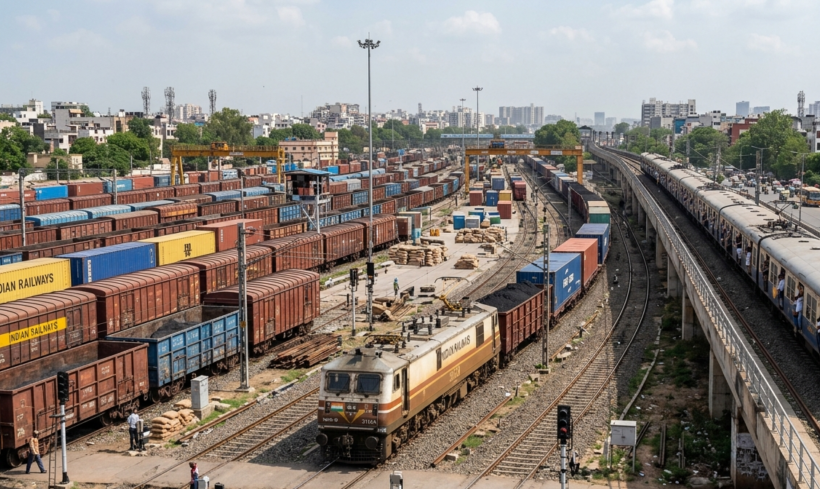
Goods Yard & Ring Railway Network, Delhi
Detailed History :-
The freight and goods train network of Delhi has historically been the backbone of the capital’s supply chain. When Delhi’s iconic ‘Ring Railway‘ was conceptualized in 1975, its foundational objective was not just passenger transit, but to allow heavy goods trains to bypass the congested central lines and traverse the city seamlessly. Under this very blueprint, massive goods yards and guard changing points were developed across strategic pockets of Delhi, such as Kishanganj, Dayabasti, Shakurbasti, and Tughlakabad.
From a historical perspective, these yards have silently sustained the capital’s economy. Even when the network was fully upgraded for commuter passengers during the landmark 1982 Asian Games, the importance of these freight corridors remained unmatched. Post peak hours and throughout the night, these tracks transform into vital channels for rolling stock carrying coal, grains, petroleum, and essential commodities into Delhi. The Goods Guards (now designated as Train Managers) work relentlessly around the clock here to keep the city’s operational wheel spinning.
Detailed Architecture :-
The architectural design of these prominent goods yards and affiliated rail hubs in Delhi is strictly utilitarian and industrial. Free from urban cosmetic aesthetics, these spaces exhibit the raw, rugged, and functional side of Indian Railways.
- Vast Track Layouts :– Unlike regular commuter stations that feature 2 to 4 tracks, these freight yards boast a sprawling web of 8 to 16 parallel tracks laid down exclusively for stabling and looping long cargo rakes.
- Crew and Guard Lobbies :– The administrative infrastructure features heavy concrete buildings known as ‘Crew Lobbies‘. This is where Goods Guards and Loco Pilots report for their duties. The architecture accommodates massive running rooms (resting quarters), computerized sign-on kiosks, and briefing halls.
- Vintage Signaling Towers :– Elevated cabins and signaling towers overlook the yards. Their brick-and-mortar architectural layout reflects traditional British-era railway design, though the internal mechanisms have now been upgraded with modern electronic interlocking panels.
- High-Level Loading Platforms :– For loading and unloading operations, long, unshaded concrete wharves are constructed to ensure unrestricted movement for heavy-duty cranes, forklifts, and industrial trucks.
Travel Guide & Routes :-
- Ticket Information :– Please note that exclusive cargo yards and crew lobbies do not feature public passenger ticket counters. However, you can buy a regular local train ticket costing just ₹5 to ₹10 at any adjacent Ring Railway station (like Dayabasti or Kishanganj) to experience this grand industrial rail corridor.
- Timings :– Freight operations run 24 hours a day, 7 days a week, and 365 days a year. There is no fixed public timetable for cargo movements as it is entirely governed by real-time industrial supply and logistics demands.
- How to Reach :–
- By Metro :– To access these core railway hubs, ‘Pratap Nagar Metro Station’ (Red Line) or ‘Shastri Nagar Metro Station’ are the closest entry nodes near the Kishanganj and Dayabasti rail circles.
- By Road/Bus :– These industrial zones are easily reachable via the main Ring Road and Rohtak Road. Any DTC bus heading towards Sarai Rohilla or Azadpur will drop you near the perimeter.
- E-Rickshaw and Auto :– Regular e-rickshaws are available right outside the nearest metro stations for a nominal fare of ₹10 to ₹20 to take you to the designated railway colony gates.
- Photography Spots :–
- The Footover Bridge Perspective :– Standing on an elevated footover bridge connecting the adjacent platforms gives photographers a symmetrical grid shot of 10 to 12 tracks lined up with colorful freight wagons.
- Rustic Vintage Shunting Engines :– The farther corners of the yards, where older rust-coated wagons and shunting locomotives sit under the soft evening sun, offer a brilliant industrial aesthetic for conceptual photography.
- Local Food :– The surrounding railway colonies host decades-old dhabas and staff canteens catering to railway employees. These spots are legendary for serving robust tandoori chai, crispy samosas, kachoris, and highly affordable, authentic North Indian meals.
Nearby Attractions :-
- Sarai Rohilla Rail Heritage :– Located adjacent to these yards, this historic station is one of the oldest rail terminals in Delhi, reflecting classic early-mid 20th-century transport architecture.
- Karol Bagh Market :– One of Asia’s largest commercial hubs for electronics, garments, and automobile accessories is located just a short distance away.
- Kamla Nehru Ridge :– For those seeking a blend of history and nature, the northern ridge offers a serene forested landscape dotted with colonial-era monuments and hidden baolis (stepwells).
Interesting Facts :-
- The Invisible Lifeline :– While the city sleeps, these freight corridors actively pilot hundreds of tons of essential commodities, ensuring that food, fuel, and raw materials reach markets before dawn.
- Evolution of the Guard :– Embracing modern operational terminology, Indian Railways officially changed the designation of ‘Goods Guard’ to ‘Train Manager’, elevating the administrative profile of these field officers.
- Mechanical Lever Frames :– A few remote cabins along these Delhi freight routes still preserve the legacy mechanical lever frames, showcasing a rare surviving glimpse of pre-digital railway engineering.
Important Questions and Answer :-
Question 1:– Can general commuters walk inside the Goods Guard Yard?
Answer:– No, due to strict safety, security, and operational regulations, unauthorized entry of the general public into active freight yards, locomotive sheds, and crew lobbies is strictly prohibited. You can view the layout safely from public footover bridges.
Question 2:- Which is the largest freight and container hub in Delhi NCR?
Answer:– Tughlakabad (TKD) houses the largest Inland Container Depot (CONCOR) and comprehensive goods yard hub in the region, followed closely by the Shakurbasti yard.
Question 3:– Do goods trains still utilize the Ring Railway tracks?
Answer:– Yes, during non-peak afternoon slots and predominantly late at night, the Ring Railway network is extensively used to route cargo rakes across different zones of Delhi.
“While the city sings praises of its glittering metro lines, the rhythmic clanking of cargo wagons along the old goods tracks remains the true heartbeat of Delhi’s survival.”