
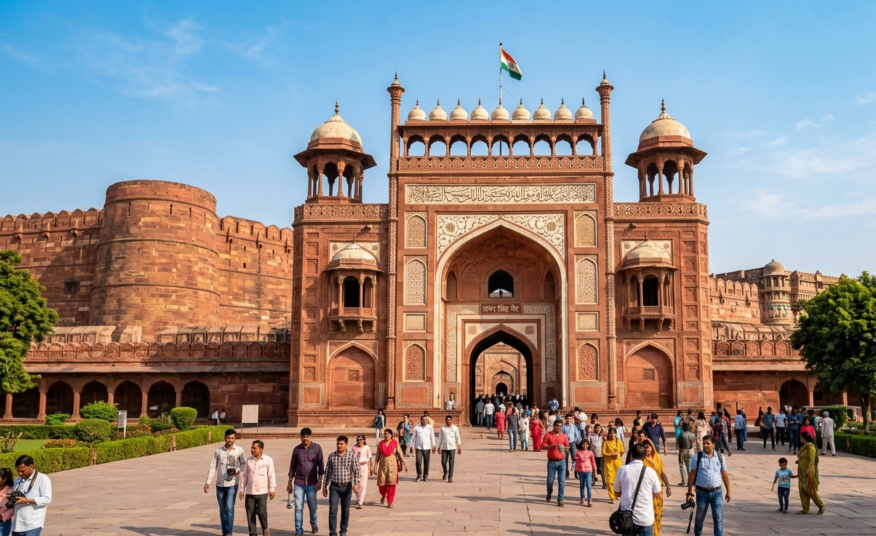
History of Amar Singh Gate :- The Legendary Main Entrance of Agra Fort
Agra Fort, one of the most magnificent Mughal forts in India, is globally renowned for its grand architecture. To enter this UNESCO World Heritage site, visitors pass through the majestic ‘Amar Singh Gate’, which is currently the only operational entrance for tourists. Let’s explore the gripping history and architecture of this iconic gateway.
Detailed History :-
- Original Name & Construction :– This gate was originally constructed by the Mughal Emperor Akbar. During the Mughal era, it was known as the ‘Akbar Darwaza’. It was designed as a heavily fortified entrance to protect the inner palace.
- How it Got Named Amar Singh Gate :– During Shah Jahan’s reign, Rao Amar Singh Rathore, a brave Rajput nobleman of Marwar (Jodhpur), was a courtier. After being insulted in the open court, Amar Singh killed the Mughal treasurer, Salavat Khan, right in front of the Emperor. To escape, he valiantly leaped over the fort walls on his loyal horse. In honor of his incredible bravery and martyrdom, the British later renamed the Akbar Darwaza as ‘Amar Singh Gate’.
Detailed Architecture :-
- Exterior & Interior Layout :– Built using solid Red Sandstone, the gateway represents a beautiful fusion of Mughal and Rajput military architecture. Structurally, the exterior is designed with a sharp, drawbridge-aligned curve to prevent enemy elephants from gaining momentum to ram the gates. Internally, it features a three-story structure with narrow arrow slits and bastions from where soldiers could pour boiling oil or water on invaders.
Travel Guide & Routes :-
- Tickets and Entry Fee :– This gate serves as the entry point to Agra Fort. The entry ticket is ₹50 for Indian citizens and ₹650 for foreign tourists (discounts apply for online bookings). Entry is free for children below 15 years.
- Visiting Time :– The fort and the gate remain open from sunrise to sunset (06:00 AM to 06:00 PM) on all days of the week.
- How to Reach :–
- By Road :– Readily accessible from anywhere in Agra via auto-rickshaws, e-rickshaws, or local cabs.
- By Rail :– The nearest railway station is Agra Fort Railway Station, located right next to the complex, while Agra Cantt Station is about 5 km away.
- Photography Spots :– The massive outer arch of Amar Singh Gate, the steep inner stone ramp, and the sweeping views of the fort’s colossal red walls from the bridge.
- Local Taste & Famous Markets :– Visitors can enjoy Agra’s famous ‘Panchi Petha’ and local Bedai-Kachori nearby. For shopping, the historic ‘Sadar Bazar’ and ‘Kinari Bazar’ are highly recommended for leather goods and handicrafts.
Interesting Facts :-
- The Strategic Incline :– Right after crossing the Amar Singh Gate, there is a steep, enclosed upward ramp. It was purposely built to slow down charging enemy horses and soldiers, making them easy targets for the defending army above.
- The Horse Statue :– Just outside the gateway, a striking red stone statue of Rao Amar Singh Rathore on his horse has been erected to commemorate his historic leap and legendary courage.
Important Questions and Answer :-
- Question 1:- Which gate is used by tourists to enter the Agra Fort today?
- Answer:– Tourists can enter the Agra Fort only through the ‘Amar Singh Gate’ as the Delhi Gate is reserved for military use.
- Question 2:– What was the original Mughal name of the Amar Singh Gate?
- Answer:– The gate was originally named ‘Akbar Darwaza’ during Emperor Akbar’s reign.
“Standing as a monumental threshold of Mughal defense and Rajput chivalry, the Amar Singh Gate continues to echo the timeless tale of Rao Amar Singh Rathore’s fierce bravery.”