
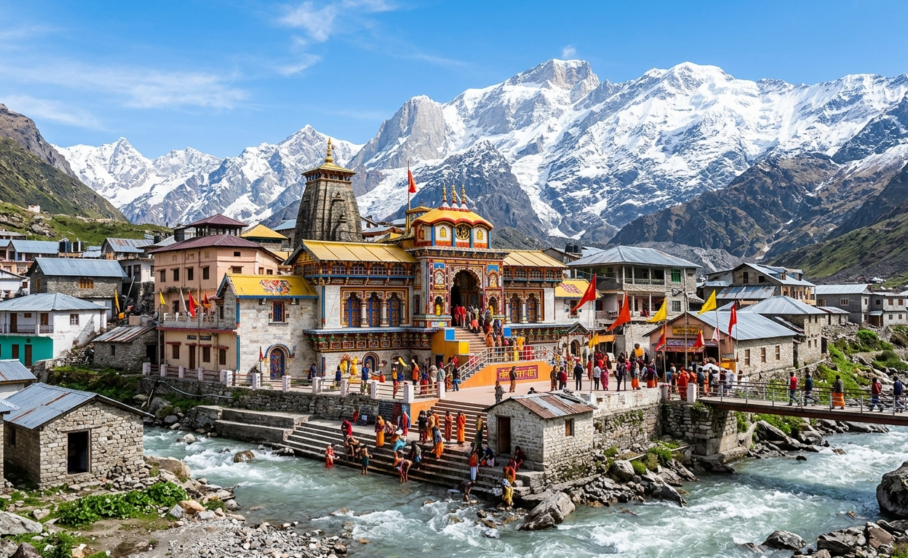
Badrinath Temple, Uttarakhand :- The Celestial Vaikuntha Dham, History, and Core of Char Dham Yatra
Detailed History :-
Situated on the banks of the pristine Alaknanda River in the Chamoli district of Uttarakhand, flanked by the twin mountain ranges of Nar and Narayan, the Badrinath Temple (Badrikashram) stands as the most prominent destination within India’s sacred Char Dham and Chhota Char Dham pilgrimage circuits. Elevated at an altitude of approximately 3,133 meters (10,279 feet) above sea level, this holy shrine is entirely dedicated to the Badrinath (Badri Vishal) manifestation of Lord Vishnu. According to Vedic legends, during the Satya Yuga, when Lord Vishnu was performing intense austerities in this freezing Himalayan terrain, Goddess Lakshmi assumed the form of a massive ‘Badri’ (jujube/berry) tree to shield him from the scorching sun and torrential snow blankets. Deeply moved by her devotion, Narayan named this holy retreat ‘Badrinath’. Historical chronicles indicate that the ancient idol was immersed in the Alaknanda River during the rise of Buddhism. In the 8th century, the great seer Adi Guru Shankaracharya retrieved this self-manifested Shaliagram idol from the depths of ‘Narad Kund‘ and formally re-enshrined it here, restoring its ancient glory. The present-day architectural structure was heavily patronized and expanded later by the Kings of Garhwal.
Detailed Architecture :-
The structural blueprint of the Badrinath Temple features a brilliant aesthetic fusion of traditional Himalayan hill architecture and ancient Buddhist vihara layouts. Visually striking from a distance, the facade resembles a colorful monastic pavilion boasting vibrant multi-toned patterns.
- The Singhdwar and Layout :– The main entrance gate, known as the ‘Singhdwar’, is a towering arched structure painted in bold, vivid tones. The layout of the temple is systematically partitioned into three main spatial zones—the Garbhagriha (Sanctum Sanctorum), Darshan Mandap (Concourse), and Sabha Mandap (Assembly Hall).
- The Shaligram Idol :– The primary altar houses a 1-foot-tall dark (Shaligram stone) image of Lord Badrinath depicted sitting in the meditative Padmasana (Lotus) posture. It is traditionally believed to be a self-manifested (Swayambhu) deity. Surrounding the central deity are fine stone sculptures of Kubera, Sage Narada, Uddhava, and the sages Nar and Narayan.
- Tapt Kund :– Located directly below the temple steps along the riverbed is a natural geothermal sulphur spring named ‘Tapt Kund’. The thermal waters here naturally maintain a constant temperature of around 45°C, providing a miraculous hot-water bath option despite the freezing outdoor weather.
Travel Guide & Routes :-
- Entry Ticket & Registration :– Entry and Darshan at the Badrinath Temple are completely Free. However, just like Kedarnath, all visiting pilgrims must complete the mandatory Char Dham Online Registration on the official Uttarakhand government tourism portal. Special sevas (like Vishnu Sahasranamam or Mahabhishek) can be booked via paid online reservations on the administrative board’s website.
- Visiting Hours & Seasonal Closure :– Due to extreme winter weather and heavy sub-zero snowfall, the temple stays open to the public for only six months a year (from early May to the first week of November). In winter, the deity’s daily worship shifts down to the Narsingh Temple in Joshimath. Daily public operational hours run from 4:30 AM to 1:00 PM and reopen from 4:00 PM to 9:00 PM.
- How to Reach :–
- By Air :– The closest domestic airport terminal is Jolly Grant Airport (DED) in Dehradun, situated around 310 km from Badrinath. Daily commercial and private charter Helicopter Services are also operated directly from Dehradun, Sahastradhara, or Govindghat to the Badrinath helipad.
- By Rail :– The primary nearest railway connections end at Rishikesh, Haridwar, and Yog Nagari Rishikesh. Reliable direct buses and private rental taxis operate daily from these stations up to Badrinath.
- By Road :– Badrinath is directly connected via National Highway 7 (NH-7) with Rishikesh, Devprayag, Rudraprayag, Chamoli, and Joshimath. Unlike Kedarnath, there is no trekking required here; the motorable road leads straight to the entry gates of the temple town, making it highly accessible for elders.
- Local Flavors & Essential Amenities :– The local eateries offer simple, wholesome, and strictly vegetarian North Indian cuisine. Outside the temple parameters, a local bazaar trades in essential items like Badri Tulsi garlands, holy Shaligram stones, genuine Rudraksha beads, and fine hand-woven woolens crafted by local Tibetan and Bhutia communities.
- Photography Spots :– Carrying smartphones or recording video inside the inner sanctum is strictly prohibited. However, visitors can snap excellent landscape pictures outside on the main stone courtyard with the vibrant Singhdwar, alongside the roaring Alaknanda River, or against the majestic backdrop of the snow-clad ‘Neelkant Peak’.
Nearby Attractions :-
- Mana Village :– Located just 3 km past the temple, this historic settlement is celebrated as the ‘First Indian Village’ (formerly known as the last village). Key sights here include the ancient Vyas Guha (cave), Ganesh Guha, and the natural stone bridge, Bhim Pul, over the cascading Saraswati River.
- Charanpaduka :– A scenic 3 km uphill walking trail from the temple leads to a boulder that bears the ancient, highly revered footprints believed to be of Lord Vishnu.
- Vasudhara Falls :– A highly mystical glacial waterfall located a 5 km trek away from Mana Village. Local folklore states that its pure mountain water drops stay clear of individuals harboring negative intentions.
- Joshimath :– The base gateway city of the shrine housing the Jyotirmath monastery founded by Adi Shankaracharya, an ancient mulberry tree, and the Narsingh Temple.
Interesting Facts :-
- The Nambudiri Priests (Rawal) :– Following a traditional mandate established by Adi Guru Shankaracharya, the chief priest (Rawal) of Badrinath must always be a Nambudiri Choppan Brahmin hailing from the southern state of Kerala.
- The Golden Neelkant Peak :– The pyramid-shaped Neelkant Peak overlooking the temple is fondly called the ‘Queen of Garhwal’. At dawn, the first rays of the sun strike its snowy face, illuminating it like solid gold.
- The Absence of Conch Shells (Shankha) :– Unlike standard Hindu shrines, conch shells are never blown during prayers at Badrinath. Scientifically, high-decibel acoustic echoes in this highly fragile eco-zone can trigger massive snow avalanches. Mythologically, it is said that the sound was withheld by Narayan so as not to disrupt Goddess Lakshmi’s silent meditation.
Important Questions and Answer :-
Question 1:– How does the journey to Badrinath compare with the Kedarnath Yatra?
Answer:– Sighting Kedarnath demands a grueling 16-18 km steep mountain trek on foot or mule from Gaurikund. Badrinath, by contrast, is fully connected via an asphalt highway, allowing direct vehicular entry right up to the base town without any physical trekking.
Question 2:- Which are the safest months to coordinate a trip to Badrinath?
Answer:– The early summer window of May to June and the pleasant autumn stretch of September to October are ideal. The heavy monsoon phase spanning July and August brings high landslide risks across the mountain roads and should be avoided.
Question 3:– Where can travelers secure comfortable overnight stay options near Badrinath?
Answer:– Travelers can opt for tourist rest houses managed by the Garhwal मंडल Vikas Nigam (GMVN), budget lodges, or private dharamshalas near the temple. Alternatively, booking accommodations at Joshimath (45 km prior) offers an abundance of standard stay options.
Author’s Thoughts :-
A pilgrimage to Badrinath Dham channels an absolute sense of profound mental clarity and spiritual fulfillment. The fierce, deep roar of the Alaknanda River coupled with the echoing chants of ‘Badri Vishal Lal Ki Jay’ instantly charges your inner self with pure positivity. Exploring the ancient caves in Mana Village and seeing the origin of the Saraswati River bridges the gap between ancient text and reality. If you seek to experience sublime Himalayan architecture mixed with timeless spiritual energy, scheduling a trip to Badrinath is highly recommended.
“If there is a living manifestation of Vaikuntha on this material earth, it resides eternally at the gates of Lord Badri Vishal.”