
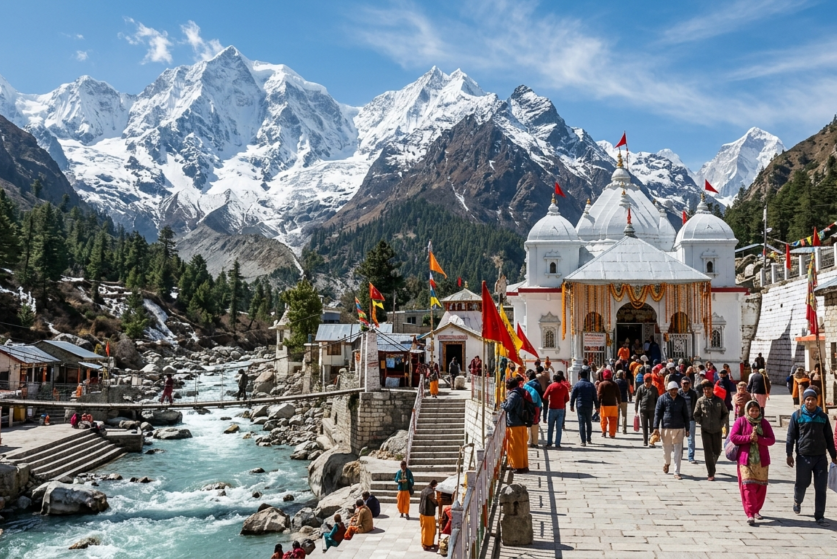
Gangotri Dham, Uttarakhand :- The Sacred Origin of Mother Ganga, History, and Sublime Himalayan Meditation
Detailed History :-
Nestled along the banks of the pristine Bhagirathi River in the Uttarkashi district of Uttarakhand, surrounded by towering, snow-capped Himalayan massifs, Gangotri Dham stands as an irreplaceable pillar of India’s holy Chhota Char Dham pilgrimage circuit. Elevated at an altitude of approximately 3,048 meters (10,000 feet) above sea level, this grand white shrine is entirely dedicated to Goddess Ganga, the river of absolution. According to ancient Hindu scriptural lore, King Bhagiratha of the Suryavanshi dynasty performed intense, thousands-of-years-long austerities on a stone slab at this very site to please Lord Shiva and Mother Ganga. His ultimate goal was to bring the celestial river down to earth to cleanse and liberate the ashes of his 60,000 ancestors who had been consumed by Sage Kapila’s wrathful curse. To break the earth-shattering momentum of Ganga’s celestial descent, Lord Shiva captured her safely within his matted locks. Because of King Bhagiratha’s monumental efforts, the initial glacial stretch of the river is profoundly revered as the ‘Bhagirathi’. Historical records show that the primary stone temple was constructed in the late 18th century by the legendary Gorkha commander Amar Singh Thapa. Later, the royal house of Jaipur systematically renovated the structural layout into the majestic marble complex seen today.
Detailed Architecture :-
The structural design of the Gangotri Temple displays an elegant and minimalist blend of the traditional Katyuri and North Indian temple architectural styles. Constructed using fine white granite blocks and polished marble, the shrine projects an aura of absolute peace and spiritual purity against the dark pine mountains.
- The Main Sanctum and Shikhara :– The pristine white primary structure features a symmetrical layout topped by golden-plated fluted finials (Kalash) and sacred pennants. The inner sanctum (Garbhagriha) houses a beautiful, highly revered gold and silver idol of Goddess Ganga. Flanking the central altar are fine metal images of Goddess Yamuna, King Bhagiratha, Adi Guru Shankaracharya, Sage Jahnu, and Goddess Lakshmi.
- Bhagirath Shila :– Located a few meters from the main platform along the riverbank is the sacred ‘Bhagirath Shila’. This natural rock matrix is worshipped as the exact seat where King Bhagiratha sat during his epic meditations. Pilgrims routinely gather here to offer ancestral Pinda Daan prayers.
- Surya Kund and Gauri Kund :– Directly adjacent to the temple premises are deep rock gorges on the Bhagirathi River known as ‘Surya Kund’ and ‘Gauri Kund’. At these spots, the glacial melt plunges fiercely through narrow stone crevices, generating a deafening, awe-inspiring acoustic roar that leaves travelers mesmerized by nature’s raw power.
Travel Guide & Routes :-
- Entry Ticket & Registration :– Entry and public Darshan within the Gangotri Temple complex are entirely Free. However, aligned with state security regulations, all visiting tourists must complete the official Char Dham Online Registration via the Uttarakhand tourism department web portal to generate their mandatory biometric access passes.
- Visiting Hours & Seasonal Closure :– Due to freezing sub-zero winter temperatures and heavy snow blockades, the temple remains accessible for only six months a year (opening on the auspicious day of Akshay Tritiya in May and closing on Kartik Purnima/Bhai Dooj in November). In winters, the symbolic deity idol is ceremonially carried down to Mukhba Village for continued daily worship. Standard public operational hours run from 6:00 AM to 1:00 PM and reopen from 4:00 PM to 8:30 PM.
- How to Reach :–
- By Air :– The nearest domestic airport infrastructure ends at Jolly Grant Airport (DED) in Dehradun, situated around 265 km away. Rental cars, local utility jeeps, and state transit buses are easily accessible outside the airport terminal to head towards Uttarkashi and Gangotri.
- By Rail :– The primary closest railway terminal points are situated at Rishikesh, Haridwar, and Dehradun. Rishikesh sits roughly 270 km prior to the shrine, a scenic mountain drive of 9 to 10 hours via local mountain transport systems.
- By Road :– Gangotri is directly connected via National Highway 34 (NH-34) with Rishikesh, Dharasu, Tehri, and Uttarkashi town. Unlike Kedarnath, there is no physical mountain trekking required; the well-maintained motorable highway terminates just a few meters from the entrance arches of the temple pavilion.
- Local Flavors & Essential Amenities :– The local local dhabas serve wholesome, strictly vegetarian North Indian mountain meals (steamed rice, lentils, seasonal vegetables, and hot spiced mountain tea). The perimeter bazaar trades in essential containers like copper and plastic cans used to collect holy Ganga water, prayer beads, hand-pressed sandalwood paste, and organic Himalayan herbs.
- Photography Spots :– Taking digital videos or photographs inside the inner sanctum sanctorum remains strictly prohibited. However, visitors can snap magnificent landscape photographs in the outer courtyard with the white Shikhara, along the stone bathing ghats of the roaring Bhagirathi, or against the massive pine-covered mountain backdrops.
Nearby Attractions :-
- Gaumukh Glacier :– Situated a challenging 19 km further up the valley from the temple town, this is the literal geographical source where the Bhagirathi River emerges from the snout of a massive glacier. Accessing this fragile eco-zone demands a mandatory trekking permit from the Forest Department in Uttarkashi.
- Harsil Valley :– Located 25 km before reaching the shrine, this is a stunningly serene, picturesque valley famous for its extensive apple orchards, dense cedar covers, and traditional wooden Himalayan hamlets.
- Mukhba Village :– A peaceful hamlet near Harsil which serves as the official winter seat of Goddess Ganga, where her idol is systematically worshipped during the six months of winter lockup.
- Bhairon Ghati :– Situated roughly 10 km prior to Gangotri, this deep gorge houses an ancient temple of Lord Bhairav. Traditional customs dictate visiting this guardian shrine before entering the main Gangotri town.
Interesting Facts :-
- The Imperishable Ganga Water :– Holy water collected from Gangotri is globally renowned for its self-preserving properties. Scientifically, due to high high-altitude mineral concentrations and trace sulfur elements absorbed from medicinal roots, this water never rots or develops organic impurities even when stored in sealed vessels for decades.
- Gorkha Patronage :– The architectural lineage of this premier Indian shrine points back to Nepalese Gorkha commander Amar Singh Thapa, who commissioned the structural construction during his regional administrative reign out of sheer reverence for Mother Ganga.
- The Submerged Shivling :– During late autumn when the river currents drop drastically, a natural rock-carved Shiva Lingam becomes visible under the water surface near the temple ghats. It marks the legendary spot where Lord Shiva is believed to have stood to receive the celestial river.
Important Questions and Answer :-
Question 1:- Does reaching the Gangotri Temple require long mountain treks on foot?
Answer:– No, unlike Kedarnath or Yamunotri, visiting Gangotri involves zero long trekking routines. A smooth, asphalted national highway goes straight up to the entrance gates of the temple town, making the walk to the main altar a brief, flat 100-200 meter stroll from the vehicular drop-off point.
Question 2:- How far is Gaumukh from Gangotri and what is the process to visit it?
Answer:– Gaumukh is located a steep 19 km trek away from Gangotri. It requires a rigorous mountain trek on foot. Because it falls within the preserved boundary of the Gangotri National Park, visitors must strictly acquire an official ‘Trek Permit’ online or offline from the Forest Department office at Uttarkashi beforehand.
Question 3:– Which are the best operational months to plan a trip to Gangotri?
Answer:– The early summer window of May to June and the post-monsoon autumn stretch of September to October offer the safest weather conditions. The heavy monsoon phase spanning July and August brings high mountain landslide vulnerabilities and should be strictly avoided by travelers.
Author’s Thoughts :-
A pilgrimage to Gangotri Dham cleanses your inner self with a profound sense of natural purity and tranquility. Driving through the aromatic pine forests of Uttarkashi and watching the crystal-blue glacial water of the Bhagirathi River instantly strips away the stress of modern life. Standing at the stone ghats during the evening Aarti while the cold Himalayan winds echo with chants of ‘Har Har Gange’ is an absolute spiritual privilege. If you long to witness the pristine birthplace of Indian spiritual heritage combined with untouched alpine landscapes, scheduling a trip to Gangotri is a journey you must undertake.
“Where the mighty Himalayas open their heart to let a stream of pure compassion flow, that heavenly altar is the true home of Mother Gangotri.”