
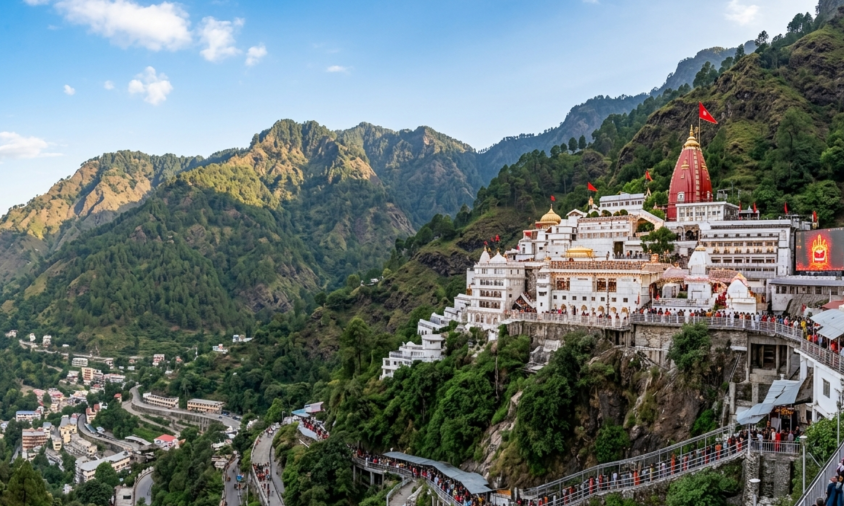
Shri Mata Vaishno Devi Temple, Katra :- The Mystical Cave of Trikuta Mountains, History, and Complete Travel Guide
Detailed History :-
Situated in a serene natural cave on the sacred folds of the Trikuta Mountain range within the Reasi district of Jammu and Kashmir, the Shri Mata Vaishno Devi Temple stands as one of the most revered and spiritually potent Shakti Peethas in Sanatan Dharma. Elevated at an altitude of approximately 1,585 meters (5,200 feet) above sea level, this holy mountain sanctuary is entirely dedicated to Adishakti Mata Vaishno Devi, affectionately addressed by millions of devotees as ‘Mata Rani‘. According to timeless Puranic legends, Goddess Vaishno Devi manifested as a divine maiden named ‘Trikuta‘ through the collective spiritual energies of Goddess Mahakali, Goddess Mahalakshmi, and Goddess Mahasaraswati for the absolute welfare of the universe. When the tantric demon Bhairavnath pursued her with malicious intentions, the Goddess journeyed up the rugged Trikuta hills. Along her path, she shot an arrow into the ground to create the holy stream ‘Banganga‘, paused to glance back at ‘Charanpaduka‘, and performed rigorous meditation for nine months inside the narrow Garbhajun cave at ‘Ardhkuwari‘. Ultimately, inside the main geological cave of the mountain, she assumed her supreme form, decapitated Bhairavnath, and dissolved into three natural rock structures profoundly revered as the Holy Pindis. Historical chronicles document that this ancient cave hideaway was rediscovered roughly 700 years ago by a dedicated local Brahmin priest named Pandit Shridhar, whom the Goddess guided directly via a prophetic dream. Today, the entire pilgrimage infrastructure is professionally administered and developed by the ‘Shri Mata Vaishno Devi Shrine Board’ (SMVDSB).
Detailed Architecture :-
The central sanctum of Mata Vaishno Devi is not an artificial concrete temple complex, but rather a mystical, naturally formed limestone cave nestled deep inside the mountain core. However, to systematically facilitate millions of annual visitors, the Shrine Board has developed extensive modern stone pavilions, plazas, and transit paths around the mountain face.
- The Holy Cave and Three Pindis :– Inside the innermost core of the natural cave (Garbhagriha), there are no conventional human-carved idols. Instead, the focus of worship centers upon three naturally formed stone mounds arising from a singular rock base, known as the ‘Holy Pindis’. Each Pindi uniquely represents a distinct cosmic attribute: to the right rests Mata Mahakali (representing destruction and energy), in the center lies Mata Mahakali (representing wealth and sustenance), and to the left sits Mata Mahasaraswati (representing knowledge and intellect). The unified matrix of these three divine aspects is worshiped as Vaishno Devi.
- Natural and Modern Subways :– The original ancient cave is highly restrictive, narrow, and features an active stream of cold mountain water running through its floor, historically requiring pilgrims to crawl or crouch to cross it. To ensure efficient crowd control, the Shrine Board engineered two spacious modern artificial subways flanking the mountain rock, which serve as dedicated entry and exit tunnels. The historic natural cave is traditionally opened for Darshan only during absolute winter off-peak weeks when daily footfalls are low.
- The Bhawan Complex :– The area encompassing the main temple, known as the Bhawan, features massive multi-story accommodation pavilions, clean public lockers, community kitchens (Langar), and high-tech digital waiting halls, reflecting an exceptional blend of modern civic engineering and crowd management.
Travel Guide & Routes :-
- Entry Ticket & Registration :– Entry and Darshan inside the Vaishno Devi complex are entirely Free. However, every visiting pilgrim must acquire a mandatory Yatra Registration Card (Yatra Parchi) before passing the initial security checkpoints. This pass can be secured offline for free at Katra Railway Station and central bus terminals, or pre-booked online via the official Shrine Board portal (maavaishnodevi.org). The board now issues specialized RFID Cards instead of paper passes, which must be strictly worn around the neck throughout the mountain track.
- Darshan Hours and Holy Aarti :– The main temple complex at the Bhawan operates continuously 24 Hours a day, all year round. Public movement inside the sanctum is temporarily paused only twice daily during the formal morning and evening Attendant Aartis (approximately 5:00 AM to 7:00 AM and 6:00 PM to 8:00 PM).
- How to Reach :–
- By Air :– The nearest functional commercial airport infrastructure ends at Jammu Airport (IXJ), situated roughly 50 km from Katra. Reliable highway taxis, regular local buses, and premium private cabs operate continuously from Jammu to Katra base. Additionally, direct Helicopter Services are run from Katra helipad up to ‘Sanjichhat‘ (located 2.5 km short of the Bhawan), which must be strictly booked via the online board portal well in advance.
- By Rail :– The base city is directly served by the state-of-the-art Shri Mata Vaishno Devi Katra Railway Station (SVDK). This specialized rail terminal is linked directly with major Indian metropolises via express superfast trains. The primary trek checkpoint, Banganga, is a brief 2-3 km ride from the station exit.
- The Trek Route :– The traditional mountain trek begins at the Banganga checkpost and covers approximately 12 to 13 km of paved tracking to reach the main Bhawan. The entire mountain pathway is completely paved with smooth concrete, brilliantly illuminated by overhead halogen lamps, and reinforced with protective tin roof sheds along most curves. For pilgrims physically unable to complete the walk, authorized horses, mules, traditional palanquins, human-pushed wheelchairs, and a modern fleet of Battery Operated Cars (operating from Ardhkuwari to Bhawan) can be hired at standard government-regulated tariffs.
- Local Flavors & Essential Amenities :– To respect the absolute spiritual sanctity of the region, only strictly vegetarian, Satvik food is prepared and served across Katra and the entire mountain trail (even the use of onions and garlic is strictly banned). Widespread institutional langan complexes and hygienic cafes run by the Shrine Board provide hot lentils, steamed rice, flatbreads, and aromatic mountain herbal tea at highly nominal rates. The central markets of Katra are famous for high-quality Walnuts, Almonds, Raisins, and Sun-dried Apples, alongside devotional Chunris, brass artifacts, and hand-woven Kashmiri woolen shawls.
- Photography Spots :– Capturing stunning panoramic photos of the rolling Trikuta mountain ranges and the glittering night view of Katra town is permitted along the open-air walking paths from Banganga to Sanjichhat and Ardhkuwari. However, once you approach the immediate perimeter of the main Bhawan complex, carrying smartphones, digital cameras, leather belts, or any electronic accessories is strictly prohibited; these personal items must be safely locked inside the complimentary cloakrooms provided at the venue.
Nearby Attractions :-
- Bhairav Ghati (Bhairavnath Temple) :– Situated roughly 1.5 to 2 km further up from the main Bhawan on a highly vertical mountain peak. Scriptural tradition states that the Vaishno Devi Yatra remains incomplete unless a devotee pays homage at the Bhairavnath shrine. A modern aerial Passenger Ropeway connects the Bhawan to Bhairav Ghati, safely covering the steep climb in just 3 minutes for a highly nominal fee.
- Ardhkuwari Temple :– Positioned exactly at the midway point (around 6 km) of the trek route. It houses the revered natural ‘Garbhajun Cave‘ through which pilgrims crawl as a symbolic act of spiritual rebirth. This site is highly famous for its extended waiting lines.
- Banganga and Charanpaduka :– The initial baseline landmarks of the journey where the Goddess is believed to have brought forth the holy stream with her arrow and paused on a boulder, leaving her immortal footprints behind.
- Shiv Khori Cave :– Located roughly 80 km away from Katra, this is a spectacular, massive natural cave housing a self-manifested (Swayambhu) stone Lingam of Lord Shiva.
Interesting Facts :-
- Distinct Tones of the Pindis :– Although emerging seamlessly from a single rock mass, the three sacred Pindis exhibit entirely distinct geological colors and textures. The Pindi of Mahakali appears deep black and slightly inclined, the central Pindi of Mahalakshmi features a distinct reddish-yellow hue and forms the largest mound, while the Pindi of Mahasaraswati shows a bright whitish, narrow alignment.
- The Living Holy Spring :– A continuous stream of ice-cold, crystal-clear water naturally bubbles out from beneath the holy cave altar, known as ‘Charanamrit’. Devotees believe that collecting or splashing this sacred mountain water instantly rejuvenates the physical body and strips away traveling fatigue.
- Advanced RFID Monitoring :– The digital RFID card issued to every traveler at the base serves as a real-time GPS tracking grid. This allows the centralized command systems of the Shrine Board to monitor real-time crowd density across individual curves of the mountain trail, ensuring absolute safety and structural crowd management during peak seasons.
Important Questions and Answer :-
Question 1:- Which is the most comfortable and modern path to walk from Katra to the main Bhawan?
Answer:– There are two primary pathways leading up the mountain: the traditional old track (via Ardhkuwari) which features steeper gradients and active mule traffic, and the newer ‘Tarakote Marg’. Tarakote Marg is systematically engineered with highly gentle slopes, wider lanes, and is completely free of animal transport, making it the absolute best, quietest, and most hygienic path for walking pilgrims and senior citizens utilizing manual wheelchairs.
Question 2:– What is the ticket price for the Bhawan-Bhairav Ghati Ropeway and can it be reserved online?
Answer:– The standard ticket for the aerial passenger ropeway to Bhairav Ghati is highly economical, costing just 100 INR per passenger for a one-way transit. This specific service cannot be booked online; pilgrims can easily secure their physical tokens directly from the dedicated offline ticketing counter at the Bhawan after finishing their main Darshan.
Question 3:- When is the ideal and least crowded phase to schedule a trip to Vaishno Devi?
Answer:– The weather remains highly favorable and pleasant from March through November. However, if your primary goal is to bypass heavy crowds and long queues, you should strictly avoid planning your visit during the peak Navratri festivals, New Year’s Eve, and the summer school holiday weeks of June and July. Planning a trip during the peak winter months of January and February brings freezing weather but offers absolute minimal crowds, allowing a relaxed Darshan with a higher chance of crossing the historic natural cave.
Author’s Thoughts :-
A pilgrimage to the holy shrine of Mata Vaishno Devi is far more than a standard high-altitude mountain trek; it is a profound journey of inner willpower and absolute spiritual surrender. The continuous, energetic echo of ‘Jai Mata Di’ rising from the passing crowds of pilgrims instantly acts as a catalyst, infusing even the most exhausted travelers with a unique physical stamina. Standing at the base and looking up at the serpentine mountain pathways glowing with a continuous chain of golden lights at night looks as if the stars themselves have descended onto the Trikuta folds. Passing through the narrow turns of Ardhkuwari and finally bowing your head before the ancient, naturally formed Pindis inside the inner sanctum brings an unparalleled sense of pure mental peace. When the divine call comes from the mountains, a journey to Mata Rani’s court is an absolute must-experience milestone in life.
S “Until the divine Mother extends her silent cosmic invitation, no human can cross the thresholds of the Trikuta hills; but when the call arrives, even the most challenging mountains open up a smooth highway for her children.”