
Shri Amarnath Cave Temple :- The Self-Manifested Ice Lingam, Timeless Legend, and Supreme Himalayan Pilgrimage
Detailed History :-
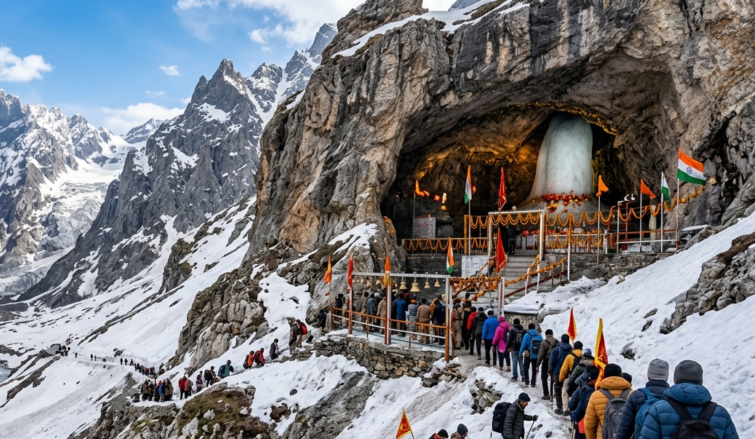
Tucked away amid the daunting, snow-swept heights of the Himalayas in the Anantnag district of Jammu and Kashmir, the Shri Amarnath Cave Temple stands as one of the most ancient, mystical, and profoundly revered pilgrimage shrines in Sanatan Dharma. Elevated at a challenging altitude of approximately 3,888 meters (12,756 feet) above sea level, this natural cavern is dedicated to Lord Shiva, affectionately addressed by millions of devotees as ‘Baba Barfani’. According to timeless Puranic scriptures, this legendary cave is the exact historical setting where Lord Shiva narrated the celestial secrets of immortality and creation—known as the ‘Amar Katha‘—to his consort, Goddess Parvati. To ensure no living creature could overhear this divine secret, Lord Shiva systematically detached his cosmic accessories along the route: he left his sacred bull Nandi at Pahalgam, the crescent moon from his hair at Chandanwari, his snake matrix at Sheshnag, and his son Lord Ganesha at Mahaguna Mountain. Ultimately, he renounced the five material elements at Panchtarni before entering the isolated cavern. Unknown to the deities, a pair of mating doves nesting inside the cave overheard the unbroken narration, attaining absolute immortality. Pilgrims routinely report sighting this legendary pair of white doves near the cave rafters to this day. Historical accounts document that the modern-day rediscovery of this geological hideaway occurred in the mid-15th century by a local Muslim shepherd named Buta Malik, who was gifted a bag of charcoal by a mystic sage that miraculously transformed into solid gold upon reaching his home. Today, this highly sensitive and massive annual pilgrimage is professionally managed by the ‘Shri Amarnathji Shrine Board’ (SASB) under the dense, flawless security grid of the Indian Armed Forces.
Detailed Architecture :-
The structural essence of the Amarnath Shrine is not an artificial monument shaped out of bricks or concrete, but rather a colossal, naturally occurring limestone cavern hollowed out into the rugged mountain rock face over millennia.
- Dimensions of the Cavern :– The historic mountain vault measures roughly 150 feet in height, 90 feet in length, and is approximately as wide, standing as a staggering marvel of natural structural geology.
- The Self-Manifested Ice Lingam :– The defining feature of the cave is its unique, naturally consolidating stalagmitic ice column representing Lord Shiva. Glacial meltwater from the rocky roof slowly trickles drop-by-drop onto a specific stone pedestal, freezing layer-by-layer into a towering, translucent column of solid ice. This stalagmite forms completely naturally without any human intervention.
- The Lunar Correlation :– The structural dimensions of this sacred ice Lingam uniquely wax and wane in direct synchronization with the lunar phases (Lunar Cycle). The frozen column peaks in absolute geometric size and density during the holy Shravan Purnima (coinciding with Raksha Bandhan) before gradually sublimating and disappearing as winter approaches. Flanking the main stalagmite are two smaller seasonal ice formations worshiped as symbols of Goddess Parvati and Lord Ganesha.
Travel Guide & Routes :-
- Registration & Compulsory Health Certificate (CHC) :– Entry and Darshan inside the Amarnath Cave are entirely Free. However, given the hazardous high-altitude conditions and thin atmospheric oxygen levels, every visiting pilgrim must strictly secure a Compulsory Health Certificate (CHC) from a state-authorized medical practitioner. This certificate is mandatory to process the official Yatra Registration Permit online via the board portal (shriamarnathjishrine.com) or designated bank channels. All travelers must strictly wear their digitally tracked RFID Cards around their necks throughout the mountain trail.
- Darshan Timings and Seasonal Window :– Due to extreme sub-zero alpine winter blankets and massive glacier movements, the pilgrimage operations are restricted to a brief annual window of 45 to 50 days during mid-summer (spanning late June or early July until the day of Raksha Bandhan in August). Daily Darshan access inside the cave runs from 5:00 AM to 5:00 PM only; for absolute safety reasons, overnight camping near the immediate cave perimeter is strictly banned by the military.
- How to Reach :– Pilgrims can access the high-altitude cave shrine via two distinctly managed alpine trekking routes:
- The Pahalgam Route (The Traditional Trail) :– The historic, longer, and safer mountain approach. Travelers transit from Jammu or Srinagar to the Pahalgam base. Motor vehicles can access up to Chandanwari, where the primary foot-track begins. The trail loops through steep landmarks including Pissu Top, the high-altitude Sheshnag Lake, and the flat fields of Panchtarni, covering roughly 32 to 36 km of demanding mountain trekking. This route requires 3 days of walking, offering gradual high-altitude acclimatization for the human body.
- The Baltal Route (The Short Trail) :– Approached via Srinagar through the alpine meadows of Sonamarg to reach the Baltal baseline camp. From Baltal, the trail to the cave spans a much shorter 14 km trekking path. However, this path features highly vertical, narrow, and slippery gradients. While it allows agile trekkers to complete the ascent, Darshan, and descent within a single 24-hour cycle, it is physically grueling.
- By Air & Helicopter Access :– The primary nearest international aviation infrastructure ends at Srinagar International Airport (SXR). Premium daily Helicopter Services are systematically run from Baltal (Nilgrath) and Pahalgam directly to the high-altitude Panchtarni helipad. From the Panchtarni drop-zone, the main cave stands a flat 5 to 6 km away, which can be easily managed via foot or local ponies.
- By Rail :– The nearest central rail terminal point links directly to Jammu Tawi Railway Station (JAT), connected extensively to pan-India routes. Luxury buses and security-escorted vehicle convoys ply regularly from Jammu up to the Baltal and Pahalgam base hubs.
- Alternative Transits :– For pilgrims physically unable to sustain the trek, government-regulated horses, mules, traditional manual palanquins, and specialized luggage carriers (pittus) can be hired at standardized fixed tariffs at the base terminals.
- Local Flavors & The Community Kitchens (Langar) :– Along the entire high-altitude alpine trail, massive, highly organized complimentary community kitchens (Langars) set up by non-profit spiritual networks operate around the clock. These specialized camps provide high-calorie, strictly vegetarian, and Satvik meals (including piping-hot lentils, rice, dynamic herbal teas, local Kashmiri Kahwa, dry fruits, and warm spiced milk) completely free of cost to all pilgrims. Due to extreme conditions, commercial restaurants or concrete markets do not exist past the base camps; small temporary stalls trade strictly in safety walking poles and essential high-altitude medications.
- Photography Spots :– To preserve the maximum security and spiritual sanctity of the inner altar, digital cameras and mobile recording inside the inner caverns are strictly prohibited. Nonetheless, visitors can document spectacular, once-in-a-lifetime alpine landscapes along the track, such as the ice-sheeted parameters of Sheshnag Lake, the dramatic river crossings at Panchtarni, and the vast moving valley glaciers.
Nearby Attractions :-
- Sheshnag Lake :– A stunning, deep-blue oligotrophic alpine lake nestled along the Pahalgam trail, flanked by seven spectacular snow-clad peaks that geometrically resemble the mythical multi-headed cosmic serpent, Sheshnag.
- Sonamarg & Thajiwas Glacier :– Situated close to the Baltal highway, this breathtaking destination is celebrated as the ‘Meadow of Gold’, famous for its accessible alpine glacier slates.
- Martand Sun Temple :– Located near Anantnag town, this 8th-century archaeological marvel features dramatic stone ruins showcasing the classic Kashmiri architectural golden era.
- Pahalgam (The Valley of Shepherds) :– A world-famous, idyllic valley perched along the gushing Lidder River, famous for the pristine landscapes of Betaab Valley and Aru Valley.
Interesting Facts :-
- The High-Altitude Sighting of Doves :– In a freezing alpine cave environment where sub-zero thermal drafts and thin air make animal survival biologically impossible, the consistent presence of a pair of white mountain doves inside the cave remains a deeply enigmatic spiritual phenomenon.
- The Structural Density of the Lingam :– While the external snowfall and surrounding valley ice remain soft, powdery, and loose, the ice forming the holy stalagmite inside the cave is incredibly dense, glass-like, and hard, matching the structural properties of ancient glacial ice sheets.
- A Cultural Legacy of Harmony :– Reflecting India’s deep roots of communal harmony, the descendants of the original finder, Buta Malik, traditionally received a fixed percentage of the annual temple offerings for generations, marking a beautiful chapter of local cross-cultural respect.
Important Questions and Answer :-
Question 1:- For a first-time pilgrim, which route is scientifically better: Pahalgam or Baltal?
Answer:– If time is a severe constraint and you possess superior cardio-respiratory endurance, the Baltal Route (14 km) lets you wrap up the journey rapidly. However, if you are traveling with family or desire a safe journey with less physical strain, the Pahalgam Route is highly recommended; its gradual inclination minimizes the risk of Acute Mountain Sickness (AMS) by giving your body ample time to acclimatize.
Question 2:- What is the cellular network connectivity standard across the Amarnath trekking trails?
Answer:– Due to high-security border regulations, standard pre-paid cellular connections registered outside Jammu and Kashmir automatically deactivate upon entry. Only post-paid networks, predominantly managed by BSNL, offer reliable cellular connectivity along the high-altitude trails. Temporary pre-verified Yatra SIM cards can be procured directly at the base camps via valid registration credentials.
Question 3:– Can pilgrims camp or secure overnight stay tents directly outside the Amarnath Cave?
Answer:– No, structural camping or overnight stays are strictly prohibited in the immediate vicinity of the main cave due to intense sub-zero drops and avalanche vulnerabilities. After completing Darshan, pilgrims must descend to the high-altitude transit station at Panchtarni (6 km prior) or head back to Baltal, where the Shrine Board organizes extensive waterproof commercial tent-pods with warm bedding.
Author’s Thoughts :-
Completing the arduous journey to the holy cave of Shri Amarnathji is far more than a standard travel milestone; it is a transformative testament to human willpower and divine grace. Walking along the edge of towering cliffs where the thin mountain air echoes with synchronized chants of ‘Bam Bam Bhole’ completely overrides physical exhaustion with raw spiritual adrenaline. Witnessing that pure, self-formed ice stalagmite inside the massive limestone cavern instantly invokes a profound silence within your soul, connecting you to the timeless energies of Mahadev. It is a legendary odyssey that changes your inner perspective on life forever.
“Where the physical world surrenders to the sheer power of ice and altitude, the eternal realm of Baba Barfani reveals its silent majesty.”