
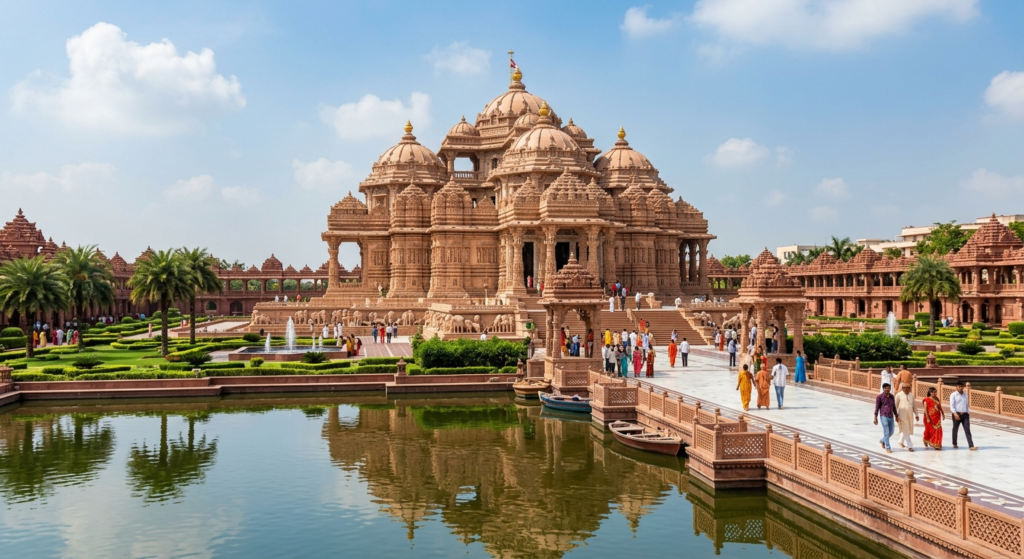
Swaminarayan Akshardham Temple, New Delhi :- The Grand Synthesis of Indian Culture, Ancient History, and Modern Architectural Marvel
Detailed History
Perched gracefully along the scenic banks of the Yamuna River in India’s capital metropolis, New Delhi, the Swaminarayan Akshardham Temple stands as one of the most colossal, majestic, and structurally unparalleled cultural complexes engineered in the modern era. The literal translation of ‘Akshardham‘ denotes ‘The Divine Abode of the Almighty’. This monumental sanctuary is entirely dedicated to Bhagwan Swaminarayan (1781-1830) and the timeless heritage, ancient rishis, arts, and values of Indian civilization. The colossal conceptualization and formatting of this complex were systematically driven under the divine inspiration and meticulous guidance of Param Pujya Pramukh Swami Maharaj, the then spiritual lineage head of the Bochasanwasi Akshar Purushottam Swaminarayan Sanstha (BAPS). Bringing this massive artistic blueprint to life required the selfless dedication of over 11,000 expert stone artisans, master sculptors, and thousands of volunteer sevadars. Constructed in a record breaking timeframe of just 5 years, the grand complex was officially dedicated to the nation on November 6, 2005, in the presence of the then President Dr. A.P.J. Abdul Kalam and Prime Minister Dr. Manmohan Singh. In 2007, its sprawling layouts were formally entered into the Guinness Book of World Records as the ‘World’s Largest Comprehensive Hindu Temple’.
Detailed Architecture :-
The dynamic structural blueprint of Delhi’s Akshardham Temple represents a phenomenal, high-precision fusion of ancient Indian temple stone crafts—specifically the Nagara, Katyuri, and Dravidian architectural formats. The defining engineering breakthrough of this massive monument lies in the absolute fact that no structural steel, commercial concrete, or iron binding elements were used anywhere in its primary construction.
- The Main Monument :– The central temple stands an imposing 141 feet high, 316 feet wide, and 356 feet long. It is carved entirely out of premium Rajasthani pink sandstones and pure white Italian Carrara marble. The external facades are covered from base to crown with ultra-fine relief carvings of historical sages, cosmic deities, celestial dancers, and native flora. The structure holds 234 extensively carved stone pillars, 9 majestic structural domes, and over 20,000 individual statues.
- The Gajendra Peth (The Elephant Base) :– Forming the structural foundation of the central monument is the massive ‘Gajendra Peth’, designed to commemorate the spiritual and cultural historical significance of the elephant in Indian folklore. It showcases 148 life-sized carved stone elephants arranged in sequence, weighing thousands of tons collectively.
- The Narayan Sarovar :– Encircling the central core is a highly sacred water grid named ‘Narayan Sarovar‘. This perimeter reservoir holds the consecrated waters fetched directly from 151 sacred rivers and lakes across India (including the Ganga, Yamuna, and Mansarovar Lake). Flanking its banks are 108 stone cow-mouth spouts (Gaumukhs), symbolizing the 108 holy names of the divine.
Travel Guide & Routes :-
- Entry Ticket and Basic Regulations :– Entry inside the Akshardham Temple complex grounds and accessing the primary deity shrine for Darshan is completely Free. However, exploring the specialized high-tech indoor Exhibitions and witnessing the evening Multimedia Water Show requires purchasing dedicated nominal tickets from the inner service counters. Security measures at the gates are exceptionally stringent. Carrying smartphones, digital cameras, remote-controlled car keys, USB drives, tobacco, or any electronic equipment inside is strictly prohibited. Visitors must safely deposit all personal belongings at the extensive, highly secure, and completely free cloakroom (custody counter) managed at the main entry plaza.
- Operational Hours and Weekly Closure :– Akshardham Temple is strictly Closed to visitors on Mondays. From Tuesday through Sunday, the daily entry gates operate from 10:00 AM to 6:30 PM (last entry), while the temple illumination and grounds remain active until 8:00 PM to 9:00 PM.
- How to Reach :–
- By Metro (The Absolute Best Route) :– The complex features a dedicated transit node via the ‘Akshardham Metro Station’ located on the Blue Line of the Delhi Metro network. Upon exiting the station terminal, the main entry gate of the temple sits barely a 5-minute flat walk (around 300 meters) away.
- By Air :– The closest domestic and international aviation hub ends at Indira Gandhi International Airport (DEL), positioned around 22 km from the temple. From the airport gates, visitors can access the temple rapidly via prepaid highway taxis or the high-speed Airport Express Metro Line (switching to the Blue Line terminal at Rajiv Chowk).
- By Rail :– The monument stands roughly 11 km from New Delhi Railway Station (NDLS) and a swift 6 km from Hazrat Nizamuddin Station. High-frequency auto-rickshaws, public buses, and app-based cabs (Ola/Uber) service both terminals around the clock.
- Local Flavors and The Premvati Food Court :– For absolute hygiene and security reasons, outside food packages are restricted at the gate. However, inside the grounds stands the ‘Premvati Food Court’, a colossal, impeccably maintained vegetarian food plaza. It caters to tourists with highly affordable, 100% pure vegetarian, and Satvik culinary delicacies (ranging from crisp South Indian Dosa and complete North Indian platters to hot samosas, street chaat, and specialized herbal wellness teas).
- The Central Souvenir Bazaar :– Nestled near the exit path is an extensive official gift emporium (Akshardham Souvenir Shop). This counter trades in authentic historical literature, fine brass castings of Bhagwan Swaminarayan, specialized Ayurvedic medicines, certified organic wellness goods, and premium stone-carved replicas of the temple architecture.
- Photography Logistics :– Because carrying smartphones or cameras inside the perimeter is fully restricted, personal mobile photography is impossible. To facilitate visitors, the board manages an Official Souvenir Photography Counter inside the main lawns. Professional staff photographers will frame your family portrait against the spectacular backdrop of the pink stone monument and deliver a premium high-gloss physical print within minutes for a highly nominal fee.
Major Exhibition Attractions :-
Akshardham is designed as an immersive educational center rather than a standard temple. Exploring its three world-class indoor exhibitions takes about 3 to 4 hours of dedicated time:
- Sahajanand Darshan (Hall of Values) :– This exhibition utilizes advanced life-like animatronics (robotic human figures), high-definition stereophonic sound, and precision light scripting to narrate highly immersive, moral short stories based on Bhagwan Swaminarayan’s life, focusing on non-violence, truth, and family values.
- Neelkanth Darshan (Giant Screen Film) :– Projected inside a custom mega-theatre complex, this captivating cinematic feature tracks the real-life epic 12,000 km barefoot expedition undertaken across the Indian subcontinent by an 11-year-old child yogi named ‘Neelkanth Varni’ (the childhood name of Bhagwan Swaminarayan).
- Sanskriti Vihar (The Cultural Boat Ride) :– A spectacular 15-minute indoor boat cruise where visitors sail down an artificial indoor river. The boat glides past life-sized interactive setups recreating 10,000 years of Indian heritage, showcasing the ancient Takshashila University, Vedic lifestyles, ancient astronomical models, and pioneering discoveries by master scientists like Aryabhata and Sushruta.
- Sahaj Anand Water Show (Musical Fountain) :– An absolute highlight that starts immediately after sunset, rated as Asia’s finest multi-media fountain grid. It utilizes colossal dancing water jets, multi-colored lasers, surround sound orchestrations, and advanced video-on-water projection mapping to stage an ancient Vedic tale from the Kena Upanishad focusing on ‘Nachiketa and the Lord of Death’ onto a massive curtain of mist.
Interesting Facts :-
- The Structural Interlocking Mystery :– It remains an absolute fascination for civil engineers that this massive multi-story stone mountain stands perfectly stabilized without a single pound of structural cement or reinforcing iron beams. The entire matrix relies solely on the ancient Indian ‘Interlocking System‘, where precision-grooved stones lock into each other like a giant jigsaw puzzle designed to last for millennia.
- The Guinness Benchmark :– The official evaluation panels of the Guinness World Records mapped its extensive layout covering 86,342 square feet of intricate stone landscaping, mathematically validating it as a unique global milestone for modern religious infrastructure.
- Geographical Unity in a Lake :– The intentional blending of water drawn from 151 unique geographical points across the Indian subcontinent into the Narayan Sarovar symbolizes a profound physical and spiritual map of India’s integrated natural landscape.
Important Questions and Answer :-
Question 1:– What is the optimal time budget required to experience Akshardham Temple and its indoor zones fully?
Answer:– If your visit is strictly focused on accessing the main temple for deity prayers, 1 to 1.5 hours is completely sufficient. However, if you plan to experience the three indoor interactive halls (Cultural Boat Ride, Animatronics Theatre, Mega-screen Movie) along with the evening laser fountain show, you should strictly budget a time window of at least 4 to 5 hours.
Question 2:– Are there manual wheelchairs available for elderly visitors inside the complex, and what are the rental fees?
Answer:– Yes, the BAPS management provides highly comfortable Complimentary Wheelchairs (Free of Cost) for senior citizens and physically challenged individuals. Visitors can easily secure a wheelchair right past the central security check zone by presenting a valid identity card and placing a fully refundable nominal security deposit.
Question 3:- How can one secure tickets for the evening Musical Water Show and what are the schedules?
Answer:– The Sahaj Anand Water Show launches promptly post-sunset (typically around 7:15 PM in summers and shifting to 6:30 PM during winter weeks). These tickets cannot be booked online or from outside the gates; you must buy your physical show passes directly from the internal exhibition ticketing booths located inside the main courtyard.
Author’s Thoughts :-
Visiting New Delhi’s Akshardham Temple is not merely a religious tour; it is a profoundly immersive encounter with the deep artistic intellect and historical magnitude of ancient India. Gliding down the artificial river during the Cultural Boat Ride and seeing our ancient universities and scientific lineages come to life invokes a deep sense of cultural pride. As twilight sets in and the golden floodlights cast long shadows across the pink sandstone reliefs while the fountains dance to Vedic rhythms, the atmosphere becomes entirely magical. The complete digital detachment enforced by the strict restriction on mobile phones acts as a brilliant blessing, allowing your mind to absorb the deep serenity of the gardens without distraction. For anyone traveling through or residing in the national capital, this masterwork of modern engineering and timeless heritage is an indispensable experience.
“Where every precision cut in the pink stone echoes the glorious narratives of ancient sages, and modern architecture bows in absolute reverence to timeless spirituality, the empire of Swaminarayan Akshardham stands supreme.”