
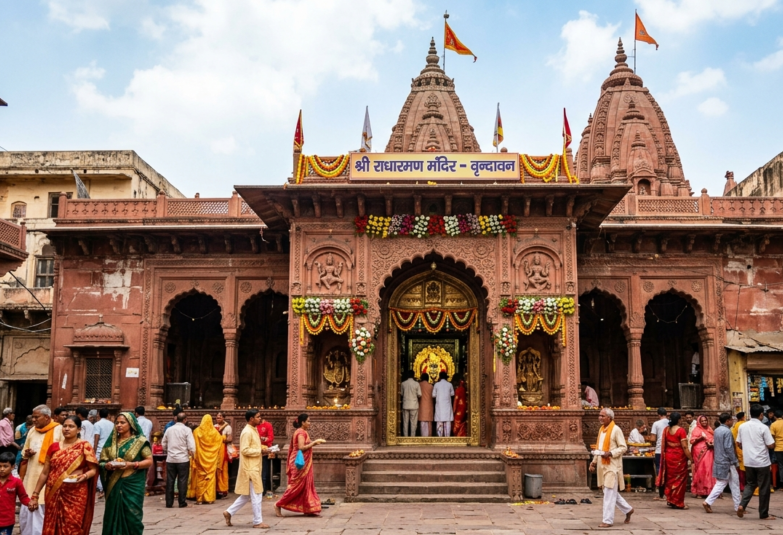
Shri Radha Raman Temple Vrindavan :- History, Mysteries, and Complete Travel Guide
Here is the detailed English translation of the blog based on the sacred and historical journey to Sri Radha Raman Temple, Vrindavan (Mathura).
Detailed History
Shri Radha Raman Temple is one of the seven ancient and most sacred Thakur shrines in Vrindavan. The temple was established in the year 1542 (on Vaishakha Purnima) by Sri Gopala Bhatta Goswami, a revered saint of the Gaudiya Vaishnava tradition.
According to sacred history, Shri Gopala Bhatta Goswami brought 12 Shaligram Shilas from the Gandaki River in Nepal to Vrindavan. He constantly cherished a deep desire in his heart to behold the divine form of Lord Krishna. A wealthy merchant once gifted him fine clothes and ornaments for the deity, but those garments could not be adorned on the spherical Shaligram Shilas. Overwhelmed with emotion, Goswami Ji prayed intensely to the Lord. On the morning of Vaishakha Purnima, when he lifted the basket covering the Shilas, he discovered that the ‘Damodara Shaligram Shila’ had self-manifested into the enchanting, smiling form of Shri Radha Raman Ji in the iconic Tribhanga posture.
Another unique mystery of this temple is that an eternal sacred fire has been burning continuously in its kitchen for over 500 years without the use of matchsticks or modern tools, and it is used exclusively to prepare the holy daily offerings (Prasadam) for the Lord.
Detailed Architecture :-
- Exterior Architecture :– The temple is constructed using red sandstone in traditional medieval Rajasthani and Hindu architectural styles (Shikharbaddha style). To safeguard it from invasions during the Mughal era, the main entry was designed within narrow residential lanes leading to a modest, sturdy courtyard, giving it the appearance of an ordinary home-shrine from the outside.
- Interior Architecture :– The sanctum sanctorum (Garbhagriha) features intricate craftsmanship with delicate floral carvings on marble and stone. Placed at the center is the mesmerizing 12-inch self-manifested deity of Sri Radha Raman Ji, featuring a captivating, gentle smile on His face.
- Presence of Sri Radha Rani :– A distinctive feature of this temple is that there is no separate deity of Sri Radha Rani installed alongside Lord Krishna. Instead, a sacred throne and crown are placed to the left of Sri Radha Raman Ji to symbolize the divine presence of Sri Radha Rani. Behind the main complex lies the Samadhi of Sri Gopala Bhatta Goswami and the preserved Kaupin (garment) of Sri Chaitanya Mahaprabhu.
Travel Guide & Routes :-
- Entry Fee :– Free (There are no ticket charges or VIP passes).
- Timings :–
- Morning:- 08:00 AM to 12:30 PM
- Evening:- 06:00 PM to 08:00 PM (Winters) / 09:00 PM (Summers)
- Mangala Aarti:- 05:00 AM (Summers) / 05:30 AM (Winters)
- How to Reach :–
- By Train :– The nearest major railway station is Mathura Junction (approx. 14 km). Local auto-rickshaws, e-rickshaws, or taxis are readily available from there to Vrindavan.
- By Road :– Vrindavan is easily accessible via NH-19 and the Yamuna Expressway from Delhi and Agra. The temple is about 1–2 km from the Vrindavan Bus Stand. Due to narrow lanes, vehicles must be parked outside, and visitors can reach the temple on foot or via e-rickshaws.
- By Air :– The nearest international airport is Indira Gandhi International Airport, New Delhi (approx. 150 km), and the nearest domestic airport is Agra (approx. 72 km).
- Photography Spots :– Photography and videography inside the temple premises and in front of the sanctum are strictly banned. You can capture memories in the surrounding ancient lanes and near Keshi Ghat.
- Local Flavors & Famous Markets :– Do not miss tasting Vrindavan’s famous Peda, Makkhan-Mishri, Rabri, and hot Kachori-Sabzi in the nearby lanes. You can shop for wooden rosary beads, brass brassware, deity dresses, and handicrafts at the nearby Shahji Temple Road and Keshi Ghat Market.
Interesting Facts
- Self-Manifested Deity :– The deity of Sri Radha Raman Ji was not carved by any sculptor; it self-manifested naturally from a sacred Shaligram Shila.
- 500-Year-Old Eternal Flame :– The temple kitchen has kept a single sacred fire burning continuously for over 500 years to cook the daily holy feast.
- Symbolic Form of Sri Radha :– This is a rare shrine in Vrindavan where Radha Rani is worshipped through Her sacred crown and throne rather than a physical idol.
Important Questions and Answer :-
Question 1:- Is there any entry fee to visit Radha Raman Temple?
Answer:- No, entry and darshan at Sri Radha Raman Temple are completely free of cost.
Question 2:- What is the best time to visit Radha Raman Temple?
Answer:- The winter months from October to March offer the most pleasant weather. Additionally, attending the early morning Mangala Aarti provides a deeply spiritual experience.
Question 3:- Are mobile phones or cameras allowed inside the temple?
Answer:- You may carry your mobile phone, but taking photos or recording videos inside the temple courtyard and sanctum is strictly prohibited.
Nearby Attractions
- Keshi Ghat :– Situated very close to Radha Raman Temple along the banks of the Yamuna River, this historical ghat is famous for its evening Aarti and peaceful boat rides.
- Shahji Temple :– Located nearby, this temple is renowned for its magnificent marble pillars, Belgian glass chandeliers, and striking architectural elegance.
- Sri Gopinath Ji Temple :– Another ancient shrine of the Gaudiya Vaishnava lineage located in the same area, offering a serene and devotional atmosphere.
- Nidhivan :– A short distance from the temple, Nidhivan is the sacred forest where, according to belief, Lord Krishna and Radha Rani perform Raasleela every night.
Author’s Thoughts
A pilgrimage to Vrindavan remains incomplete without experiencing the divine darshan of Sri Radha Raman Ji. Entering this temple fills the heart with an indescribable sense of peace and devotion. Far from grand pomp and overwhelming crowds, the atmosphere here immerses you in pure spiritual bliss. The sweet, smiling face of the 12-inch deity captivates every visitor. If you are planning a trip to Vrindavan, make sure to sit quietly in prayer for a few moments during the morning Mangala Aarti or evening Darshan.
“Where Radha Raman Himself emerged from the sacred Shaligram, that holy land is Vrindavan—the ultimate abode of devotion.”