
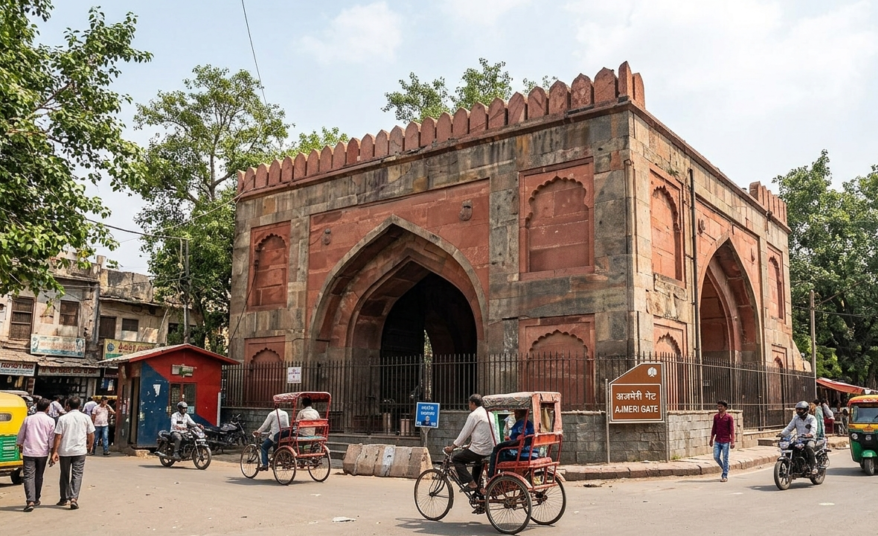
Ajmeri Gate :- History, Architecture, and Travel Guide (Delhi & Jaipur)
Detailed History
In India’s rich historical landscape, two famous landmarks share the name ‘Ajmeri Gate’. The first is the historic Ajmeri Gate in Delhi, built in 1644 by the Mughal Emperor Shah Jahan as part of the defensive wall of Shahjahanabad (Old Delhi). The second is located in Jaipur (Pink City), constructed in 1727 AD by Maharaja Sawai Jai Singh II during the founding of the planned city.
Both gates were named ‘Ajmeri Gate‘ because the roads originating from them led directly toward the historic city of Ajmer in Rajasthan. Delhi’s Ajmeri Gate played a pivotal military and strategic role during the Mughal rule and the First War of Independence in 1857. Similarly, Jaipur’s Ajmeri Gate functioned as a key entry portal for merchants, royals, and travelers arriving from the western trade routes.
Detailed Architecture
Delhi’s Ajmeri Gate :–
Constructed using red sandstone and heavy rubble masonry, the gate features classic Mughal design elements. It boasts a grand central pointed archway flanked by semi-octagonal protective bastions on both sides, topped with traditional battlements.
Jaipur’s Ajmeri Gate :–
Jaipur’s gate reflects an exquisite blend of traditional Rajput and Indo-Saracenic architectural styles. Made with pink sandstone and lime plaster, the top of the gate is adorned with decorative pavilions (chhatris), elegant jharokhas (balconies), and intricately carved stone lattices (jalis). At night, the illuminated gate displays a striking heritage charm.
Travel Guide & Routes
- Ticket Fee :– Free Entry (Public Heritage Monument)
- Timings :– Open 24 Hours (Daytime visits recommended for sightseeing)
- How to Reach :–
- Delhi Ajmeri Gate :– The nearest metro station is New Delhi Metro Station (Yellow Line / Airport Express Line), located just a 5-minute walk away. It is directly opposite the Ajmeri Gate exit of New Delhi Railway Station. Easily accessible by auto-rickshaws or cabs.
- Jaipur Ajmeri Gate :– The nearest metro station is Chhoti Chaupar or Ajmeri Gate Metro Station. It takes about 10–15 minutes by auto-rickshaw or e-rickshaw from Jaipur Junction Railway Station or Sindhi Camp Bus Stand.
- Photography Spots :– Front elevation of the high archways, night view under decorative city lights, and surrounding street life.
- Local Food :–
- In Delhi:- Authentic Mughlai cuisine near Jama Masjid, Paranthas, and Rabri-Falooda.
- In Jaipur:- Kulhad Lassi on M.I. Road (Lassiwala), Pyaaz Kachori, and Ghewar.
- Famous Bazaars :–
- Delhi:- Chawri Bazar, Nai Sarak, and Khari Baoli.
- Jaipur:- Bapu Bazar, Nehru Bazar, and Kishanpole Bazar.
Interesting Facts
- Delhi’s Ajmeri Gate gives its name to the famous Ajmeri Gate side entrance of New Delhi Railway Station.
- It is one of the only 5 surviving original gates out of the 14 built around Shahjahanabad.
- Jaipur’s Ajmeri Gate is an integral part of the UNESCO World Heritage Walled City ensemble.
- Historically, the heavy wooden doors of Jaipur’s gate were closed at sunset for city security.
Important Questions and Answer :-
Question 1:- Is there an entry fee to visit Ajmeri Gate?
Answer:– No, visiting Ajmeri Gate in both Delhi and Jaipur is completely free.
Question 2:- Which metro station is closest to Delhi’s Ajmeri Gate?
Answer:– New Delhi Metro Station (Yellow Line) is the closest metro station.
Question 3:- What are the famous markets near Jaipur’s Ajmeri Gate?
Answer:– Bapu Bazar, Nehru Bazar, and Kishanpole Bazar are located right next to Ajmeri Gate in Jaipur.
“Ajmeri Gate is not merely a structure of stone, but a timeless bridge connecting royal heritage with the vibrant pulse of modern India.”