
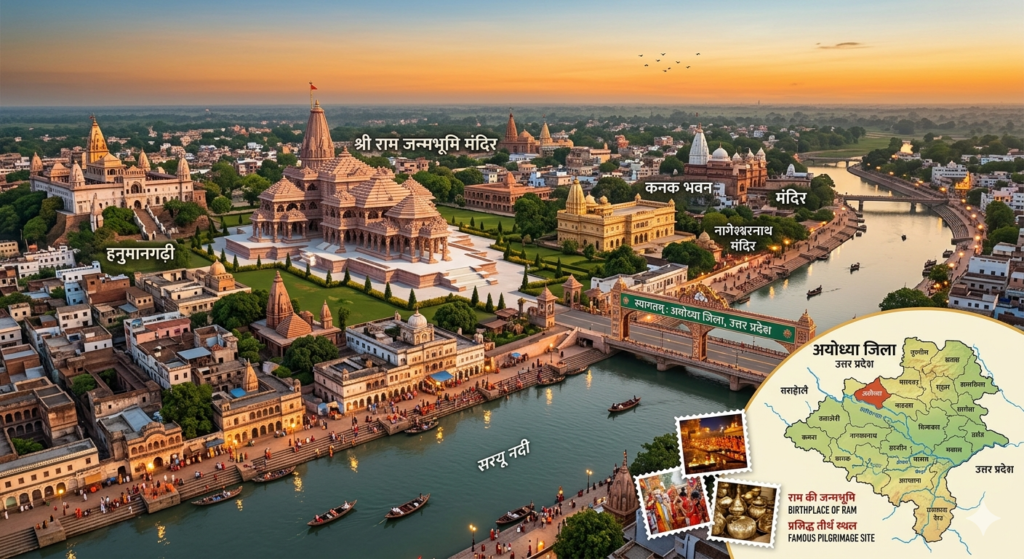
The City of Lord Rama :- A Complete Guide to Ayodhya Dham
Detailed History
Situated on the sacred banks of the Saryu River, Ayodhya is one of the oldest and holiest cities in the world. According to mythology, the city was established by Manu himself. It served as the capital for the kings of the Ikshvaku dynasty, including Lord Rama. The name ‘Ayodhya‘ means ‘that which cannot be conquered by war.’ It is the first of the seven sacred cities (Sapta Puri). Historically, it was the capital of the Kosala Kingdom and flourished under various empires like the Guptas and Mauryas. After centuries of struggle, the newly built Shri Ram Janmabhoomi Temple has re-established it with a new global grandeur.
Detailed Architecture
- Exterior Architecture :– The Shri Ram Janmabhoomi Temple is a masterpiece of the ‘Nagara style.’ It uses pink sandstone from Bansi Paharpur, Rajasthan. The temple features five pavilions (mandapas) adorned with intricate carvings. Kanak Bhawan boasts a grand structure resembling Rajasthani palaces. Hanuman Garhi is built like a fortress with high ramparts and massive gateways. The Ram Ki Paidi ghats are a beautiful blend of ancient and modern hydraulic engineering.
- Interior Architecture :– The inner sanctum of the Ram Temple is crafted with white Makrana marble. More than 360 deities are carved onto the pillars and walls. The interior of Kanak Bhawan features gold-like paintings and fine glasswork. The Nageshwarnath Temple has a traditional Shiva temple layout, where the coolness of the stones provides spiritual calm. Museums in Ayodhya house ancient idols and inscriptions reflecting its rich artistic heritage.
Travel Guide & Routes :-
- Tickets and Timing :– Entry to Ram Mandir and Hanuman Garhi is free. The temple is open from 6:30 AM to 9:30 PM. Aarti passes can be obtained online or at the counters.
- How to Reach :–
- Rail :– Ayodhya Dham Junction (AY) and Ayodhya Cantt are major stations connected nationwide.
- Road :– Located on the Lucknow-Gorakhpur Highway, easily accessible via state buses and private taxis.
- Air :– Maharishi Valmiki International Airport, Ayodhya Dham is now fully operational.
- Photography Spots :– Ram Ki Paidi (at night), Lata Mangeshkar Chowk (The Veena), and sunset at the Saryu Ghats.
- Local Taste :– ‘Kachori-Sabzi,’ ‘Rabri,’ and the famous ‘Hanuman Garhi Laddus’ offered as Prasad.
- Famous Markets :– Tehri Bazaar and the main temple road for sandalwood, religious beads, and Ram-nami shawls.
Nearby Attractions
- Hanuman Garhi :– A grand fortress-temple of Lord Hanuman, the protector of Ayodhya.
- Kanak Bhawan :– The golden palace of Mother Sita and Lord Rama.
- Saryu River & Ram Ki Paidi :– Where devotees bathe and watch the grand laser show in the evening.
- Gulab Bari & Bahu Begum ka Maqbara :– Historical monuments from the era of the Nawabs near Ayodhya.
- Nandigram (Bharat Kund) :– The place where Bharat performed penance during Rama’s exile.
Interesting Facts
- The Ram Mandir in Ayodhya is considered the third largest Hindu temple in the world.
- No iron or steel has been used in the temple’s construction to ensure it lasts for thousands of years.
- According to belief, one must visit Hanuman Garhi and seek permission before visiting the Ram Temple.
- The Saryu River is believed to have originated from the eyes of Lord Vishnu.
- Ayodhya houses a ‘Tulsi Udyan’, where Saint Tulsidas is said to have written parts of the Ramcharitmanas.
Important Questions and Answer :-
- Question :- Best time to visit Ayodhya? Answer:– Between October and March. The ‘Deepotsav’ during Diwali is world-famous.
- Question :- Is online booking mandatory for Ram Mandir? Answer:– Not for general darshan, but recommended for special Aartis.
- Question :- Which is the main railway station? Answer:– Ayodhya Dham Junction (AY) is the primary and most modern station.
- Question :- Is boating available in Saryu River? Answer:– Yes, both traditional boats and modern cruises are available.
- Question :- What is the distance between Ram Janmabhoomi and Hanuman Garhi? Answer:– They are within walking distance (approx. 1 km).
Writer’s Perspective :-
My visit to Ayodhya was more than just a tour; it was a spiritual awakening. As you step onto the ‘Ram Path,’ the echoes of ‘Jai Shri Ram’ and the scent of incense transport you to another realm. My personal experience says that Ayodhya is transforming—the confluence of ancient faith and modern infrastructure is incredible here. During the Saryu Aarti, when thousands of lamps are lit, the sight is etched into the eyes forever. As a blogger, I suggest you don’t just visit for a day; stay for at least two days to feel the dawn Aarti and the night-time glow of Ayodhya. The local Kachori and Rabri will make your journey even sweeter.
“Where devotion meets grandeur and the Saryu flows serene, Ayodhya is the most divine city ever seen.”