
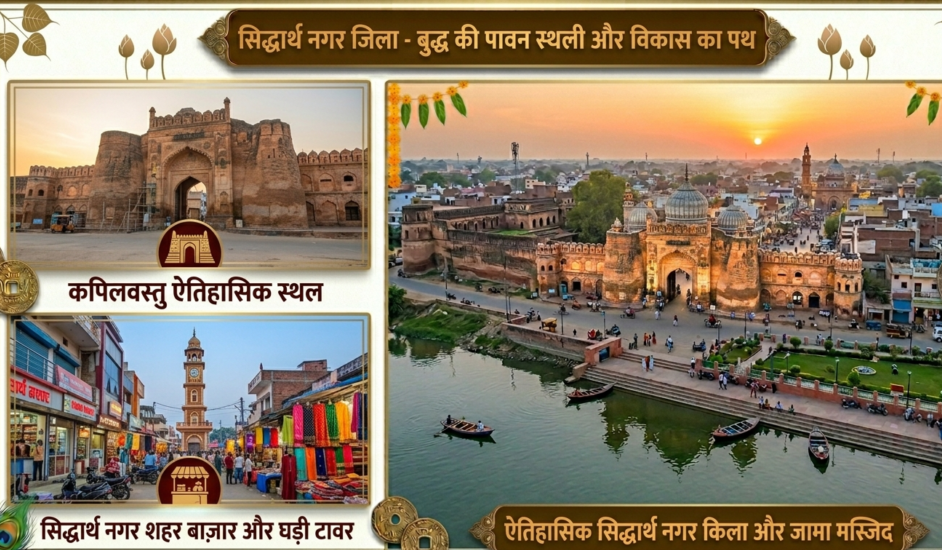
Siddharth Nagar :- The Childhood Abode of Buddha and Glory of Ancient Kapilvastu
Detailed History
Siddharth Nagar is an immensely historical and spiritual district located in the Terai region of Uttar Pradesh. The district is named after ‘Siddharth‘, the childhood name of Lord Buddha. Historically, this region was part of ‘Kapilvastu‘, the capital of the ancient Shakya Republic, ruled by King Suddhodana. Lord Buddha spent the first 29 years of his life here, witnessing royal life before embarking on his search for truth. It was established as a separate district from Basti on December 29, 1988. Today, the district is not only a center of faith for Buddhist pilgrims but its fertile land is world-famous for ‘Kala Namak Rice’ (often called the ‘Gift of Buddha’).
Detailed Architecture
The architecture of Siddharth Nagar is a confluence of the simplicity of ancient stupas and the artistry of Buddhist-style monasteries.
- Exterior Architecture :– The main attraction, the stupa at ‘Piprahwa’, is built of ancient bricks, reflecting the construction styles of the Maurya and Kushan periods. Modern Buddhist monasteries feature golden spires, slanting roofs, and statues depicting the life of Buddha. The Siddharth University and government buildings display modern architecture suited to the regional climate.
- Interior Architecture :– The excavated chambers and structures at Piprahwa Stupa testify to the advanced engineering of ancient times. New Buddhist Viharas house vast meditation halls where the walls are beautifully inscribed with the teachings of Buddha and symbols of peace. The interior decor prioritizes tranquility and simplicity.
Nearby Attractions
- Piprahwa (Kapilvastu) :– The place where the family of Shakyamuni Buddha lived. It contains remains of the ancient palace and a massive stupa.
- Ganwaria :– Located near Piprahwa, this site is identified as the palace of King Suddhodana. The excavated remains are of great significance to history enthusiasts.
- Siddharth University (Kapilvastu) :– A major center for modern education and research with an impressive building.
- Bharat Bhari Temple :– An ancient Hindu temple and sacred pond where, according to mythology, King Bharat rested.
- Yogmaya Temple :– Located in Dumariyaganj, this temple is a major center of faith for local people.
Travel Guide & Routes
- Tickets and Timings :– There is a nominal entry fee for Piprahwa (ASI site) for Indian tourists. Entry to Buddhist monasteries and temples is Free. The ideal time to visit is from 8:00 AM to 5:00 PM.
- How to Reach :–
- By Rail :– Siddharth Nagar (Naugarh) railway station is connected to major cities. Gorakhpur (approx. 80 km) is a major junction connected across India.
- By Road :– The district is well-connected by road to Basti, Gorakhpur, and the Nepal border (Sonauli). Regular buses and taxis are available from Gorakhpur.
- By Air :– The nearest airport is Mahayogi Gorakhnath Airport (Gorakhpur). Kushinagar International Airport is also accessible.
- Photography Spots :– Sunset view at Piprahwa Stupa, ancient remains of Kapilvastu, and the lush green fields of Kala Namak rice.
- Local Taste :– Do try the ‘Kala Namak Rice’, known for its unique aroma and taste. Local ‘Chaat’ and ‘Gulgule’ are also very popular.
- Famous Markets :– Bansi Bazar and Uska Bazar, famous for handicrafts and agricultural products.
Interesting Facts
- During excavations at Piprahwa, bone relics of Buddha were found, which are now preserved in the National Museum.
- The ‘Kala Namak Rice’ produced here holds a GI Tag and is exported worldwide as a blessed grain.
- Siddharth Nagar borders Lumbini in Nepal (the birthplace of Buddha), making it a crucial part of the ‘Buddhist Circuit’.
Important Questions and Answer :-
- Question 1:- What was the old name of Siddharth Nagar? Answer:- The main center of the district is ‘Naugarh’, but its historical identity is tied to ‘Kapilvastu’.
- Question 2:- Why is Kapilvastu (Piprahwa) famous? Answer:- It was the capital of King Suddhodana and the childhood residence of Lord Buddha.
- Question 3:- What is the specialty of Kala Namak Rice? Answer: It is known for its intense aroma, superior taste, and medicinal properties.
- Question 4:- How far is Lumbini (Nepal) from Siddharth Nagar? Answer: The distance to Lumbini is approximately 40-50 kilometers.
- Question 5:- When is the best time to visit? Answer:- The period from October to March is the most pleasant and ideal for travel.
Author’s Perspective :-
In my view, Siddharth Nagar is not just a district but the starting point of a journey toward peace. The echo of Buddha’s footsteps can still be felt in the soil here. Sitting in the calm environment of Piprahwa, you can live through the pages of history that showed the world the path of peace. The greenery and simple lifestyle are captivating. If you wish to stay away from the hustle and bustle and get closer to history and spirituality, a trip to Siddharth Nagar will be a soulful experience for you.
S “Siddharth Nagar is adorned with the memories of Buddha and the fragrance of golden rice.”