
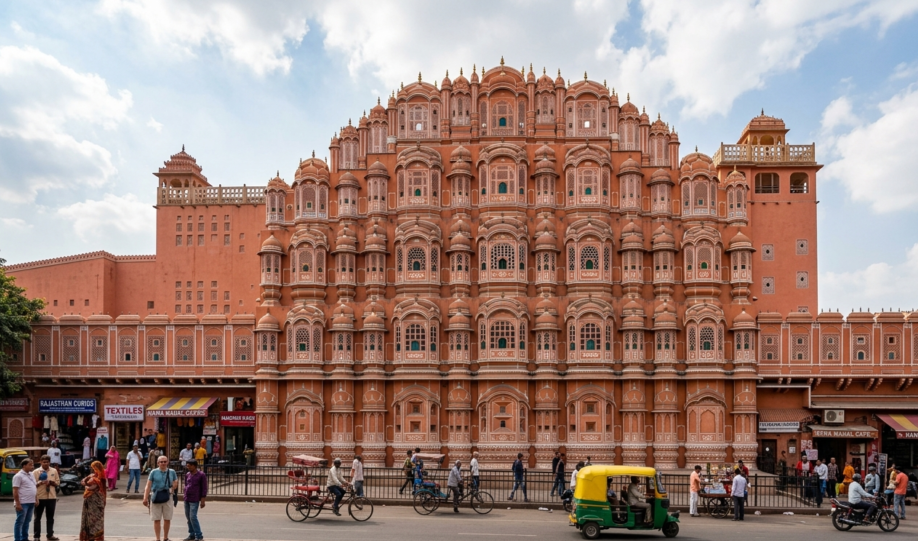
Hawa Mahal :- The Complete Narrative of Jaipur’s Heritage
Detailed History
Built in 1799 by Maharaja Sawai Pratap Singh of Jaipur, Hawa Mahal was designed by Lal Chand Ustad in the shape of Lord Krishna’s crown. It served as a secluded viewing point for royal women to observe city life and festivals while remaining unseen behind the intricate lattice screens, honoring the ‘Purdah’ tradition of the time.
Detailed Architecture
Exterior Architecture :–
- Pyramidal Shape :– The structure resembles a 5-story honeycomb from the outside.
- Jharokhas :– It boasts 953 finely carved windows (Jharokhas) with detailed stonework.
- Color Theme :– Constructed with red and pink sandstone, symbolizing the spirit of the Pink City.
- Natural Cooling :– Designed using the ‘Venturi Effect’ to keep the interiors cool naturally.
Interior Architecture :–
- Floors :– The floors are named Sharad Mandir, Ratan Mandir, Vichitra Mandir, Prakash Mandir, and Hawa Mandir.
- Ramps :– Instead of stairs, ramps were constructed to allow royal palanquins to reach the top levels.
- Decor :– The interior features stained-glass windows and courtyards that reflect Rajasthani artistry.
Nearby Attractions
- City Palace :– Located adjacent to Hawa Mahal, housing museums and royal chambers.
- Jantar Mantar :– A UNESCO site featuring ancient astronomical instruments.
- Govind Dev Ji Temple :– A historic temple dedicated to Lord Krishna, central to Jaipur’s culture.
- Albert Hall Museum :– The state museum of Rajasthan, home to rare artifacts and an Egyptian mummy.
- Nahargarh Fort :– Perched on the hills, offering a stunning panoramic view of the city.
Travel Guide & Routes
- Tickets :– ₹50 for Indians, ₹200 for Foreigners (student discounts available).
- Timing :– 9:00 AM to 5:00 PM daily.
- How to Reach :– 5 km from Jaipur Junction Railway Station; accessible by buses, autos, and e-rickshaws.
- Photography Spots :– Rooftop cafes opposite the palace and the ornate windows inside.
- Local Taste & Markets :– Johari Bazaar and Bapu Bazaar are famous for jewelry and handicrafts.
Interesting Facts
- Hawa Mahal is considered the tallest building in the world built without a foundation.
- The entire structure stands on a wall base only 8 inches thick.
- There is no front entrance; entry is through the rear courtyard.
Important Questions and Answer :-
- Question:- Who was the lead architect of Hawa Mahal?
- Answer:- Lal Chand Ustad designed the Hawa Mahal.
- Question:- How many windows are there in the palace?
- Answer:- There are 953 carved windows or Jharokhas.
- Question:- Which stone was used in its construction?
- Answer:– Red and pink sandstone was used.
- Question:- Why are there no stairs to the upper floors?
- Answer:– Ramps were built to make it easier for palanquins to reach the top.
- Question:- How did it get the name ‘Hawa Mahal’?
- Answer:- It was named after the 5th-floor temple called ‘Hawa Mandir’.
Author’s Thoughts :-
Hawa Mahal is the soul of Jaipur. Its design proves that ancient wisdom in architecture was far ahead of its time. Feeling the breeze through the Jharokhas while gazing at the Pink City is a surreal experience. It is a mandatory visit for anyone exploring the heart of Rajasthan.
“A masterpiece of wind and stone—experience the magic of Hawa Mahal.”