
Kerala :- The Enchanting Journey to God’s Own Country
Detailed History
The history of Kerala is immensely rich, vibrant, and stands as a testament to global cultural exchanges. In ancient Indian texts and Epics, Kerala found its historical mention as ‘Cherapadha‘. According to popular mythological legends, Lord Parashurama, the sixth avatar of Lord Vishnu, threw his divine axe into the Arabian Sea, commanding the waters to recede. The fertile, emerald land that emerged from the sea came to be known as ‘Kerala‘ (derived from Kera, meaning the land of coconut palms). Historically, the territory was officially recorded as ‘Keralaputra’ in the rock edicts of Mauryan Emperor Ashoka during the 3rd century BCE.
In ancient and medieval times, Kerala reigned as the absolute epicenter of the global spice trade. Drawn by the hypnotic aroma of premium black pepper and cardamom, ancient Romans, Greeks, Egyptians, Arabs, and Chinese mariners braved the oceans to land on the historic Malabar Coast. The ancient port of Muziris (modern-day Kodungallur) was a bustling international maritime hub. Over the centuries, the land was ruled by the Chera Dynasty, the powerful Zamorins (Samudiris) of Kozhikode, and later the Maharajas of the Princely State of Travancore. In 1498, Portuguese explorer Vasco da Gama stepped onto the shores of Kappad in Calicut (Kozhikode), carving out a historic sea route to India that altered modern world history. Following the Portuguese, the Dutch, French, and British established strongholds. Post-independence, on November 1, 1956, the territories of Travancore, Cochin, and Malabar were unified on a linguistic basis to form the modern state of Kerala.
Detailed Architecture
The architectural landscape of Kerala is uniquely adapted to its torrential rainfall, humid weather conditions, and the abundant availability of fine timbers like teak, rosewood, and local red laterite stones. This highly specialized style is formally called the ‘Kerala Architectural Style‘.
Exterior Architecture :–
- Sloping Multi-tiered Roofs :– The most striking feature of traditional Kerala temples and houses (Nalukettu) is their steeply sloped, multi-tiered roofs. These roofs are strategically designed to shed heavy monsoon rainwater instantly. They are beautifully covered with local red clay tiles or fine thatch.
- Nalukettu Framework :– This represents the classic residential architecture of ancestral Kerala. The exterior structure exhibits large, rectangular layouts flanked by wide open verandas supported by heavily carved heavy wooden pillars.
- Gothic and Colonial Influence :– The historic Fort Kochi region houses structures like the St. Francis Church (the first European church in India) and the Mattancherry Palace (Dutch Palace), reflecting an elegant structural blending of Portuguese, Dutch, and British architecture.
Interior Architecture :–
- The Central Courtyard (Nadumuttam) :– Built at the absolute heart of a traditional Nalukettu house is a square, open-to-sky central courtyard. This section acts as a natural ventilation system, filling the home with fresh air and sunlight.
- Exquisite Wood Carving :– The ceilings and lintels of royal palaces (such as the Padmanabhapuram Palace) and temple inner chambers feature masterfully detailed wood carvings done on teakwood, illustrating vivid scenes from ancient Indian epics.
- Vibrant Mural Paintings :– The interior walls surrounding temple shrines are adorned with traditional Kerala murals. Painted using entirely natural vegetable dyes, these highly detailed artworks showcase grand mythological episodes in shades of ochre, red, and green.
Travel Guide & Routes
Tickets and Entry Fees :–
- There is no general entry ticket or regional permit required for domestic or international tourists to cross into the state of Kerala.
- Entry into the famous Sree Padmanabhaswamy Temple is entirely free, although visitors must strictly follow the traditional dress code (men must wear a Mundu/dhoti, and women must wear a traditional saree or long ethnic suit).
- Nature reserves like Eravikulam National Park (Munnar) and Periyar National Park (Thekkady) charge nominal entrance tickets ranging from ₹50 to ₹150 for Indians and ₹300 to ₹600 for foreign travelers. Deluxe overnight rentals for traditional Alleppey houseboats range from ₹5,000 to ₹15,000 per day depending on the luxury classification.
Timings (Visiting, Opening & Closing Times) :–
- Best Time to Visit :– The cooler, dry months from September to March offer premium sightseeing conditions. However, the monsoon months from June to August open up a unique window for heavy monsoon tourism and authentic Ayurvedic rejuvenation therapies.
- Sightseeing Windows :– Eravikulam National Park remains open from 07:30 AM to 04:00 PM. Sree Padmanabhaswamy Temple is accessible for public darshan from 03:30 AM to 12:00 PM (morning session) and from 05:00 PM to 07:20 PM (evening session).
How to Reach (Routes) :–
- By Air :– Kerala boasts excellent international aviation connectivity via four major international airports – Cochin International Airport (COK – the world’s very first airport powered entirely by solar energy), Trivandrum International Airport (TRV), Calicut International Airport (CCJ), and Kannur International Airport (CNN).
- By Train :– Ernakulam Junction (Cochin), Thiruvananthapuram Central, Kozhikode, and Shoranur are the major railway stations. High-speed premium trains like Vande Bharat Express, Rajdhani, and regular superfast trains flawlessly link Kerala to all Indian metros.
- By Road :– The state is smoothly linked to Tamil Nadu and Karnataka via National Highways (NH-66, NH-544, and NH-85). Kerala State Transport (KSRTC) operates high-end multi-axle luxury sleeper buses connecting Cochin and Trivandrum to major commercial hubs like Bengaluru and Chennai daily.
Photography Spots, Local Cuisine, and Famous Markets
Photography Spots :–
- Chinese Fishing Nets (Fort Kochi) :– Captures classic silhouette frames against the backdrop of a dramatic, golden ocean sunset.
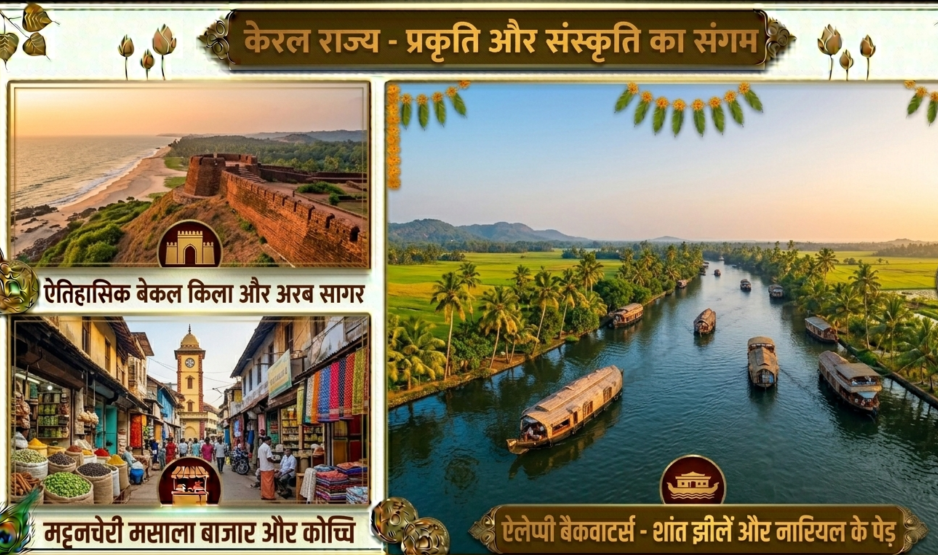
- The Backwaters of Alleppey (Alappuzha) :– Offers postcard-perfect shots of traditional thatched-roof houseboats gliding gently across tranquil lagoons fringed by leaning coconut palms.
- Tea Estates of Munnar :– Ideal for capturing vast, geometric expanses of emerald tea plantations wrapped in heavy morning mountain mists.
- Banasura Sagar Dam (Wayanad) :– India’s largest earthen dam, presenting breathtaking landscape frames of pristine blue waters nestled against rugged mountain ranges.
- Kovalam Lighthouse Beach :– Great for capturing panoramic views of the curving sandy shoreline from atop the iconic red-and-white vintage tower.
Local Cuisine :–
- The Grand Kerala Sadya :– A monumental vegetarian festive banquet served traditionally on a fresh green banana leaf. It includes a mountain of red parboiled rice accompanied by Avial (a rich stew of mixed vegetables and coconut), Thoran, Olan, Sambar, Rasam, and finished with a rich sweet dessert called Payasam. Breakfast classics include fluffy ‘Appam with vegetable/meat stew’ and ‘Puttu with Kadala Curry’. Seafood connoisseurs highly celebrate Malabar Prawn Curry and the iconic fragrant Malabar Chicken Biryani. Authentic banana chips fried fresh in pure coconut oil are an essential take-home treat.
Famous Markets :–
- Broadway & Ernakulam Market (Cochin) :– The premier historic hub for purchasing high-quality indigenous spices like black pepper, green cardamom, cloves, and premium cashews.
- Connemara Market (Thiruvananthapuram) :– A vibrant marketplace highly popular for buying traditional Kasavu sarees and handwoven coir items.
- Fort Kochi Antique Market :– Celebrated for rare vintage colonial collectibles, handmade aromatic herbal soaps, and ethnic linen wear.
Nearby Attractions
- Munnar :– The premier hill station of South India, famous for its expansive tea estates, Anamudi Peak (the highest point in South India), and the rare Neelakurinji flowers that bloom once every 12 years.
- Alleppey and Kuttanad :– Affectionately titled the ‘Venice of the East’, this iconic network of calm inland canals, vast lagoons, and below-sea-level paddy farming is famous worldwide for scenic houseboat stays.
- Thekkady (Periyar Wildlife Sanctuary) :– A protected mountain reserve offering boat safaris on Lake Periyar to view herds of wild elephants, rare birds, and occasional Bengal tigers in their natural habitat.
- Varkala and Kovalam Beaches :– Varkala is world-renowned for its dramatic, unique red cliffs rising directly from the Arabian Sea alongside the centuries-old Janardhana Swamy Temple.
- Jatayu Earth’s Center (Kollam) :– Features the world’s largest bird sculpture (the monolithic statue of the mythical bird Jatayu), doubling up as a world-class adventure park.
Important Questions and Answer :-
Question 1:- Why is Kerala globally referred to as ‘God’s Own Country’?
Answer:– Kerala earned this global title due to its unmatched natural diversity, pristine backwaters, endless stretches of coconut grooves, mist-clad hill stations, and deep-rooted cultural heritage. The iconic tag was created by Kerala Tourism in the 1980s to define the state’s pristine, heavenly atmosphere.
Question 2:- What are the iconic classical dance forms originating from Kerala?
Answer:– ‘Kathakali’ is Kerala’s internationally acclaimed classical dance-drama, instantly recognized by its elaborate facial makeup, heavy traditional headgears, and powerful hand gestures (Mudras). ‘Mohiniyattam’, the dance of the enchantress, is another highly celebrated classical form known for its graceful, lyrical body movements.
Question 3:- What makes the annual ‘Nehru Trophy Boat Race’ in Alleppey special?
Answer:– Held every August on the waters of Punnamada Lake, it is a historic snake boat race (Chundan Vallam). Over a hundred synchronized oarsmen row a single, massive 100-foot-long wooden boat to the rhythmic beats of traditional boat songs (Vanchippattu), creating an adrenaline-pumping spectacle.
Question 4:- Why does the Sree Padmanabhaswamy Temple hold vast global fame?
Answer:– Located in Thiruvananthapuram, this ancient temple dedicated to Lord Vishnu is officially recorded as the wealthiest religious institution in the world. Its secret underground vaults (Vault B and others) hold astronomical treasures consisting of ancient gold ornaments, heavy diamond crowns, and precious historic coins worth billions.
Question 5:- What is ‘Kalaripayattu’ and what is its historical value?
Answer:– ‘Kalaripayattu’ is Kerala’s traditional martial art form, widely respected as the oldest surviving martial art in the world. It involves intense physical conditioning, agility drills, and combat training using sticks, shields, and iron swords, forming the pride of Kerala’s heritage.
Author’s Thoughts
Kerala is far more than just a regular holiday destination on a map; it is a beautifully written emerald poem sculpted by nature itself. Gliding along the serene backwaters of Alleppey on a traditional thatched houseboat, watching the coconut palms tilt gracefully over the water, or breathing in the cool air of Munnar’s misty peaks makes you realize that absolute peace resides here. The truest victory of Kerala lies in its exceptional literacy, flawless cleanliness, and its highly progressive, hospitable people. They have seamlessly preserved ancient sciences like Ayurveda and Kalaripayattu while confidently leading the nation into sustainable eco-tourism. Kerala is a mystical sanctuary that mends the soul, permanently making you fall in love with its quiet, green rhythm. “The moment you touch the tranquil waters and mist-kissed hills of Kerala, your inner self finds its peace, as if nature itself whispered—Welcome to God’s Own Country.”