
Maharashtra :- The Land of Chhatrapati Shivaji Maharaj, Grand Culture & Gateway to Economic Prosperity
Detailed History
The history of Maharashtra is a glorious saga of unparalleled valor, profound spirituality, and path-breaking social revolutions. In ancient mythological scriptures, this vast region was chronicled as ‘Dandakaranya‘, where Lord Rama, along with Sita and Lakshmana, spent a significant period of their exile in the serene forests of Panchavati (modern-day Nashik). Historically, during the 3rd century BCE, this land formed a vital core of the grand Mauryan Empire. Following the Mauryas, the Satavahana Dynasty emerged as one of the most powerful empires of South India, establishing their rule here and ushering in an era of unprecedented maritime trade, art, and classical culture. Over the subsequent centuries, the Vakatakas, Chalukyas, Rashtrakutas, and the Yadavas of Devagiri nurtured and enriched this soil. It was during the Yadava reign that the revered Saint Dnyaneshwar Maharaj authored the ‘Dnyaneshwari‘, laying the philosophical foundation for the egalitarian Bhakti movement in Western India.
During the mid-17th century, the landscape of Maharashtra witnessed its most transformative era with the rise of Chhatrapati Shivaji Maharaj, the founder of Hindavi Swarajya. He defiantly challenged the oppressive absolute powers of the Mughal Empire and the Adil Shahi Sultanate to establish a sovereign, just, and powerful Maratha Empire. Shivaji Maharaj’s legendary guerrilla warfare tactics (Ganimi Kava) and his visionary construction of massive sea fortresses (like Sindhudurg and Vijaydurg) remain masterclasses in military science to this day. Under the subsequent leadership of the Peshwas, the Maratha Empire expanded monumentally, stretching its influence from Attock (now in Pakistan) to Cuttack (in Odisha). During the British Raj, the region was integrated into the sprawling ‘Bombay Presidency‘. Post-independence, the historic ‘Samyukta Maharashtra Movement’ mobilized millions demanding a unified state for Marathi-speaking people, culminating in the formal declaration of the modern state of Maharashtra on May 1, 1960.
Detailed Architecture :-
The architectural structural matrix of Maharashtra exhibits an awe-inspiring, magnificent fusion of ancient rock-cut cave excavations, indomitable medieval mountain fortresses, and grand colonial-era Victorian Gothic structures:
Exterior Architecture :–
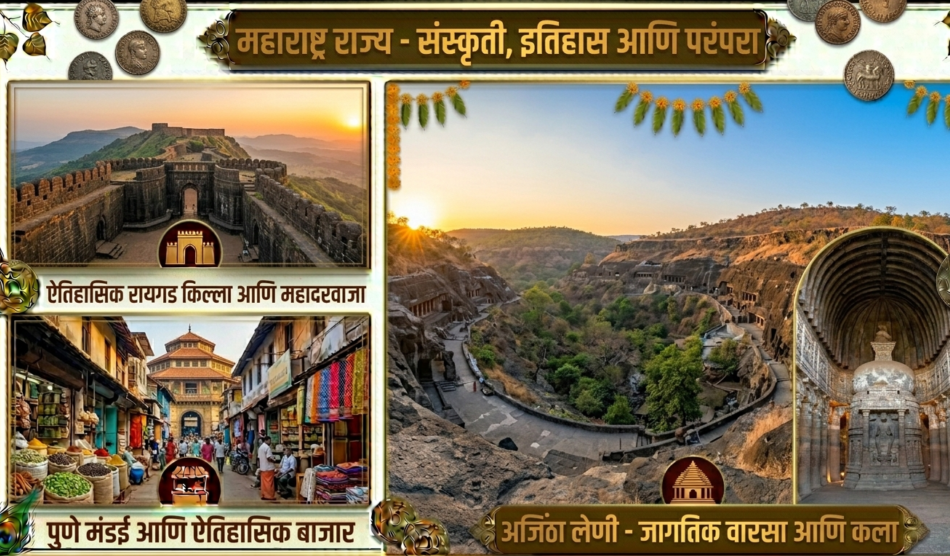
- Rock-Cut Cave Architecture :– Located in Chhatrapati Sambhajinagar (formerly Aurangabad), Cave 16 of the Ellora Complex (The Kailash Temple) stands as the ultimate monolithic wonder of the world. Its jaw-dropping exterior architecture is unique because it was not assembled using stone blocks or mortar; instead, an entire massive basaltic hill was systematically carved from the top down (top-down monolithic excavation) by master sculptors. Similarly, the UNESCO-listed Ajanta Caves feature an imposing semi-circular exterior layout carved along a horseshoe-shaped river ravine.
- Military & Fort Architecture :– Hill fortresses like Raigad, Pratapgad, and Rajgarh display an aggressive, brilliant defensive exterior design. Engineers masterfully incorporated the sheer natural cliffs of the Sahyadri range into massive stone ramparts, creating concealed, double-layered ‘Gaumukhi’ (cow-mouth shaped) entry gates that were completely impervious to battering rams or war elephants. Sea forts like Sindhudurg featured molten lead poured directly into their underwater foundation stones to withstand the relentless battering of the Arabian Sea waves.
- Victorian Gothic & Indo-Saracenic Styles :– The monumental Chhatrapati Shivaji Maharaj Terminus (CSMT) and the iconic Gateway of India in Mumbai are architectural masterpieces. The exterior of CSMT displays soaring rib-vaulted domes, pointed lancet arches, and intricate stone gables adorned with dynamic relief carvings of lions and leopards, epitomizing high Victorian Gothic Revival art.
Interior Architecture :–
- Inside the grand Kailash Temple, massive deeply-recessed load-bearing pillars, ornate inner sanctums, and extensive narrative panels—such as the dramatic depiction of Ravana shaking Mount Kailash—make the cold basalt stone feel alive. The inner layouts of the Ajanta Caves house spacious Viharas (monastic residential halls) and magnificent Chaityas (prayer halls) adorned with world-famous ‘Fresco Paintings’ capturing the Jataka tales using organic natural pigments.
- The interior architecture of secular Maratha structures, like Pune’s legendary Shaniwar Wada, featured extensively carved teakwood pillars (Suru pillars) shaped like cypress trees, opening into multi-tiered courtyards that once housed majestic lotus-shaped fountains (Hazari Karanje).
Travel Guide & Routes
Tickets and Entry Fees :–
- There is no mandatory entry pass, inner-line permit, or regional tax required for domestic or international tourists crossing into the state boundaries of Maharashtra.
- Standard entry tickets for high-profile UNESCO World Heritage Sites (Ajanta, Ellora, Elephanta Caves) and iconic protected monuments (Shaniwar Wada, Bibi Ka Maqbara) range from ₹25 to ₹40 for Indian nationals and ₹300 to ₹600 for international passport holders.
- To access the Elephanta Caves, returning ferry boat tickets from the Gateway of India jetty cost between ₹200 and ₹300 per passenger.
Timings (Visiting, Opening & Closing Times) :–
- Best Time to Visit :– The winter block from October to March offers exceptionally comfortable, cool conditions across the state. However, for exploring hill stations like Mahabaleshwar, Lonavala, Matheran, or trekking the ancient fort routes of the Western Ghats, the monsoon season (June to September) is absolutely magical, turning the entire Sahyadri range into an emerald paradise wrapped in low-hanging clouds.
- Crucial Planning Note :– The Ajanta Caves remain officially closed to public entry every Monday, and the Ellora Caves remain closed every Tuesday. On all other days, they are open from 06:00 AM to 06:00 PM.
How to Reach (Routes) :–
- By Air :– Mumbai’s ‘Chhatrapati Shivaji Maharaj International Airport’ (BOM) stands as one of the primary ultra-busy global aviation getaways into South Asia, directly linking the state to every major continent. Highly efficient international and domestic airports also routinely service Pune, Nagpur, Nashik, and Chhatrapati Sambhajinagar (Aurangabad).
- By Train :– Mumbai (CSMT/Central), Pune, Nagpur, and Bhusawal form the core trans-continental railway networks of Indian Railways. Premium high-speed rail assets like Vande Bharat Express, Shatabdi, and Rajdhani connect Maharashtra seamlessly to all corners of India. The ubiquitous Mumbai Local Train network serves as the daily commercial lifeline of the metropolis.
- By Road :– The state is traversed by top-tier, world-class multi-lane expressways. The iconic Mumbai-Pune Expressway and the newly engineered ‘Samruddhi Mahamarg’ (connecting Mumbai to Nagpur across 700+ km) offer superlative road transit conditions. The MSRTC operates highly reliable, premium air-conditioned Volvo coaches under the ‘Shivneri’ and ‘Shivshahi’ fleets across all major city pairs.
Photography Spots, Local Cuisine, and Famous Markets
Photography Spots :–
- Gateway of India & Marine Drive (Mumbai) :– Immortalizes beautiful twilight frames along the crescent-shaped Marine Drive promenade, universally celebrated as the ‘Queen’s Necklace’ due to its sparkling grid of streetlights at night.
- The Top Rim of Kailash Temple (Ellora) :– Offers an unparalleled, grand bird’s-eye view frame looking down into the massive multi-story courtyard excavated out of the mountain.
- Arthur’s Seat Point (Mahabaleshwar) :– Perfect for capturing expansive, dramatic landscape shots of the sheer vertical cliffs and dropping canyons of the Sahyadri range.
- Konkan Kada (Harishchandragarh Fort) :– A legendary concave, semi-circular overhanging cliff dropping nearly 2,000 feet straight into the Konkan plains, offering the most dramatic sunset photography frames in Western India.
- Rajmachi Point (Lonavala) :– Exceptional during peak monsoons for capturing multi-tiered seasonal waterfalls cascading down intense green mountain slopes.
Local Cuisine :–
- Vada Pav & Misal Pav :– The humble ‘Vada Pav’—a spicy deep-fried potato patty sandwiched in a soft bun with garlic chutney—stands as Mumbai’s ultimate culinary icon. Pune and Kolhapur are famous for their fiery, intensely spiced ‘Misal Pav’ (a complex sprout curry topped with crunchy farsan and served with bread). Other iconic cultural delicacies include ‘Puran Poli’ (a sweet, cardamom-infused lentil flatbread), ‘Pithla Bhakri’ (a rustic, comforting gram-flour porridge paired with millet flatbread), rich saffron-infused ‘Shrikhand-Puri’, and coastal Konkani specialties like ‘Solkadhi’ (a refreshing pink digestive drink made from coconut milk and kokum). Nagpur’s sweet oranges and Nashik’s world-class table grapes are globally renowned.
Famous Markets :–
- Crawford Market & Linking Road (Mumbai) :– Highly popular for an endless array of wholesale dry fruits, domestic goods, and highly affordable contemporary street fashion.
- Tulsi Baug & Lakshmi Road (Pune) :– The beating historical commercial heart of Pune, ideal for traditional Maharashtrian brassware, ethnic nose rings (Nath), and authentic bridal wear.
- Connaught Place & Citadelle Road (Aurangabad) :– Famous worldwide for sourcing authentic hand-woven ‘Himroo’ shawls and royal ‘Paithani’ silk sarees holding premium Geographical Indication (GI Tags).
Nearby Attractions
- Mumbai (The City of Dreams) :– India’s dominant financial capital, loved for its historic Siddhivinayak Temple, the sea-bound Haji Ali Dargah, iconic colonial architecture, and the glamorous beachside residential estates of Bollywood’s biggest icons.
- Shirdi (The Abode of Sai Baba) :– Located in the Ahmednagar district, this globally revered spiritual sanctuary attracts millions of international and domestic devotees seeking blessings at the shrine of Sai Baba.
- Nashik (The Wine & Holy Capital) :– Situated along the holy banks of the Godavari River, it successfully bridges ancient spirituality (the Trimbakeshwar Jyotirlinga and Panchavati forest complex) with modern luxury, serving as the official ‘Wine Capital of India’ due to its sprawling estate vineyards.
- Lonavala & Khandala :– Twin mist-covered hill stations perched along the Sahyadri crest, universally loved for their dramatic hiking trails, ancient rock-cut Karla and Bhaja caves, and signature sweet peanut brittle (Chikki).
- Kolhapur :– A culturally rich royal city famed for its historic Mahalakshmi (Ambabai) Temple, artisanal handcrafted leather Kolhapuri footwear, and its iconic, rich local culinary gravies (Tambda-Pandra Rassa).
Important Questions and answer :-
Question 1:- What makes the construction of the Kailash Temple at Ellora an unrepeatable feat of ancient engineering?
Answer:– The Kailash Temple (Cave 16) is a marvel because it was engineered via ‘monolithic excavation‘ using a top-down approach. Over a span of several decades in the 8th century under Rashtrakuta King Krishna I, ancient master stone-cutters manually chiseled away more than 400,000 tons of solid basalt rock from a mountain cliff, carving an entire double-storied temple complex complete with life-sized obelisks, bridges, and complex multi-room sanctuaries using only rudimentary hand chisels and hammers.
Question 2:- What was the primary objective of the historic ‘Samyukta Maharashtra Movement’?
Answer:– Following India’s independence, the linguistic reorganization of states became a major national priority. The Samyukta Maharashtra Movement was a powerful mass socio-political agitation demanding a separate, dedicated state for Marathi-speaking people with Mumbai (then Bombay) as its capital. Following intense public advocacy and the martyrdom of 106 activists, the bilingual Bombay State was formally split on May 1, 1960, giving rise to the modern states of Maharashtra and Gujarat.
Question 3:- What are the signature folk dance and theatrical traditions of Maharashtra?
Answer:– ‘Lavani‘ is the most iconic, high-energy folk dance form of Maharashtra, characterized by powerful rhythmic footwork timed to the beats of the Dholki drum, performed by women draped in traditional nine-yard Nauvari sarees. This is often integrated into ‘Tamasha’ (vibrant folk theater), while ‘Powada’ represents dramatic, theatrical ballad singing celebrating the historic military victories and valor of Chhatrapati Shivaji Maharaj.
Question 4:- Why did Lokmanya Bal Gangadhar Tilak transform the Ganesh Chaturthi festival into a public celebration in 1893?
Answer:– While Ganesh Chaturthi was celebrated privately since the Peshwa era, nationalist leader Lokmanya Tilak strategically transformed it into a massive public festival (Sarvajanik Ganeshotsav) in 1893 to bypass British colonial bans on public political gatherings. It served as a brilliant social vehicle to bridge caste divides, foster community unity, and ignite a collective sense of patriotism against colonial rule.
Question 5:- What unique environmental and tourism values do the Sahyadri Mountains hold for Maharashtra?
Answer:– The Sahyadri Range (the Western Ghats running parallel to the coast) forms the ecological and geographic backbone of Maharashtra. Designated as a UNESCO World Natural Heritage site, it is one of the world’s premier biodiversity hotspots. It acts as the catchment area for major peninsular rivers, houses hundreds of historic Maratha hill forts, and acts as a massive tourism magnet during the monsoons when its high plateaus, hidden valleys, and roaring waterfalls wake up to full life.
Author’s Thoughts :-
Maharashtra is not just a state defined by geographical borders; it is a monumental philosophy—a ‘Maha-Rashtra’ where ancient spirituality, fierce historical pride, and hyper-modern global ambitions beat in perfect unison. To stand on the historic ramparts of Raigad Fort is to hear the echoing battle cries of a righteous empire that fought for self-respect; to look out over the glittering skyline of Mumbai’s Marine Drive is to witness the economic engine powering modern India. The sheer physical grit of the state is mirrored beautifully in the rugged cliffs of the Sahyadris, while its deeply compassionate soul lives on in the egalitarian songs of its medieval saints. From the flawless discipline of Mumbai’s legendary Dabbawalas to the shared euphoria of the Pandharpur Wari pilgrimage, Maharashtra teaches us timeless lessons in resilience, community, and unyielding courage. It remains an absolute, essential odyssey for any traveler who wishes to experience the true muscle, grit, and expansive heart of India.
“Within the unyielding stone of Maratha fortresses, the roar of history still lives, while the green peaks of the Sahyadri mountains drape the land in timeless majesty.”