
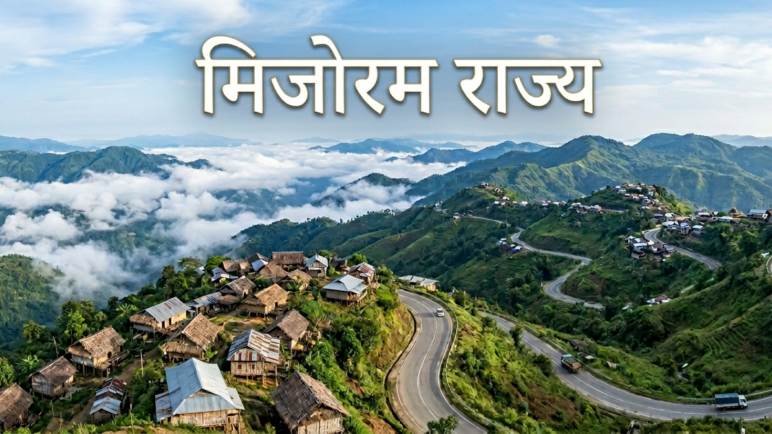
Mizoram :– The Paradise of Clouds and Lush Green Hills
Detailed History
Mizoram is a breathtakingly beautiful and serene state located in the northeastern corner of India, universally hailed as the ‘Land of the Highlanders‘. The history of Mizoram is deeply intertwined with its indigenous tribes and their glorious past. The word ‘Mizo‘ is a combination of two words—’Mi’ meaning people and ‘Zo’ meaning hills. Thus, Mizo literally translates to ‘Hill People‘. Until the 19th century, this region was completely independent and governed by various tribal chieftains.
During the period of 1891-95, the British administration established control over this region and annexed it into Assam as a district named ‘Lushai Hills’. Post-independence, it was renamed ‘Mizo District’ in 1954. Following a prolonged movement by the Mizo National Front (MNF) and the historic Mizo Peace Accord, Mizoram was officially declared the 23rd full-fledged state of India on February 21, 1987. The state boasts one of the highest literacy rates in India (above 91%) and its society is widely renowned for its remarkable discipline and the spirit of Tlawmngaihna (selfless community service).
Detailed Architecture
The architectural matrix of Mizoram exhibits a unique blend of modern structures and traditional tribal craftsmanship.
- Traditional Mizo Houses (Zawlbuk and Stilts Houses) :– Traditional houses can still be widely spotted in the rural areas of Mizoram. These structures are built on bamboo and timber pillars (stilts) along mountain slopes. These frames are earthquake-resistant and woven using Jhàu (a local variety of high-quality bamboo). In ancient times, the ‘Zawlbuk’ (bachelors’ dormitory) served as the monumental centerpiece of village architecture.
- Solomon’s Temple (Aizawl) :– Located in the capital city of Aizawl, this grand church is the finest specimen of modern architecture in Mizoram. Constructed with pristine white marble, this massive structure is famous across the Northeast for its architectural beauty. Its square layout, grand towers, and detailed interior carvings symbolize ultimate peace and sanctity.
- KV Paradise :– Often referred to as the modern ‘Taj Mahal’ of Mizoram. This beautiful three-tiered marble monument is perched on a hill slope in Aizawl, custom-built by a local resident in loving memory of his late wife.
Travel Guide & Routes :-
- Mandatory Permits (Inner Line Permit – ILP) :– All domestic Indian nationals are strictly required to obtain an Inner Line Permit (ILP) to enter Mizoram. This can be instantly acquired online (ilp.mizoram.gov.in) or physically On Arrival at Siliguri, Kolkata, Guwahati, New Delhi, and Aizawl Airport for approximately ₹150 to ₹200.
- Tickets and Entry Fees :– Most ecological landmarks in Mizoram, such as Vantawng Falls, Durtlang Hills, and Reiek Peak, levy no entry charges (Free Entry). Admission to the Mizoram State Museum costs ₹20 for adults and ₹10 for children.
- Timings (Visiting Time) :– Most tourist sightseeing spots remain accessible from 09:00 AM to 05:00 PM. Travelers must note that nightfall happens exceptionally early in the Northeast (by 04:30 PM – 05:00 PM), making early morning departures highly recommended. On Sundays, the entire state, including public transport and commercial shops, remains completely closed; plan your itinerary accordingly.
- How to Reach (Routes) :–
- By Air :– The ‘Lengpui Airport‘ in Aizawl is the primary aviation gateway, linked via routine direct flights to Kolkata, Guwahati, and Imphal. The airport is situated roughly 32 km from the main city center, accessible via private tourist cabs.
- By Train :– The nearest functional railway station is Sairang within Mizoram boundaries, and Silchar in Assam. Regular shared Sumo vehicles and private taxis operate continuously from Silchar to Aizawl.
- By Road :– National Highway 54 (NH 54) links Mizoram smoothly to Silchar in Assam. Reliable overnight luxury buses and regional Sumo services connect Guwahati and Silchar to the capital city of Aizawl.
- Photography Spots :– Aizawl Skywalk View Point, Reiek Peak (Reiek Tlang), Vantawng Waterfalls, and the misty Hmuifang Hills.
- Local Cuisine :– The authentic culinary style relies heavily on steamed, nutritious food prepared with zero commercial spices. Travelers must try ‘Bai’ (a comforting soup made of mixed green vegetables and pork), ‘Kot Pitha’ (a crispy sweet fritter made of rice flour and ripe bananas), and ‘Misha Mach Poora’ (smoky, spit-roasted river fish).
- Famous Markets :– ‘Bara Bazar’ and ‘Mizo Haat’ in Aizawl. These commercial hubs are perfect for sourcing traditional Mizo handwoven wraps (Puan), and premium bamboo and cane wickerwork handicrafts.
Interesting Facts :-
- The Tropic of Cancer :– The geographic line of the Tropic of Cancer passes directly across the outskirts of the capital city, Aizawl, where a prominent structural landmark board has been officially erected for tourists.
- The Bamboo Dance (Cheraw Dance) :– Mizoram’s legendary ‘Cheraw Dance’ is one of the oldest and most complex folk dances in the world, where dancers step with artistic agility and speed between horizontally moving bamboo staves clapped together on the ground.
- Mautam (The Bamboo Blooming Famine) :– Every 48 years, the vast bamboo forests of Mizoram bloom simultaneously. This massive ecological event triggers a dramatic explosion in the wild rat population, leading to massive crop destruction, traditionally recorded in Mizo history as the ‘Mautam Famine’.
- The No-Honking State :– Mizoram stands proudly as a shining example in India where drivers routinely navigate busy mountain roads without blowing their horns unnecessarily. The state’s exceptional traffic discipline and civic sense are a model for the entire nation.
Important Questions and Answer :-
Question 1:- What is the absolute best time of the year to plan a trip to Mizoram?
Answer:– The winter window from October to March is the premium time to travel through Mizoram. The weather remains pleasantly cool and crisp, and the mountain skies stay completely clear, offering sweeping views of the deep green valleys. Furthermore, the state’s grandest spring festival, ‘Chapchar Kut’, is celebrated with immense pomp in March. Traveling during the monsoons (June to September) is highly discouraged due to heavy downpours and landslide risks.
Question 2:- What are the primary, must-visit tourist destinations within Mizoram?
Answer:– The highest-rated highlights include the hillside capital city of Aizawl, the grand Solomon’s Temple, the panoramic hiking ridges of Reiek Peak, Vantawng Falls near Thenzawl (the highest plunge waterfall in the state), the serene Tamdil Lake, and Phawngpui (The Blue Mountain), which stands as the highest peak in Mizoram.
Question 3:- Is traveling through Mizoram safe for solo tourists, and what languages are spoken there?
Answer:– Mizoram is recognized as one of the safest and most peaceful states with an incredibly low crime rate across India. The indigenous language is ‘Mizo’; however, owing to the exceptional literacy standards, a vast majority of the locals and shopkeepers speak and comprehend English and Hindi quite fluently.
“Nestled securely in the lap of low clouds, Mizoram’s emerald hills and highly disciplined culture leave a lifelong impression on every traveler’s soul.”