
Detailed History
Located on the banks of the Ganges River in the mid-west of Uttar Pradesh, Farrukhabad district is renowned for its rich cultural heritage, Zardozi embroidery, and historical significance. From a historical and mythological perspective, the ancient and old name of Farrukhabad was ‘Panchal Nagar’ or ‘Panchal Desh’. During the Mahabharata era, this region was a major part of King Drupad’s Panchal Kingdom.
Mythological and Mahabharata Connection :–
- Panchal and Kampil :– ‘Kampil‘ (ancient Kampilya), located in the Farrukhabad district, used to be the capital of King Drupad. This is the sacred land where King Drupad’s daughter, Draupadi, was born, and where the historic Draupadi Swayamvar (the fish-eye archery contest) took place, which was won by Arjun. For this reason, the entire region was identified as Panchal Nagari during the Mahabharata period.
Origin of the Modern Name :–
The story of the ancient Panchal region being renamed ‘Farrukhabad’ is linked to the Mughal era. In the year 1714, the Bangash Pathan ruler Nawab Mohammad Khan Bangash founded this city. He named this historic town ‘Farrukhabad’ after the contemporary Mughal Emperor Farrukhsiyar. Mohammad Khan Bangash made this city his capital and developed it into a major hub for trade and culture. Thus, the ancient ‘Panchal’ became famous as ‘Farrukhabad’ during the Mughal period.
Detailed Architecture
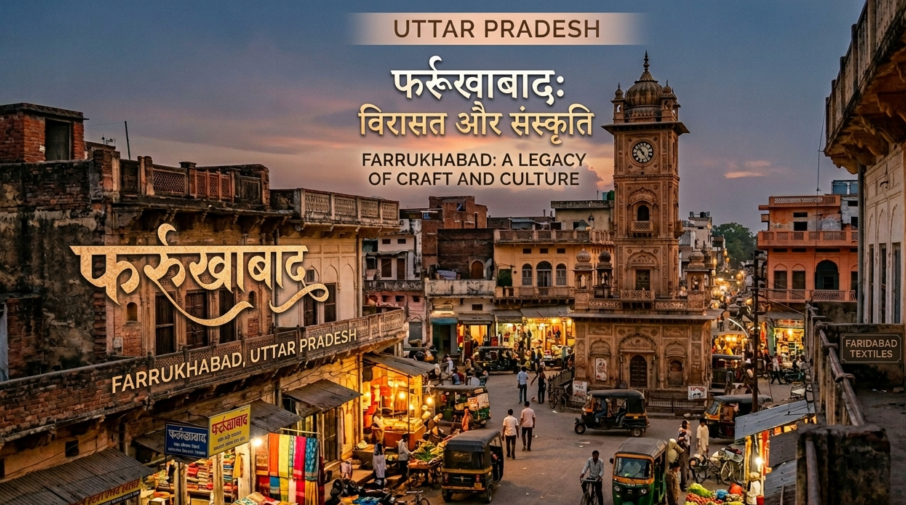
The architecture and structural layout of Farrukhabad exhibit a wonderful blend of ancient Hindu-Jain traditions and medieval Mughal-Nawabi architectural styles.
Interior and Exterior Design :-
- Ancient and Religious Architecture :– The ancient Jain and Hindu temples located in the Kampil region are built in the traditional Indian temple architectural style. The interior design of the Jain temples here features serene sanctum sanctorums, beautifully carved pillars, and the exquisite use of marble. The exterior spires (Shikharas) of the temples bear the imprint of traditional Nagara style architecture.
- Mughal and Nawab Era Architecture :– The structure of Farrukhabad city and its twin town ‘Fatehgarh’ reflects the architecture of the Nawabi era. The remnants of forts, massive gateways, and old havelis built by Nawab Mohammad Khan Bangash are constructed using red bricks, lime, and sandstones. Their exterior architecture features large arches, domes, and jharokhas. Fatehgarh was later developed by the British as a cantonment (Cantt), hence its interior and exterior architecture also displays colonial-style bungalows with high ceilings and spacious verandas.
Travel Guide & Routes
The complete guide for tourists and visitors traveling to Farrukhabad and its historical sites is given below.
Entry Ticket and Timings :–
- Ticket :– Entry to most of the historical and religious sites in Farrukhabad and Kampil (such as Draupadi Kund, ancient temples) is completely Free.
- Timings :– The temples and sightseeing spots here are generally open from 05:00 AM to 12:00 PM and then from 04:00 PM to 09:00 PM. Commercial markets open from 10:00 AM to 09:00 PM.
How to Reach :–
- By Air :– The nearest operational domestic airport is Kanpur (Chakeri Airport), which is about 140 km away. Apart from this, Chaudhary Charan Singh International Airport in Lucknow is located at a distance of about 180 km. From there, you can directly reach Farrukhabad by taxi or bus.
- By Rail :– Farrukhabad Junction (FBD) and Fatehgarh (FGR) are the major railway stations in the district, which are directly connected by rail routes to big cities like Lucknow, Kanpur, Delhi, Agra, and Shikohabad. E-rickshaws and autos are easily available from the railway station to travel to any part of the city.
- By Road :– Farrukhabad is excellently connected by road to all major cities of Uttar Pradesh. Direct buses from Uttar Pradesh State Road Transport Corporation (UPSRTC) and private Volvo buses run regularly from Delhi, Agra, Kanpur, and Lucknow. For local travel, autos and e-rickshaws are the most convenient means.
Photography Spots :–
- Draupadi Kund, Kampil :– Showcasing the history of the Mahabharata era, this place is very famous for photography.
- Ganga Ghat, Ghatiyaghat :– The views of sunset and Aarti on the banks of the Ganges River during the morning and evening provide stunning photographs.
- Ancient Nawab Era Gates :– The historic high gateways from the era of the Nawabs located in the older parts of the city are excellent for vintage photography.
Local Flavors and Famous Markets :–
- Local Flavors :– Farrukhabad is known for its delicious street food. The ‘Aloo ke Gutke’ (spiced dry potatoes), Khasta Kachori, and traditional Chaat here are highly famous. Apart from this, the taste of traditional sweets and Rabri is also exquisite.
- Famous Markets :– Farrukhabad is world-famous for its Zardozi and Block Printing (Handloom & Textile) work. ‘Chowk Bazaar’ and ‘Nehru Road Market’ are the most prominent markets for textile shopping, Zardozi sarees, and handicrafts.
Interesting Facts
- Birthplace of Draupadi :– It is believed that the Kampil region of Farrukhabad is the sacred place where Draupadi (Krishnaa) and her brother Dhrishtadyumna emerged from King Drupad’s Yajna.
- Kapilayatan and Jain Pilgrimage :– Kampil holds the honor of being the birthplace and land of penance of Lord Vimalnath, the 13th Tirthankara of Jainism, making it a highly sacred pilgrimage site for the Jain community.
- Asia’s Largest Potato Market :– Farrukhabad is called the ‘Potato Hub’ of Uttar Pradesh. The Satanpur Mandi located here is counted among the largest potato markets in Asia.
- Hub of Zardozi Art :– The Zardozi work (embroidery with gold and silver threads on clothes) here is so famous that products crafted here are exported abroad as well.
Important Questions and Answer :-
Question 1:- What was the ancient or old name of Farrukhabad?
Answer:– The ancient name of Farrukhabad was ‘Panchal Nagar’ and the historic region falling under it was named ‘Kampilya’ (present-day Kampil).
Question 2:– Who founded the city of Farrukhabad and after whom was it named?
Answer:– This city was founded in the year 1714 by Nawab Mohammad Khan Bangash, and he named it ‘Farrukhabad’ after the then Mughal ruler Farrukhsiyar.
Question 3:– What is the connection of Farrukhabad with the Mahabharata era?
Answer:– During the Mahabharata period, it was the capital (Kampilya) of King Drupad’s Panchal Kingdom. Goddess Draupadi was born here, and her Swayamvar was also organized on this very land.
Question 4:- For which handicraft industry is Farrukhabad globally famous?
Answer:– Farrukhabad is world-renowned for its Zardozi embroidery work, textile printing (Block Printing), and tobacco industry.
“Embodying the mythological grandeur of the Mahabharata-era Panchal and the fine craftsmanship of the Nawab period, Farrukhabad still sings the immortal saga of history on the banks of the Ganges.”