Lifeline of the Capital :- Exploring the Delhi Metro Network
Detailed History
The Delhi Metro is not just a transit system; it is the absolute lifeline of the National Capital Region (NCR). Before its inception, Delhi heavily relied on buses, which led to massive traffic congestion and high pollution levels. The planning for a world-class rapid transit system began in the 1990s, leading to the construction of the network by the Delhi Metro Rail Corporation (DMRC), a joint venture between the Government of India and the Government of Delhi.
The first commercial operation started on December 25, 2002, on the Red Line between Shahdara and Tis Hazari. Led by the visionary “Metro Man” E. Sreedharan, the project achieved what many thought was impossible in a crowded historic city: completing mega-phases ahead of schedule and well within budget. Over the years, it expanded rapidly across multiple phases, connecting Delhi with neighboring satellite cities like Noida, Ghaziabad, Gurugram, Faridabad, and Bahadurgarh. Today, it stands as one of the largest and most efficient continuous metro networks in the entire world.
Detailed Architecture :-
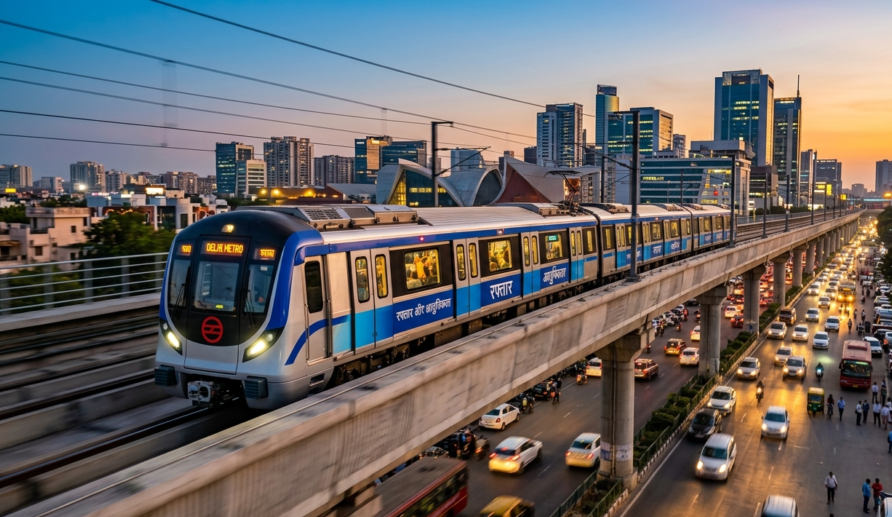
The architecture of the Delhi Metro is a marvelous blend of modern civil engineering and smart urban planning. The network comprises three distinct structural layouts: elevated, underground, and at-grade (surface) tracks.
Exterior Architecture :-
The elevated stations are built using pre-cast concrete segments and massive single-pier pillars that minimize the usage of road space below. The roofs of modern stations use curved steel structures with tensile fabric or polycarbonate sheets to maximize natural daylight while keeping the platforms cool. Underground stations are engineering marvels built using the ‘Cut-and-Cover’ method as well as sophisticated Tunnel Boring Machines (TBMs) to avoid disturbing the historic heritage buildings standing directly above them on the surface.
Interior Architecture :-
Inside, the stations are designed for high-volume pedestrian flow. They feature wide concourses, heavy-duty escalators, and glass-walled elevators. The flooring uses durable, slip-resistant granite and vitrified tiles with tactile pathways specifically designed to guide visually impaired passengers safely. The platforms are equipped with modern signage, LED display boards, and in several high-traffic stations, automatic Platform Screen Doors (PSDs) that synchronize with the train doors for enhanced passenger safety. Many prominent stations, like Mandi House, INA, and Rajiv Chowk, also showcase beautiful interior murals, paintings, and heritage artifacts reflecting the rich culture of India.
Travel Guide & Routes :-
Tickets & Fares :-
- Token / QR Ticket :– Single-journey tickets can be purchased at station counters, via Ticket Vending Machines (TVMs), or through official mobile apps (DMRC Travel, Paytm, DMRC Momentum 2.0). Fares range from ₹10 to ₹60 depending on the distance.
- Smart Card :– Ideal for regular travelers. It offers a 10% discount on every journey, with an additional 10% discount during non-peak hours.
- Tourist Card :– Available for unlimited travel. The 1-Day card costs ₹200 (including a ₹50 refundable deposit) and the 3-Day card costs ₹500 (including a ₹50 refundable deposit).
Timings :-
- Opening Time :– Trains generally start operating from 06:00 AM across most terminal stations (except the Airport Express Line, which starts earlier at 04:45 AM).
- Closing Time :– The last train departs from major terminal stations at around 11:00 PM.
- Frequency :– Ranges from 2 minutes to 5 minutes during peak office hours, and 5 minutes to 10 minutes during non-peak hours.
How to Reach the Network (Routes) :-
- By Air :– If you land at the Indira Gandhi International Airport (Terminal 3 or Terminal 1), you can directly board the high-speed Orange Line (Airport Express Line) or Magenta Line to enter the main city network.
- By Train :– Major railway stations like New Delhi (NDLS), Old Delhi (DLI), Hazrat Nizamuddin (NZM), and Anand Vihar (ANVT) have dedicated metro stations directly connected to their premises.
- By Road / Bus :– Major Inter-State Bus Terminals (ISBT) at Kashmere Gate, Anand Vihar, and Sarai Kale Khan are directly integrated with massive metro interchange hubs.
- Interchanges :– The biggest interchange hubs inside the network are Rajiv Chowk (Blue/Yellow), Kashmere Gate (Red/Yellow/Violet), and Central Secretariat (Yellow/Violet).
Photography Spots
- Signature Bridge View (Pink Line) :– The stretch near Yamuna Bank offers stunning views of the river and the iconic Signature Bridge.
- Dhaula Kuan Interchange :– The highest point of the Delhi Metro network on the Pink Line offers a breathtaking panoramic view of the bustling city roads and flyovers below.
- Mandi House & INA Stations :– Beautifully decorated inside with traditional artwork, terracotta murals, and historical exhibits perfect for capturing aesthetic indoor shots.
Local Flavors & Famous Markets Nearby
- Chandni Chowk Station (Yellow Line) :– Step out directly into the heart of Old Delhi to taste world-famous street food like Paranthe Wali Gali, Natraj Dahi Bhalle, and Jalebi Wala. It connects to the massive traditional clothing and jewelry markets.
- Dilli Haat – INA Station (Pink/Yellow Line) :– Located right outside the exit, this open-air food and craft bazaar offers authentic local cuisines from every single Indian state alongside traditional handicrafts.
- Rajiv Chowk Station (Blue/Yellow Line) :– Gives you direct access to Connaught Place (CP), a hub for premium restaurants, cafes, international brands, and the famous Palika Bazaar underground shopping complex.
- Sarojini Nagar Station (Pink Line) :– Drops you right at the gates of Delhi’s most famous budget fashion and street-shopping market.
Interesting Facts
- Deepest & Highest Points :– The deepest point of the network is the Hauz Khas station (Magenta Line), sitting roughly 29 meters underground (equivalent to a 10-story building). The highest point is at Dhaula Kuan, where the Pink Line passes at a soaring height of 23.6 meters above the ground.
- Environmentally Clean :– The Delhi Metro is the world’s first rail-based transit system to claim carbon credits from the United Nations for reducing greenhouse gas emissions. Large portions of the network run completely on solar power generated from rooftop panels installed across stations and depots.
- Escalator Unique Feature :– All escalators in the Delhi Metro are equipped with a special “Sari Guard” feature on the lower sides to prevent traditional long Indian clothing like saris from getting caught in the moving machinery.
- Unmanned Operations :– The Magenta Line and Pink Line operate using highly advanced Communication-Based Train Control (CBTC) signaling, allowing for completely driverless train operations.
Important Questions and Answer :-
Question 1:- Which is the longest and shortest line in the Delhi Metro network?
Answer:– The Blue Line (Dwarka Sector 21 to Noida Electronic City/Vaishali) is the longest operational line spanning over 65 km. The Grey Line (Dwarka to Dhansa Bus Stand) is the shortest line, covering a distance of just around 5.4 km.
Question 2:– Are there special coaches reserved for women in the Delhi Metro?
Answer:– Yes, absolutely. The very first coach of every train moving in the direction of travel is strictly reserved for female passengers to ensure maximum safety and comfort.
Question 3:- Can we carry heavy luggage inside the Delhi Metro trains?
Answer:– Passengers are allowed to carry one baggage piece weighing up to 25 kg, with maximum dimensions not exceeding 80 cm x 50 cm x 30 cm. All baggage must pass through X-ray scanning at the station entry.
Question 4:- Is eating or drinking allowed inside the trains and station platforms?
Answer:– No. To maintain top-notch hygiene, cleanliness, and passenger discipline, eating, drinking, and chewing gum are strictly prohibited inside the trains and paid areas of the stations. Violators face immediate fines.
“Navigating through the historic roots and futuristic horizons, the Delhi Metro remains the unstoppable pulse that keeps India’s capital moving forward.”