Revolutionizing Urban Transit :- The History, Architecture, and Guide to Metro Trains
Detailed History :-
A Metro train—alternatively known as a ‘subway‘, ‘underground‘, or ‘the tube’ in various parts of the world—is the most critical pillar of modern urban mass rapid transit. In the 19th century, as industrialization boomed and major global metropolises (especially London) witnessed an unprecedented population explosion, the streets became heavily congested. To alleviate this surface traffic crisis, engineers conceptualized an revolutionary underground railway system.
The ultimate honor of launching the world’s very first underground transit network goes to Great Britain. On January 10, 1863, the Metropolitan Railway opened to the public in London. In its initial decades, these trains were pulled by traditional coal-fired steam locomotives, which filled the tunnels with thick, dark smoke. The paradigm shifted entirely in 1890 when the world’s first electric underground line was introduced, changing urban transit forever. In India, the metro revolution began in 1984 with the launch of the Kolkata Metro, followed by the game-changing launch of the Delhi Metro in 2002. Today, metro networks operate across nearly 200 rapid transit cities in over 60 countries, carrying hundreds of millions of commuters daily.
Detailed Architecture :-
The architecture and rolling stock engineering of a metro train differ drastically from standard long-distance commercial trains. They are precisely engineered to accelerate and decelerate rapidly over short distances while safely accommodating heavy passenger crushes.
Exterior Architecture & Engineering :-
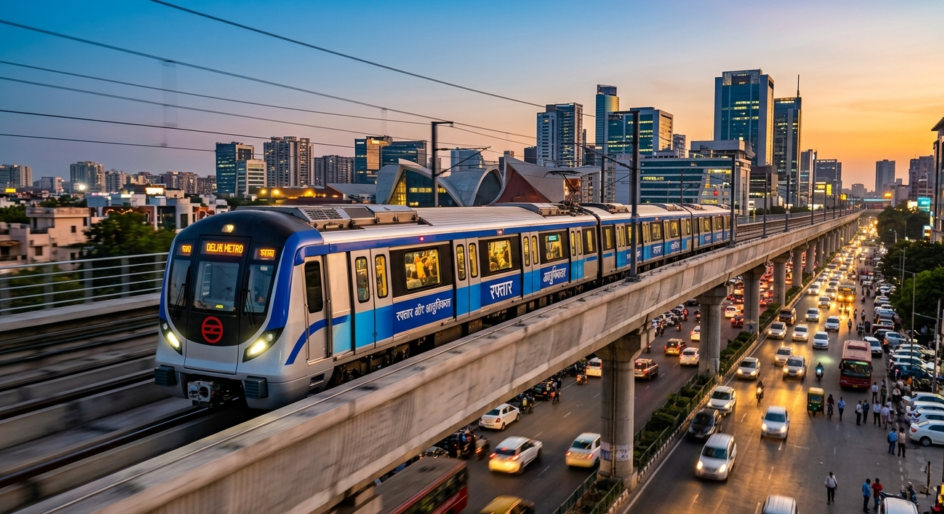
Modern metro coaches are constructed using lightweight yet ultra-strong materials like stainless steel or aluminum alloys. This drastically reduced weight ensures maximum energy efficiency, allowing the train to accelerate instantly out of a station and brake smoothly. The front face of the train features a highly optimized ‘aerodynamic‘ design—a sleek, curved profile that reduces air resistance at high speeds. The sides of the coaches are fitted with wide, automated plug-sliding doors that open and close via synchronized computerized signals only when the train comes to a complete halt at a platform.
Interior Architecture :-
The internal layout of a metro coach is designed with a heavy focus on space optimization and passenger comfort.
- Seating Configuration :– Seats are arranged longitudinally along the side walls of the coaches. This maximizes the central aisle area, creating massive standing room for heavy peak-hour passenger flows. The seats themselves are molded from highly durable fiberglass or polished stainless steel.
- Strap Hangers & Grab Poles :– To assist standing passengers in maintaining balance, a network of stainless steel grab poles (vertical pillars) and flexible overhead hand grips (strap hangers) are strategically distributed throughout the coach.
- Electronic Displays & Announcements :– Every coach is integrated with digital LED and LCD route maps that display real-time journey progress and the next approaching station. This is synchronized with an automated public address system broadcasting crisp voice announcements in English and local regional languages.
- Open Gangway Design :– Contemporary metro train formations feature continuous open gangways (inter-connected coaches), allowing passengers to walk freely from one coach to another even while the train is in motion, facilitating even distribution of the crowd.
Travel Guide & Routes :-
Navigating a metro train network is incredibly systematic, highly secure, and beginner-friendly. If you are planning to travel via a metro system for the first time in any global city, follow this comprehensive, step-by-step block sequence guide.
Tickets & Fare System :-
- Tokens / QR Code Tickets :– For a single journey, you can buy a plastic token or a paper/digital QR code ticket at the station counters or through automated Ticket Vending Machines (TVMs). Fares are calculated dynamically based on the distance between your boarding and destination stations.
- Smart Cards :– If you are a frequent commuter, purchasing a reusable Metro Smart Card is highly recommended. It can be easily topped up online or at counters, saves time by letting you bypass ticket lines, and often offers a flat 10% discount on fares.
- Automatic Fare Collection (AFC) Gates :– To access the platform area, you must tap your smart card or scan your QR code ticket at the sensor of the electronic entry gates (AFC Gates). The barriers open automatically. It is mandatory to scan your ticket/card again at your exit station to open the gates; the correct fare will be automatically deducted.
Network Layout & Interchanges
- Underground Corridors :– These lines run through deep tunnels bored beneath the surface, perfectly suited for historic, densely populated city centers where surface space is non-existent.
- Elevated Viaducts :– These tracks run high above the ground on massive concrete pillars, built swiftly across modern avenues and outer suburbs.
- System Route Maps :– Every station prominently displays a color-coded network route map. Different routes are classified by unique colors (e.g., Red Line, Blue Line, Yellow Line). Points where two or more color lines cross are designated as Interchange Stations, where passengers can seamlessly switch trains to change their direction of travel without buying a new ticket.
Photography Spots
- The Elevated Panoramic Curve :– Sitting next to the wide windows when an elevated metro train smoothly glides along a sharp curve provides breathtaking panoramic vistas of a city’s architectural skyline, expansive flyovers, and bustling highways.
- Architectural Stations :– Many modern transit stations double as underground architectural marvels, showcasing beautiful lighting installations, localized murals, and contemporary art exhibits that make for a perfect aesthetic backdrop.
Connecting to Local Vibe & Markets
- Metro transit lines are strategically planned to directly intersect with a city’s most iconic commercial districts, historic street markets, central railway terminals, and prominent food streets. Stepping out of a designated station exit instantly drops you right in front of local culinary hotspots and premium shopping centers.
Interesting Facts
- Unmanned Operations (Driverless Technology) :– Modern-day metro networks utilize an advanced Signaling technology called CBTC (Communication-Based Train Control). This enables completely automated, driverless train operations where a centralized computer brain controls the acceleration, speed, and braking of multiple trains across the tracks with pinpoint accuracy.
- Generating Power via Braking (Regenerative Braking) :– When a modern metro train applies its brakes, its advanced electric traction motors instantly reverse roles to act as power generators. The kinetic energy of the slowing train is converted back into electricity and fed directly into the overhead power lines, where nearby accelerating trains immediately consume it. This eco-friendly feature saves around 30% to 35% of total energy consumption.
- The Global Giant :– The Shanghai Metro network in China stands as the longest and largest continuous rapid transit system in the world, spanning an incredible operational route length of over 800 kilometers.
- The World’s Longest Art Gallery :– The Stockholm Metro system in Sweden is famously regarded as the world’s longest art exhibition. Across its 100 underground stations, artists have transformed the raw, cave-like blasted rock surfaces into spectacular galleries covered in unique paintings, mosaics, and structural sculptures.
Important Questions and Answer :-
Question 1:- What is the primary difference between a metro train and a standard long-distance train?
Answer:– Long-distance trains connect separate cities over hundreds of kilometers and are typically pulled by a single massive locomotive at the front. Metro trains operate within a single metropolitan city at rapid intervals. They utilize a ‘Distributed Power System’ where electric motors are mounted directly underneath multiple passenger coaches, allowing the train to speed up and slow down almost instantly.
Question 2:- How do metro trains receive their constant supply of electricity?
Answer:– Metro systems generally utilize one of two electrification methods. The first is the Overhead Equipment (OHE) system, where a rooftop device called a pantograph touches high-voltage wires running above the train. The second is the Third Rail system, where an energized conductor rail runs parallel to the running tracks, supplying electricity to the train via side-mounted collector shoes underneath the coaches.
Question 3:- What specialized emergency systems are present inside a metro train?
Answer:– Metro trains are among the safest modes of transport globally. They are equipped with Passenger Emergency Alarm handles or Passenger Emergency Communication Units (PECU) that allow commuters to talk directly to the train operator or control room during a crisis. Additionally, trains feature onboard CCTV surveillance, automatic fire detection systems, and fire extinguishers in every coach.
Question 4:- Is there an actual difference between a subway, a tube, and a metro?
Answer:– Functionally, they all describe the exact same rapid transit system. The term ‘Subway’ is predominantly used in the United States (like New Delhi vs. New York Subway), ‘Underground’ or ‘The Tube’ is native to London, while ‘Metro’ (derived from Metropolitan) is the globally accepted standard term used extensively across Europe, Asia, and India.“Bridging distances and beating traffic, the Metro train is the futuristic wheel that keeps the modern world spinning without a pause.”