
Detailed History
The Red Fort (Lal Qila) of Delhi is one of the most iconic and historically significant monuments in India. Its construction was initiated by the fifth Mughal Emperor, Shah Jahan, in 1638 when he decided to shift his capital from Agra to Delhi. This newly planned walled city was named ‘Shahjahanabad‘, which is popularly known today as Old Delhi.
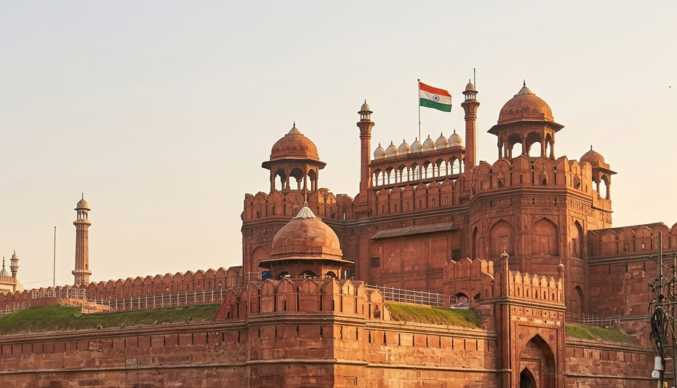
The construction was completed in 1648 under the supervision of the chief architect Ustad Ahmad Lahori, the brilliant mind who also designed the world-famous Taj Mahal. The Red Fort served as the political seat of the Mughal Empire for nearly 200 years. Following the First War of Independence in 1857, the British East India Company seized control of the fort, imprisoned the last Mughal Emperor, Bahadur Shah Zafar, and exiled him to Rangoon. After India gained independence on August 15, 1947, the first Prime Minister, Jawaharlal Nehru, hoisted the National Flag at the Lahore Gate. Since then, it has become a grand tradition for the Prime Minister of India to hoist the tricolor here every Independence Day. In 2007, UNESCO designated it as a World Heritage Site.
Detailed Architecture
The architecture of the Red Fort represents the pinnacle of Mughal creativity, blending Persian, Timurid, Hindu, and Islamic architectural elements into a singular masterpiece.
- Exterior :– The fort is laid out in an irregular octagonal shape, enclosed by massive, high retaining walls made of premium red sandstone. These defensive walls stretch over 2.41 kilometers, with heights varying from 18 meters on the river side to 33 meters on the city side. The fort features two primary structural gateways: the ‘Lahore Gate’ (the grand main entrance) and the ‘Delhi Gate’. The imposing ramparts are embellished with delicate turrets, ornamental chhatris (domed pavilions), and balconies. A wide, deep moat surrounds the outer walls, which was historically filled with water diverted from the Yamuna River.
- Interior :– Upon entering through the Lahore Gate, visitors encounter the ‘Chhatta Chowk‘, a historic covered bazaar lined with shops. Beyond this lies the ‘Diwan-i-Am‘ (Hall of Public Audience), featuring an exquisite marble balcony where the emperor sat to hear grievances. Further inside is the ultra-luxurious ‘Diwan-i-Khas‘ (Hall of Private Audience), constructed out of fine white marble where private ministerial affairs were conducted. This hall once housed the legendary ‘Takht-i-Taus’ (Peacock Throne) before it was plundered by Nadir Shah. The inner sanctuary also holds royal residential palaces like the ‘Rang Mahal’ (Palace of Colors) and ‘Mumtaz Mahal’, decorated with intricate Pietra Dura inlay work using gold, silver, and precious gemstones. The complex also features the pristine white marble ‘Moti Masjid’ (Pearl Mosque) and the sprawling formal gardens of ‘Hayat Baksh Bagh’.
Travel Guide & Routes
- Ticket and Charges :– The entry fee for Indian citizens is approximately ₹35 to ₹40 (booking online offers a slight discount). For foreign tourists, the ticket cost is between ₹550 and ₹600. Entry is completely free for children under the age of 15. Separate ticketing applies for the museums inside and the evening Sound and Light Show.
- Visiting Time :– The Red Fort is open to visitors from 9:00 AM to 6:00 PM. It is highly important to note that the fort remains completely closed on Mondays.
- How to Reach :–
- By Metro :– The Delhi Metro is the most efficient way to reach the monument. The nearest station is the ‘Red Fort Metro Station’ on the Violet Line, situated right opposite the fort entrance. Alternatively, the ‘Chandni Chowk Metro Station’ on the Yellow Line is a comfortable 10-minute walk away.
- By Bus & Auto :– Numerous DTC buses heading towards Kashmere Gate or Old Delhi Railway Station pass directly via the Red Fort. Local e-rickshaws and auto-rickshaws are readily available throughout central Delhi.
- Photography Spots :– The majestic facade of the Lahore Gate, the ornate pillars of Diwan-i-Khas, the fountains inside Rang Mahal, and the open lawns of Hayat Baksh Bagh are the most popular photography locations.
- Local Flavors :– Located directly across the fort is Chandni Chowk. Visitors must try the legendary deep-fried paranthas at Paranthe Wali Gali, sweet falooda kulfi at Giani’s, Dahi Bhalle at Natraj, and authentic Mughlai kebabs and rich korma at the historic Karim’s.
- Famous Markets :– The internal ‘Chhatta Chowk‘ is great for traditional trinkets and handicrafts. The adjacent Chandni Chowk market is world-famous for bridal wear and jewelry, Kinari Bazar for intricate laces, and Nai Sarak for books and stationery.
Nearby Attractions in Detail
- Jama Masjid :– Located just 1 kilometer from the Red Fort, this is one of the largest mosques in India, built by Emperor Shah Jahan. Climbing its southern minaret rewards visitors with an expansive, unparalleled view of Old Delhi’s cityscape.
- Gurudwara Sis Ganj Sahib :– Situated in the heart of Chandni Chowk, this historic Sikh shrine marks the site where the ninth Sikh Guru, Guru Teeg Bahadur, was martyred under the orders of Mughal Emperor Aurangzeb.
- Raj Ghat :– Positioned about 2 kilometers away on the banks of the Yamuna River, this tranquil, landscaped memorial park marks the cremation site of Mahatma Gandhi, featuring a simple black marble platform with an eternal flame.
- Shri Digambar Jain Lal Mandir :– Standing directly opposite the Red Fort, Delhi’s oldest Jain temple is built from striking red sandstone and is widely known for housing a unique, charitable veterinary hospital for birds.
Interesting Facts
- The Red Fort was originally white. It was constructed using native limestone, but when the stone began to chip away, the British authorities painted the structure red to preserve it.
- To clear space for military barracks, British forces systematically destroyed nearly 80% of the interior structures, including several inner Mughal pavilions and harem gardens.
- An illustration of the Red Fort is proudly featured on the reverse side of the Indian ₹500 currency note.
- A continuous stream of water from the Yamuna River used to flow through the palaces via an internal canal network known as ‘Nahar-i-Bihisht’ (Stream of Paradise) to act as a natural air cooler.
Important Questions and Answer :-
Question 1:- Which material was used to build the Red Fort and who built it?
Answer:– The Red Fort was constructed using high-quality red sandstone and was commissioned by the Mughal Emperor Shah Jahan.
Question 2:- Is the Red Fort open to the public on Mondays?
Answer:– No, the Red Fort is strictly closed to public visitors on Mondays. It remains open from Tuesday to Sunday between 9:00 AM and 6:00 PM.
Question 3:– Who was the principal architect behind the design of the Red Fort?
Answer:– The chief architect was Ustad Ahmad Lahori, the same legendary designer who orchestrated the layout of the Taj Mahal.
Author’s Thoughts :-
The Red Fort is far more than a collection of historic red stones and mortar; it stands as a living witness to India’s journey from peak imperial opulence to colonial subjugation, and finally, its hard-fought independence. Standing before its towering ramparts inspires an overwhelming sense of patriotism and deep reverence. Surrounded by the chaotic energy of Old Delhi, this heritage monument reminds us that while eras pass, our historical foundations remain unshakable. I highly recommend staying back for the evening Sound and Light show, which beautifully brings the rich saga of this fort to life before your eyes.
“With centuries of history etched into its crimson stones, the Red Fort is not just the pride of Delhi, but the beating heart of India’s legacy.”