
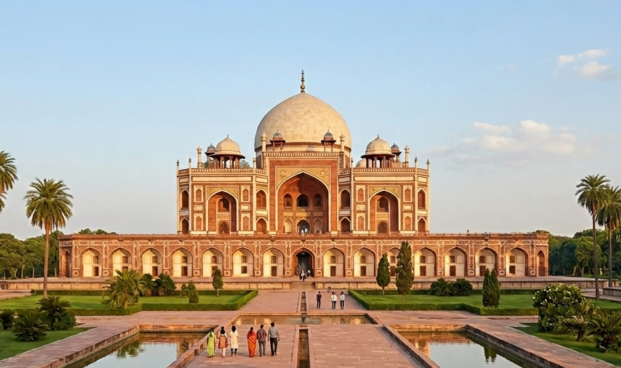
Detailed History
Safdarjung’s Tomb, located at the intersection of Safdarjung Road and Lodhi Road in New Delhi, stands as a historic symbol of the fading and final phase of Mughal architecture. This grand mausoleum is the resting place of Mirza Muqim Abul Mansoor Khan, an extremely powerful Prime Minister (Wazir) of the Mughal Empire and the ruler of Awadh, who was popularly known in history as ‘Safdarjung‘. He passed away in the year 1574 AD (with the tomb being erected in the mid-18th century).
Following his death, his son, Nawab Shuja-ud-Daula, commissioned the construction of this grand mausoleum from 1753 to 1754 AD. It is widely recognized as the last monumental garden-tomb based on the classic Mughal style built in Delhi. By this era, the Mughal Empire was undergoing severe decline, and the royal treasury was largely depleted. For this reason, due to a severe shortage of high-quality construction materials, builders extracted premium red sandstone and white marble strips from the nearby Tomb of Abdul Rahim Khan-i-Khana to complete this structure. Although built during a weakened geopolitical era, the monument successfully retains an aura of imperial grandeur. Today, it is protected and maintained by the Archaeological Survey of India (ASI).
Detailed Architecture :-
While heavily inspired by the grand structural plan of Humayun’s Tomb, Safdarjung’s Tomb incorporates specific artistic variations that define the late Mughal era.
- Exterior :– The main tomb structure is elevated on a wide, tall vaulted plinth, surrounded entirely by a formal ‘Charbagh’ layout of enclosed gardens. Built as a two-storey structure, it utilizes a combination of red and brown sandstone for its main walls, while the signature central dome is layered with vertical bands of smooth white marble. The towering bulbous dome represents classic Persian engineering. The external facades feature grand, recessed ornamental arches (Peshthaks). At the four corners of the main building, multi-storeyed polygonal minarets are seamlessly integrated into the structure, decorated with detailed marble inlay patterns.
- Interior :– Entering the main sanctuary rewards visitors with a grand, spacious central octagonal chamber. At the absolute center of this hall lie the ornamental cenotaphs of Safdarjung and his wife, while their actual burial vaults rest safely in the underground chamber below. The inner walls and ceilings are coated with fine plaster work, showcasing highly detailed plaster moldings, geometric patterns, and intricate carvings reminiscent of the Rococo style. The complex features four intersecting formal water channels flowing in cardinal directions, equipped with beautifully placed fountains.
Travel Guide & Routes
- Ticket and Charges :– The entry ticket fee for Indian citizens and visitors from SAARC and BIMSTEC nations is around ₹35 to ₹40 (booking digitally or online carries a small discount). For international foreign tourists, the ticket cost is between ₹550 and ₹600. Entry is entirely free for children under 15 years of age.
- Visiting Time :– Safdarjung’s Tomb is open to public tourists on all seven days of the week. The visiting hours are from 7:00 AM to 5:00 PM or 6:00 PM (typically from sunrise to sunset). Exploring the peaceful grounds during the early morning hours provides a deeply refreshing experience.
- How to Reach :–
- By Metro :– The absolute easiest way to reach the monument is via the Delhi Metro network. The closest station is the ‘Jor Bagh Metro Station’ located on the Yellow Line. The tomb entrance is situated just a brief 200 to 300 meters walk from the station exit.
- By Bus & Auto :– Numerous DTC buses routing towards Safdarjung Airport, AIIMS, or Central Secretariat pass directly past the monument. Local auto-rickshaws and app-based cabs are readily available across the city.
- Photography Spots :– The central reflection of the main dome inside the water channels, the symmetrical alignments from the grand main gateway, the artistic corner minarets framed against the green lawns, and the golden hour glow on the sandstone walls are the best photography locations.
- Local Flavors :– The adjacent neighborhood of Lodhi Colony houses several high-end chic cafes and boutique eateries. Furthermore, the nearby Khan Market and INA area offer excellent options to enjoy legendary local snacks, street-side chaat, hot Chole Bhature, and rich Mughlai dishes.
- Famous Markets :– For ethnic Indian handicrafts, regional handlooms, and traditional artifacts representing different Indian states, visitors can explore ‘Dilli Haat’ (INA). For high-end luxury goods and premium literature, the elite ‘Khan Market’ is located very close by.
Nearby Attractions in Detail :-
- Lodhi Garden :– Situated just 1 kilometer away, this is an incredibly beautiful, expansive historical public park in Delhi. It protects magnificent 15th-century monuments from the Sayyid and Lodhi dynasties, including the tombs of Sikandar Lodi and Mohammed Shah, along with the grand Shisha Gumbad. It is a highly popular destination for morning walks and leisurely picnics.
- Khan Market :– Located about 2 kilometers away, this is widely celebrated as one of Delhi’s most iconic and premium commercial hubs, packed with excellent bookstores, luxury boutiques, designer labels, and top-tier cafes frequented by diplomats and global travelers.
- Lodhi Art District :– Positioned in Lodhi Colony, this is India’s first dedicated open-air public art district. The vast walls of the residential buildings here have been transformed into massive canvases by renowned national and international street artists, showcasing stunning, socially relevant graffiti.
- Hazrat Nizamuddin Aulia Dargah :– Located roughly 3 kilometers away, this is the holy shrine of the iconic Sufi saint Khwaja Nizamuddin Aulia, famous worldwide for its mystical, soul-stirring live Qawwali sessions on select evenings.
Interesting Facts
- Safdarjung’s Tomb is frequently called the ‘Last Flicker of Mughal Architecture’ because no other major imperial monument or grand garden-tomb was constructed by the dynasty after its completion.
- Close analysis reveals that the tomb lacks the flawless architectural symmetry found in earlier landmarks like the Taj Mahal; its exaggerated vertical proportions are viewed by some architectural historians as a sign of experimental styling during a fading empire.
- The main compound features three highly elegant, single-storey pavilions built into the outer walls, poetically named ‘Moti Mahal‘ (Pearl Palace), ‘Jangli Mahal‘ (Palace in the Woods), and ‘Badshah Pasand‘ (The Emperor’s Choice).
- The picturesque settings of the monument have made it a favorite location for cinema. It has served as a scenic backdrop for various Indian film sequences and its surrounding areas inspired settings seen in Hollywood blockbusters like The Dark Knight Rises.
Important Questions and Answer :-
Question 1:- Who constructed Safdarjung’s Tomb and in whose memory?
Answer:– Safdarjung’s Tomb was commissioned by Nawab Shuja-ud-Daula to honor the memory of his father, Mirza Muqim Abul Mansoor Khan (Safdarjung), who served as the powerful Prime Minister of the Mughal Empire.
Question 2:- What is the primary architectural significance of this monument?
Answer:– Its primary significance lies in the fact that it represents the absolute final grand garden-tomb structure built under the cultural influence of the Mughal architectural style in Delhi.
Question 3:– Is Safdarjung’s Tomb open to public visitors on Mondays?
Answer:– Yes, Safdarjung’s Tomb remains completely open to public tourists on all days of the week, including Mondays, from sunrise to sunset.
Author’s Thoughts
Safdarjung’s Tomb is far more than an ancient resting place; it stands as a poignant architectural mirror reflecting the final, desperate artistic grasp of a collapsing empire. While the Taj Mahal and Humayun’s Tomb narrate tales of unmatched wealth and soaring confidence, Safdarjung’s Tomb carries a gentle, melancholic grace. Sitting on its lawns amidst the modern rush of New Delhi allows you to touch the quiet corners of history. As a writer, I feel that if you wish to escape the heavy crowds of larger tourist hubs and quietly contemplate the twilight era of Mughal craftsmanship, a late afternoon stroll through the gates of Safdarjung’s Tomb is an absolute must.
“Carrying the quiet crimson glow of a fading imperial sunset, Safdarjung’s Tomb remains a beautiful, lasting echo of a bygone era’s grandest dreams.”