
Detailed History
The Lotus Temple, located in Kalkaji near Nehru Place in New Delhi, is officially known as the Bahá’í House of Worship. It stands as a brilliant global icon of contemporary architectural engineering and profound spiritual serenity. Unlike traditional historic temples, this unique sanctuary is not dedicated to any single specific deity or mythological idol. Instead, it is a prominent house of prayer representing the Bahá’í Faith—a relatively modern global religion that emphasizes the essential oneness of God, the unity of all major world religions, and the spiritual alignment of all humanity.
The breathtaking structural blueprint of the temple was conceptualized by the renowned Iranian-Canadian architect Fariborz Sahba. The extensive construction of this mega-structure commenced in 1980 and, after nearly six years of meticulous craftsmanship and engineering, it was officially dedicated and opened to the general public on December 23, 1986. Artisans, structural engineers, and laborers from various parts of the globe gathered to bring this geometric wonder to life. Since its grand inauguration, the Lotus Temple has won numerous prestigious international design awards and continues to serve as one of the most visited cultural landmarks in Delhi, drawing millions of international and domestic travelers seeking mental peace every year.
Detailed Architecture :-
The architectural profile of the Lotus Temple is inspired entirely by the blooming lotus flower, which holds a deeply revered position in Indian culture as a timeless symbol of purity, peace, and simplicity. Adhering to the structural tenets of the Bahá’í Faith, the building features a mandatory nine-sided (nonagonal) circular layout.
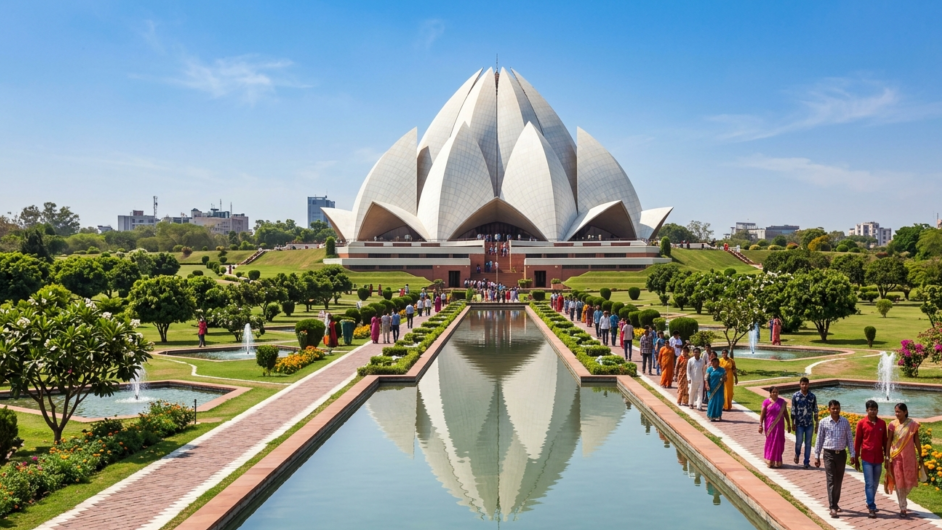
- Exterior :– The exterior of the monument mimics a massive, partially open white lotus flower blossoming out of the green landscape. The structural core is formed by 27 free-standing petals cast out of solid concrete and clad in smooth stone panels. These petals are arranged in symmetrical clusters of three to form nine grand directional entry arches. The entire outer shell is clad in premium Pentelic Marble imported from the Mount Pentelicus quarries in Greece, giving the temple its signature pristine white luminescent glow. The central structure is flanked by 9 beautiful blue-water ponds, which serve a dual purpose: they create a visual illusion of a giant lotus floating on water and act as a natural geothermal cooling mechanism for the interiors.
- Interior :– Passing through any of the nine grand entrance doorways leads visitors into a cavernous central Prayer Hall that can comfortably accommodate up to 2,500 people simultaneously. The vaulted ceiling arches to a dramatic height of nearly 34 meters. The most striking element of the interior is the total absence of any religious idols, pictures, altars, or specific sectarian symbols. The inner concrete surfaces are completely minimalist and bare to encourage quiet internal reflection. The crown of the dome features complex geometric ribs that allow soft, natural skylight to stream directly down onto the central assembly floor.
Travel Guide & Routes :-
- Ticket and Charges :– Entry into the entire Lotus Temple compound, gardens, and the central prayer hall is completely Free for all visitors. No ticketing fees or entry donations are required.
- Visiting Time :– The temple timings scale seasonally based on sunlight hours. Generally, it is open to tourists from 9:00 AM to 5:30 PM during the winter months and remains open until 7:00 PM during the summer season. It is vital to note that the Lotus Temple is strictly closed on Mondays.
- How to Reach :–
- By Metro :– Commuting via the Delhi Metro is highly recommended. The closest transit hub is the ‘Kalkaji Mandir Metro Station’, which serves as an interchange terminal for both the Violet Line and the Magenta Line. The main passenger entrance gate of the temple is just a short 5-minute walk from the station exit.
- By Bus & Auto :– Several DTC bus lines operating towards Nehru Place, Okhla, or Greater Kailash pass directly via the outer ring road cuts near the temple. Local e-rickshaws and app-based taxis are widely accessible.
- Photography Spots :– Capturing the grand symmetrical silhouette of the marble lotus from the main walkway, framing the flower petals against the clean reflections of the surrounding water ponds, and capturing the illuminated monument against the twilight sky are the best photography locations. Note that internal photography inside the main prayer vault is strictly prohibited.
- Local Flavors :– The neighboring commercial district of Nehru Place offers extensive food hubs, global fast-food chains, and fine-dining restaurants. For authentic street treats, the Kalkaji Main Market area serves legendary hot Chole Bhature, spicy kachoris, and classic Delhi-style chaat plates.
- Famous Markets :– For technology enthusiasts, laptops, and consumer electronics, the adjacent ‘Nehrue Place Market’ is celebrated as one of Asia’s largest IT hardware trade hubs. For fashion apparel and street bargaining, tourists can easily access the Kalkaji Main Market or hop on the metro to reach the famous Central Market in Lajpat Nagar.
Nearby Attractions in Detail :-
- Kalkaji Temple :– Located just 500 meters away, this is one of the oldest and most historically significant Hindu shrines in Delhi, dedicated to Goddess Kalka (an incarnation of Shakti). The brick and stone temple complex witnesses massive gatherings of spiritual devotees, especially during the festive seasons of Navratri.
- ISKCON Temple (Nehru Place) :– Situated roughly 1 kilometer away on a small hillock, this majestic temple complex is dedicated to Lord Krishna and Radha. It is famous for its soaring shikharas, beautiful inner murals, vibrant evening musical kirtans, and an interactive Vedic museum that utilizes automated animatronics and laser shows to present ancient texts.
- Astha Kunj Park :– This massive urban public park sprawls across the green corridors connecting the ISKCON Temple, Kalkaji Temple, and the Lotus Temple. It serves as a beautiful green lung featuring tree-lined jogging tracks, open lawns, and a tranquil escape from city traffic.
- Nehrue Place Complex :– Beyond its identity as a bustling IT hub, this commercial area features the vibrant ‘Epicuria Food Mall’ and numerous premium lounges, multi-screen cinemas, and trendy cafes for evening recreation.
Interesting Facts
- In accordance with global Bahá’í philosophies, people belonging to any religion, caste, nationality, or linguistic background are welcome to enter the sanctuary and pray silently according to their own personal beliefs.
- Maintaining absolute silence inside the central Prayer Hall is strictly mandatory. Making noise, whispering loudly, playing musical instruments, giving ritual sermons, or performing specific orthodox ceremonies is prohibited.
- Casting the double-curved concrete petals during construction presented an unprecedented engineering challenge. The complex wooden and steel scaffolding built to support the curing concrete was hailed as a marvel of modern construction management.
- The Lotus Temple is a major pioneer in green energy utilization among Indian monuments. A massive rooftop solar power plant installed within the complex generates a major portion of the electricity required to power the entire facility.
Important Questions and Answer :-
Q1: Which specific deity is worshipped inside the Lotus Temple?
A1: There is no idol or specific deity worshipped inside the temple. It is a house of prayer belonging to the Bahá’í Faith, open to all individuals to meditate upon the singular, formless Creator of the universe.
Q2: Are visitors allowed to take photographs inside the main hall of the Lotus Temple?
A2: No, while visitors are free to take pictures across the extensive external lawns, gardens, and fountains, photography or video recording inside the main prayer sanctuary is completely banned to maintain spiritual decorum.
Q3: Can we visit the Lotus Temple on any day of the week?
A3: No, the Lotus Temple remains completely closed to public tourists and visitors on Mondays for routine architectural maintenance. It operates normally from Tuesday to Sunday.
Author’s Thoughts
Amidst the constant rush, chaotic traffic, and high-octane life of New Delhi, the Lotus Temple exists as a rare sanctuary where time seems to slow down. The true brilliance of this landmark lies not just in the complex mathematical engineering of its white marble petals, but in the heavy, comforting blanket of silence that greets you the moment you step inside its hall. While historical temples across the world evoke awe through grand rituals and the ringing of bells, the Lotus Temple connects with your soul through complete, unadulterated stillness. Stripped of all sectarian divisions and visual distractions, sitting quietly on its wooden benches becomes a deeply personal meditative journey. As a writer and traveler, I believe that a visit to the Lotus Temple is essential—not just to admire a modern wonder of architecture, but to experience how beautiful the world feels when we choose to silence the noise around us.
Signature Sentence: “Resting elegantly amidst shimmering blue waters, this concrete lotus stands as a mesmerizing monument to peace, proving that the most profound spiritual conversations happen in absolute silence.”