
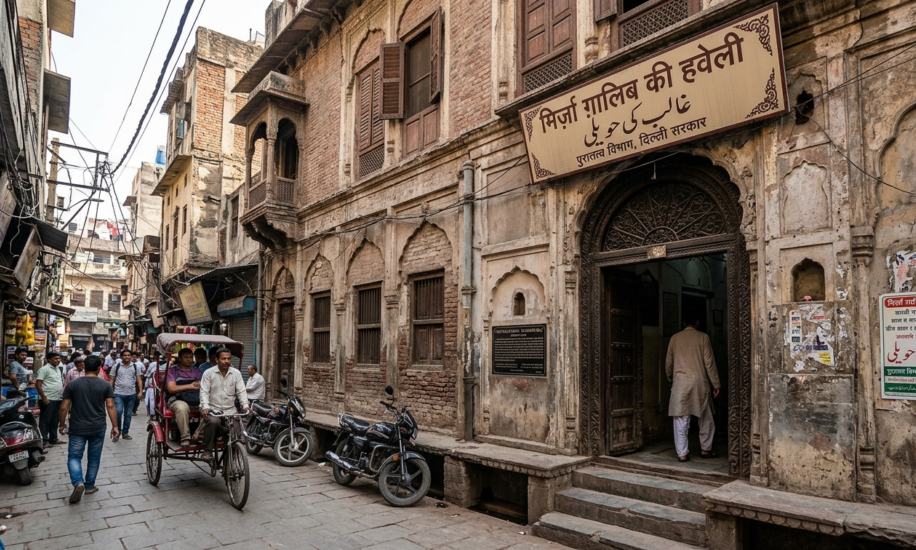
Mirza Ghalib ki Haveli :- A Historical Heritage of Delhi
Mirza Ghalib ki Haveli is a historic heritage site located in Gali Qasim Jan, Ballimaran, near Chandni Chowk in Old Delhi. It was the residence of the legendary Urdu and Persian poet, Mirza Asadullah Khan Ghalib, where he spent the final years of his life (1860-1869) and penned some of his most celebrated ghazals. It has now been transformed into a memorial museum, offering a glimpse into the life and times of the great poet.
Detailed History
The history of Mirza Ghalib ki Haveli dates back more than 150 years. This haveli bore witness to a turbulent era when the Mughal Empire was declining and British rule was establishing its stronghold over India. Ghalib originally hailed from Agra but moved to Delhi after his marriage. Although he lived in various rented houses across Delhi, the final and most significant phase of his life was spent in this very haveli.
The haveli was originally part of a massive residential complex, but over time, large portions of it were destroyed or encroached upon. In the year 1999, the Government of Delhi acquired a significant portion of this structure, renovated it, and dedicated it to the public as a memorial museum. Today, this haveli is not just a building but a pilgrimage site for lovers of Urdu literature (Adab) from around the globe.
Detailed Architecture
The architecture of this haveli is a fine specimen of the traditional Mughal style, predominantly utilizing Lakhori bricks.
- Exterior :– The main entrance of the haveli features a high, grand arched gateway reminiscent of traditional Mughal entrances. The walls are constructed using ancient Lakhori bricks and lime mortar, giving it a rustic and antique appearance. Upon entering, there is a small open courtyard, which was a signature element of traditional Old Delhi houses.
- Interior :– The inner quarters of the haveli have been elegantly converted into a museum. The internal rooms still preserve the original Mughal-style arches and stone pillars. The floors and walls have been restored to recreate the authentic 19th-century Delhi ambiance. A large hall inside features a life-size bust of Mirza Ghalib. The walls are adorned with replicas of his handwritten letters, couplets (shers), and rare photographs.
Travel Guide & Routes
If you are planning a visit to Mirza Ghalib ki Haveli, here is the complete travel guide compiled in a sequential format.
- Entry Ticket :– Entry to Mirza Ghalib ki Haveli and the museum is completely Free. No ticket is required.
- Visiting Time :– The haveli is open from 11:00 AM to 6:00 PM.
- Closing Day :– It remains closed on Mondays and certain national holidays.
- Photography Spots :– The grand arched entrance, the life-size bust of Mirza Ghalib in the central hall, and the beautifully framed couplets on the rustic Lakhori brick walls serve as excellent photography backdrops.
- Local Food :– Being located near Ballimaran and Chandni Chowk, visitors can relish the iconic street food of Old Delhi, including the famous paranthas at Paranthe Wali Gali, kebabs at Karim’s, Mughlai delicacies, and traditional desserts like Shahi Tukda and Rabri.
- Famous Market :– Right outside the haveli lies the bustling Ballimaran Market, renowned across India for wholesale optical frames and traditional footwear (Juttis). The famous wholesale markets of Chandni Chowk and Kinari Bazar are also within walking distance.
- How to Reach :–
- By Metro :– The nearest metro stations are Chandni Chowk (Yellow Line) and Chawri Bazar. From either station, you can easily take an e-rickshaw or walk to Gali Qasim Jan in Ballimaran.
- By Road :– You can reach the main Chandni Chowk road or Old Delhi Railway Station by bus or cab. Since the inner lanes of Ballimaran are extremely narrow, you will need to cover the remaining distance on foot or via a cycle rickshaw.
Nearby Attractions
During your visit to Ghalib’s Haveli, you can also explore these prominent nearby historical sites.
- Jama Masjid :– One of the largest mosques in India, located just 1.5 km away.
- Red Fort :– A UNESCO World Heritage Site, easily accessible via a short rickshaw ride.
- Sunehri Masjid & Gurudwara Sis Ganj Sahib :– Historical spiritual sites located on the main Chandni Chowk stretch.
- Digambar Jain Lal Mandir & Gauri Shankar Temple :– Ancient places of worship standing at the entrance of Chandni Chowk.
Interesting Facts
- Ghalib never paid any rent for this haveli; it was gifted or provided rent-free to him by a close physician friend, Hakim Sharif Khan.
- Before its restoration, a section of this historical haveli had degenerated into a coal depot and a storage space for wedding tents until the government intervened.
- The museum houses authentic period artifacts, including Ghalib’s favorite hookah utensils, traditional attire of that era, and ancient coins from the late Mughal period.
- During Ghalib’s lifetime, this haveli regularly hosted legendary mushairas (poetry gatherings) where the finest minds of Delhi assembled in the evenings.
Important Questions and Answer :-
Question 1:– Where is Mirza Ghalib ki Haveli located?
Answer:- The haveli is situated inside ‘Gali Qasim Jan’ in the Ballimaran area of Chandni Chowk, Old Delhi.
Question 2:– Is there an entry fee to visit Ghalib’s Haveli?
Answer:- No, entry to the Mirza Ghalib Haveli and its museum is entirely free for all visitors.
Question 3:- On which day is Ghalib’s Haveli closed?
Answer:- The haveli remains closed to tourists every Monday.
Question 4:– Which is the nearest metro station to Ghalib’s Haveli?
Answer:- The nearest metro station is ‘Chandni Chowk‘ on the Yellow Line.
Author’s Thoughts
Mirza Ghalib ki Haveli is not merely a structure made of bricks and mortar; it is a living page from the golden era of Urdu poetry. Stepping out of the chaotic, bustling lanes of Old Delhi and into the serene courtyard of this haveli feels like traveling back in time. Reading his profound verses inscribed on the walls, such as—“Poochhte hain wo ki Ghalib kaun hai, koi batlao ki hum batlaen kya“—instantly transports you to the intellectual gatherings of the 19th century. For anyone who wishes to truly connect with the soul, history, and literary culture of Delhi, a visit to this haveli is a deeply moving experience.
“The walls of Ghalib’s Haveli still echo with the unspoken essence of Urdu’s most beautiful verses.”