
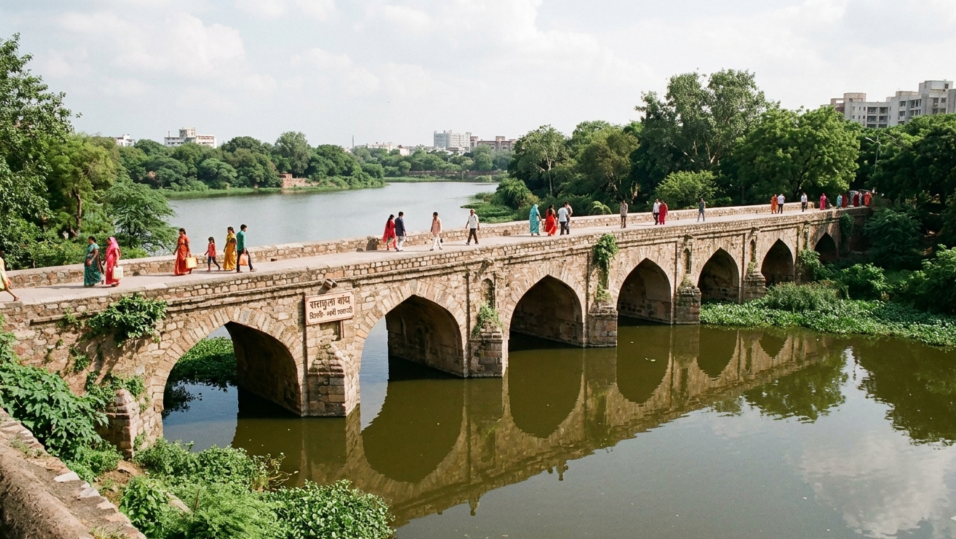
Satpula Dam, New Delhi :- The Ancient Water-Harvesting System of Delhi and a Masterclass in Tughlaq-Era Engineering
Located near Saket and the arterial Press Enclave Marg in New Delhi, Satpula stands as one of the most intellectually compelling, structurally unique, and offbeat historical monuments in the national capital. The literal translation of ‘Satpula‘ is ‘Seven Bridges‘ or ‘The Structure with Seven Arches‘. Far from being a mere passive tomb or fortress wall, it represents a highly advanced, fully functional medieval water-harvesting system and hydraulic control dam. Engineered in the 14th century during the reign of Sultan Muhammad bin Tughlaq of the Tughlaq Dynasty, this monument offers timeless material proof of how adept ancient and medieval Indian builders were in water conservation, topography mapping, and civil engineering. Today, ensconced within a tranquil DDA park, it forms a major destination for heritage walks and architecture lovers. If you wish to escape the metropolitan chaos and witness a rare monument dedicated entirely to resource management, exploring Satpula promises an deeply enriching experience.
Detailed History
The historical trajectory of the Satpula Dam is fundamentally intertwined with the militaristic security and administrative resource requirements of ‘Jahanpanah’, the fourth medieval city of Delhi.
- The Sultan and the Creation of Jahanpanah :– In the early 1340s, Sultan Muhammad bin Tughlaq (1325–1351) conceptualized and fortified a vast urban stronghold named ‘Jahanpanah’ (meaning ‘The Refuge of the World’) to insulate his citizens from the persistent threats of Mongol invasions. Satpula was engineered around 1343 AD as an active, structural component of the city’s defensive southern fortification wall.
- The Dual Functional Mandate :– The creation of Satpula served two critical administrative objectives. Crucially, it operated as a heavily fortified check-post integrated into the city’s defense walls, making it impossible for invading cavalries to easily breach the southern plains. Secondly, it acted as an extensive weir dam designed to trap and regulate the massive seasonal rainwater torrents rushing down from the nearby Aravalli hills, creating a vast artificial lake that sustained the agricultural and domestic water needs of the capital throughout the dry months.
- The Sufi Blessing and Healing Waters :– Rich local traditions and medieval texts associate the dam with the legendary Sufi saint Hazrat Nasiruddin Mahmud, popularly revered across the subcontinent as ‘Roshan Chirag-e-Delhi’ (The Illuminated Lamp of Delhi). It is widely believed that his spiritual presence near the site blessed the reservoir waters, imbuing them with extraordinary medicinal properties. Consequently, for centuries, thousands of travelers and pilgrims journeyed to the Satpula lake to bathe in its waters, seeking natural cures for various physical elements and skin conditions.
Detailed Architecture
The architectural language of Satpula is a definitive study in the rugged utilitarianism, minimalist profiles, and heavy load-bearing engineering characteristic of the Tughlaq era. Constructed entirely using locally quarried grey quartzite stones, the structural core remains impeccably intact after nearly seven centuries.
- The Seven Primary Sluice Arches :– The definitive signature of this masonry dam is its alignment of seven large arched openings, which natively gave the structure its name. These seven arches acted as primary water discharge channels. Originally, these vents were equipped with massive, vertical wooden sluice gates operated by complex rope-and-pulley mechanisms, enabling operators to control the flow and level of water with absolute precision.
- The Two-Storeyed Defensive Layout :– The dam is structurally configured as a grand two-storeyed bridge-like pavilion. Anchoring both the eastern and western flanks of the barrier are two massive, square defensive bastions (Towers). These bastions fulfilled a dual role: providing secure residential quarters for the specialized guards and gate operators, and serving as elevated combat platforms equipped with arrow-slits to counter invading forces during military sieges.
- Internal Subterranean Vaults and Structural Slant :– Deep stone staircases are neatly cut into the bastions, guiding operators to the upper roof walkway and the subterranean gate chambers. The upper deck functions smoothly as a wide defensive roadway. To successfully counter the tremendous hydrostatic pressure exerted by the trapped lake waters during heavy monsoons, the exterior retaining walls were engineered with a distinct inward tilt (Battered Walls)—the iconic architectural hallmark of Tughlaq civil construction.
- The Footprint of the Ancient Reservoir :– To the north of the arches lies a massive, low-lying green plain, which originally served as the primary artificial lake basin. When the monsoon waters surged and cascaded through these seven stone arches, the structure would have presented a breathtaking spectacle of medieval hydro-engineering.
Travel Guide & Routes
To plan a seamless, highly organized, and physically comfortable excursion to the Satpula Dam, utilize this detailed operational block index.
- Monuments Operational Timings :–
- Satpula is accessible to the public from 06:00 AM to 06:00 PM daily.
- Weekly Offs :– The monument remains open all seven days of the week, observing no holiday closures.
- Optimum Seasonal Window :– The post-monsoon phase (September to October) and the core winter months (November to February) are highly recommended, offering lush green park surroundings and pleasant weather for outdoor exploration.
- Admission Tariff :–
- Entry to the Satpula Dam and the surrounding public park complex is entirely FREE of cost for both domestic and international travelers.
- How to Reach :–
- By Metro :– The absolute premier transit choices are the Saket Metro Station or the Malviya Nagar Metro Station, both operating smoothly on the Delhi Metro Yellow Line. Alternatively, the Chirag Delhi Metro Station on the Magenta Line functions in immediate geographic proximity. From any of these terminals, visitors can procure a local auto-rickshaw or e-rickshaw to reach the DDA Park entry adjacent to Khirki Village within 5 to 10 minutes.
- By Road/Bus :– The complex sits directly along Press Enclave Marg in South Delhi, positioned directly opposite the Saket District Court complex and the premier commercial mall strip. It is deeply connected via app-based cabs (Ola/Uber) and numerous municipal DTC buses dropping commuters off at the prominent Press Enclave bays.
- Distance from Key Rail Hubs :– Located roughly 14 kilometers from New Delhi Railway Station (NDLS) and 11 kilometers from Hazrat Nizamuddin Railway Station.
- Photography Guidelines and Top Vantage Points :–
- Personal photography using smartphones or consumer digital cameras is fully permitted with no associated pricing.
- Top Vantage Points :– Capturing the clean front profile of the Seven Arches from the dry lake basin, stepping back to frame the entire two-storeyed structure alongside the flanking defensive bastions, or focusing on the stone masonry details inside the arched recesses.
- Culinary Provisions (Local Flavors) :–
- The Saket Premium Mall District :– Situated directly across the road are world-class lifestyle malls including Select Citywalk and DLF Avenue, hosting hundreds of international dining franchises, fine-dining restaurants, and artisanal dessert cafes.
- Malviya Nagar Main Market :– For travelers seeking authentic regional street food, the nearby Malviya Nagar alleys host iconic street vendors famous for hot Mughlai kebabs, crispy chaats, and rich North Indian curries.
- Famous Specialized Shopping Hubs Around :–
- Saket Commercial District :– The premier address in South Delhi for high-end international fashion apparel, cosmetics, and lifestyle accessories.
- Khirki Village Arts District :– The immediate historic urban village surrounding the dam features independent contemporary art studios and localized alternative design boutiques.
Nearby Attractions
Maximize your South Delhi historical itinerary by effortlessly combining Satpula with these exceptional monuments located within immediate walking distance.
- Khirki Mosque (Khirki Masjid) :– Located merely a few hundred meters away, this 14th-century architectural marvel stands as a rare, comprehensively covered fortress-like mosque, globally renowned for its unique lattice windows and cruciform internal courtyards.
- Begumpur Mosque :– A colossal Tughlaq-era congregational mosque that once anchored the bureaucratic core of Jahanpanah, famous for its massive central courtyard and commanding domes.
- The Qutub Minar Complex :– Positioned roughly 4 kilometers west, this iconic UNESCO World Heritage site houses the tallest brick minaret in the world and pristine early Islamic monuments.
- Bijay Mandal & Jahanpanah Fort Walls :– The historic remains of Muhammad bin Tughlaq’s principal palace complex, including the structural foundations of the legendary ‘Hall of a Thousand Pillars’.
Interesting Facts
- A 680-Year-Old Hydro-Structure :– Satpula stands out as one of the very few surviving, fully empirical examples of a non-religious, purely civil engineering dam from medieval India, serving as a massive case study for modern hydraulic engineers.
- The Sufi Sanitarium :– In medieval times, the reservoir functioned essentially as a spiritual sanitarium, where thousands of individuals suffering from chronic skin disorders camped out, trusting entirely in the curative qualities attributed to the blessings of Chirag-e-Delhi.
- An Architectural Hybrid :– It represents a brilliant, rare structural hybrid where a single civic installation simultaneously functioned as an imposing defense wall, a structural transport bridge, and a high-load retention dam.
Important Questions and Answer :-
Question 1:– What does the name ‘Satpula’ translate to, and where is it located in Delhi?
Answer:– ‘Satpula‘ translates directly to ‘Seven Bridges’ or ‘Seven Openings’. The historic monument is located within a public DDA park adjacent to Khirki Village, running along Press Enclave Marg in the Saket district of South Delhi.
Question 2:– Who commissioned the engineering of the Satpula Dam and during which era?
Answer:– The dam was commissioned around 1343 AD by Sultan Muhammad bin Tughlaq of the Tughlaq Dynasty to secure the water table and fortify the southern boundaries of his newly built city, Jahanpanah.
Question 3:- Is there an entrance tariff or processing fee required to explore the monument?
Answer:– No, access to the entire Satpula monument and its surrounding parklands is completely FREE of charge for all national and international visitors.
Question 4:– Which is the most efficient metro route to map a journey to the site?
Answer:– The closest operational links are the Saket and Malviya Nagar Metro Stations on the Yellow Line, alongside the Chirag Delhi Station on the Magenta Line, all situated a brief 5-minute auto-rickshaw ride away from the park entrance.
Question 5:– What makes Satpula highly unique from a technical architectural standpoint?
Answer:– Satpula is unique because it integrates an advanced medieval water management matrix featuring seven arched spillways, vertical wooden sluice gates to balance hydrostatic water pressures, battered retaining walls, and defensive fortified bastions for garrisoned troop deployment.
Author’s Thoughts
From a contemporary ecological and engineering perspective, Delhi’s Satpula Dam stands as a brilliant, silent indictment of our modern urban planning failures. Today, as major global metropolises, and New Delhi in particular, continuously struggle with catastrophic water scarcity, depleting groundwater tables, and mismanaged seasonal monsoons, this 680-year-old stone dam offers an invaluable, practical lesson in rainwater harvesting and localized resource sustainability. It is deeply ironic that while millions flock to the glittering, hyper-commercial malls of Saket every week, this monumental engineering marvel sits quietly tucked away right behind them, largely ignored by the mainstream tourist gaze. Running your hands over the ancient quartzite masonry and exploring the vaulted chambers makes you profoundly appreciate the far-sighted genius of Tughlaq civil engineers. This site is far more than a backdrop for historians; it is an active classroom for anyone seeking to understand environmental resilience. The next time you visit South Delhi, take a detour into this quiet heritage park to appreciate a time when humanity built with nature, rather than against it.
“Impeccably cataloging the sophisticated water-engineering and environmental wisdom of medieval India, Delhi’s historic Satpula Dam stands as a timeless monument, teaching modern societies the absolute, vital importance of rainwater harvesting and resource preservation.”