
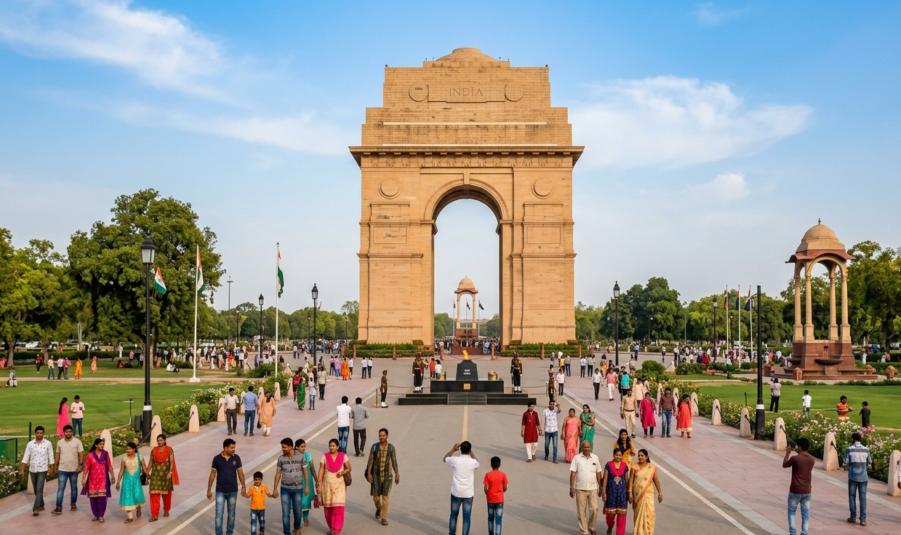
The Pride of the Nation :- India Gate
Located in the heart of Delhi, India Gate is not just a structure of stones, but a living symbol of sacrifice, pride, and patriotism of our brave soldiers. Every year, millions of people visit to admire its grandeur and pay tribute to the martyrs. Let us explore this historic heritage in deep detail.
Detailed History
The history of India Gate is intertwined with World War I (1914–1918) and the Third Anglo-Afghan War. During the British era, it was built in memory of over 84,000 Indian soldiers who laid down their lives fighting for the British Empire.
- Foundation Stone :– The foundation stone was laid on February 10, 1921, by the Duke of Connaught.
- Construction Period :– It took nearly 10 years to complete, and it was inaugurated on February 12, 1931, by Viceroy Lord Irwin.
- Amar Jawan Jyoti :– Following the Indo-Pak War of 1971, the ‘Amar Jawan Jyoti’ (Flame of the Immortal Soldier) was established here and inaugurated by the then Prime Minister Indira Gandhi in 1972. Recently, this flame was merged with the main flame at the nearby National War Memorial.
- Names of Soldiers :– The walls of this massive monument are inscribed with the names of over 13,000 martyred soldiers.
Detailed Architecture :-
The architecture of India Gate is incredibly grand and majestic. It was designed by the world-renowned architect Sir Edwin Lutyens.
- Exterior Architecture :– The monument is inspired by the famous ‘Arc de Triomphe’ in Paris. It stands at a total height of 42 meters (approx. 138 feet). The entire structure is built using red and yellow sandstones, specially brought from Bharatpur. At the top of the arch, there is a shallow dome-like bowl, which was used to burn oil-lit flames on special historic occasions like Republic Day.
- Interior and Surroundings :– The area under the arch of India Gate is vast and spacious. It is surrounded by lush green lawns that enhance its scenic beauty. Right behind India Gate stands an empty Canopy, which once housed the statue of King George V, but now proudly features a grand granite statue of Netaji Subhas Chandra Bose.
Travel Guide & Routes :-
If you are planning to visit India Gate, here is all the essential information structured sequentially for a smooth trip.
- Ticket and Entry Fee :– Entry to the India Gate complex is completely Free. There is no ticket required.
- Visiting Time :– It remains open to the public 24 hours a day, 7 days a week. However, the best time to visit is between 7:00 PM and 10:00 PM when the monument is beautifully illuminated with tri-color lights.
- How to Reach (Routes) :–
- By Metro :– The nearest metro station is Central Secretariat, located on the Yellow and Violet Lines. From here, you can easily walk or take an auto-rickshaw.
- By Bus & Auto :– DTC buses and auto-rickshaws are readily available from all parts of Delhi directly to India Gate.
- Photography Spots :– The angle near Netaji Subhas Chandra Bose’s canopy, the front view of the main illuminated arch during the evening, and the pristine lawns of the National War Memorial are the best spots for photography.
- Local Food :– The lawns are surrounded by local vendors selling Delhi’s famous street food like Chaat, Chuski (ice gola), Bhelpuri, Ice cream, and Golgappas. Enjoying an ice cream here in the evening breeze is a signature Delhi experience.
- Nearby Markets :– Located nearby are Connaught Place (CP), Khan Market, and Janpath Market, which are excellent for shopping and dining.
Interesting Facts :-
- The walls of India Gate feature names of not just Indian soldiers, but also some British soldiers and officers who lost their lives on the North-West Frontier.
- No concrete was used in the construction of this monument; it is entirely built through the precise carving and interlocking of sandstones.
- Every year on January 26, the grand Republic Day Parade passes right in front of India Gate (along the Kartavya Path), showcasing India’s cultural and military strength to the world.
Important Questions and Answer :-
Question 1:– Why was India Gate constructed?
Answer:- It was built to honor and remember the thousands of Indian soldiers who lost their lives during World War I and the Third Anglo-Afghan War.
Question 2:– Which new monument is located near India Gate?
Answer:- The National War Memorial is located just behind India Gate, dedicated to all the soldiers martyred in post-independence conflicts.
Question 3:– What is the best season to visit India Gate?
Answer:- The winter months from October to March are the best time to visit, as the weather in Delhi remains pleasant and ideal for outdoor strolls.
Author’s Thoughts :-
In my view, India Gate is not merely a landmark of Delhi; it is the heartbeat of India’s self-respect and patriotism. In the evening, when the monument is bathed in the three colors of the national flag amidst a cool breeze, every Indian heart fills with immense pride. This place reminds us of the countless heroes who risked everything for our freedom and security. The peace and patriotic energy felt here are truly beyond words.
- “A monument of stone that echoes the timeless stories of ultimate sacrifice and national glory.”