
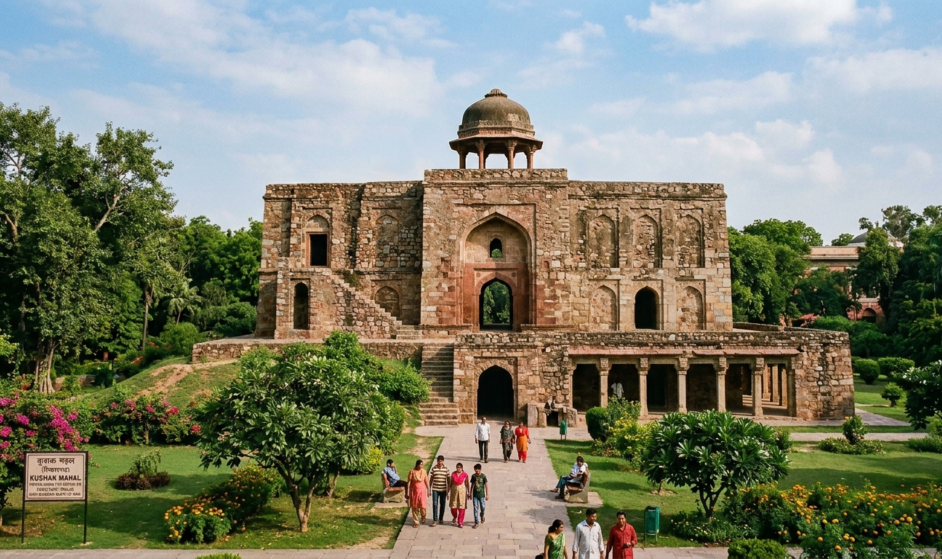
Kushak Mahal, Delhi :- The Hidden Historical Gem of Teen Murti Estate and Firoz Shah Tughlaq’s Royal Hunting Lodge
Nestled discreetly within the prestigious lawns of the Teen Murti Estate (Pradhanmantri Sangrahalaya complex) in Lutyens’ Delhi, Kushak Mahal stands as one of the most serene, historically rich, and offbeat monuments in the national capital. Engineered in the 14th century, this structure is a magnificent and ruggedly intact specimen of Tughlaq architecture. Far from being a mere residential pavilion or political court, it functioned primarily as an elite Hunting Lodge (Shikargah) for Sultan Firoz Shah Tughlaq. Today, the ancient stone palace stands with quiet dignity amidst the sprawling green gardens, framed by the modern dome of the Nehru Planetarium and the state-of-the-art Pradhanmantri Sangrahalaya. This monument beautifully visualizes how the deep layers of medieval history remain flawlessly preserved within the structural landscape of modern New Delhi. For heritage walk enthusiasts and solo travelers seeking a peaceful, uncrowded corner that transports them directly back to the Sultanate era, exploring Kushak Mahal is a deeply rewarding experience.
Detailed History
The historical trajectory of Kushak Mahal is fundamentally tied to the development of ‘Firozabad‘, the fifth medieval city of Delhi, and Sultan Firoz Shah Tughlaq’s profound lifelong passion for hunting and structural engineering.
- The Sultan and the Construction Era :– This historic pavilion was commissioned during the mid-14th century by Sultan Firoz Shah Tughlaq (1351–1388), a ruler celebrated in Indian history for his extensive civic building projects, agrarian canals, public hospitals, and academic libraries. The Sultan had an immense fondness for establishing hunting lodges and retreats on the forested peripheries of his capital.
- Function as a Royal Shikargah :– During the 14th century, this entire geographic pocket of Delhi was an expansive, dense jungle ecosystem teeming with wild animals. Sultan Firoz Shah Tughlaq frequently marched to these grounds accompanied by his court ministers, royal guests, and specialized troops for extended hunting expeditions. This sturdy, two-storeyed stone structure was engineered to provide a secure retreat where the Sultan could rest, strategize military movements, and process his hunting game.
- The Lutyens Integration :– The lodge was strategically elevated on a high natural earthen mound to provide an uninterrupted panoramic view of the surrounding wilderness. Centuries later, when British architect Sir Edwin Lutyens was drafting the blueprint for New Delhi and erecting ‘Flagstaff House‘ (which later became Teen Murti Bhavan), he recognized the historical value of this structure. Instead of demolishing it, the colonial architects brilliantly preserved the medieval lodge as an integral heritage focal point within the estate boundaries.
Detailed Architecture
The architectural language of Kushak Mahal is an exceptional study in the early Tughlaq style—characterized by structural minimalism, massive load-bearing walls, and military-grade durability. Built using locally quarried grey quartzite stones bonded with lime mortar, the palace has stood the test of time for nearly 700 years.
- Symmetrical Two-Storeyed Layout :– The palace features a perfectly square structural footprint resting on a raised stone plinth. It is configured as a solid, two-storeyed pavilion. A defining architectural signature of the Tughlaq style present here is the distinct inward slant of the external walls (Battered Walls). This sloping engineering profile distributed weight more efficiently and anchored the structure securely against seismic activity and heavy physical assaults.
- The Ground Floor Vaulted Arches :– The ground level features three open, deep archways (bays) that guide visitors into a cool, columned internal hall. The structure relies on thick, square stone pillars engineered from massive blocks to support the heavy weight of the roof and the upper terrace. The arches are completely plain, devoid of the intricate floral carvings or marble inlays seen in later Mughal monuments, projecting a raw, historic charm.
- The Upper Terrace and Central Pavilion :– Heavy stone stairs lead visitors up to the spacious open-air roof terrace. This upper deck originally featured a central columned canopy or pavilion capped by a small stone dome, from which the Sultan could survey his troops and the forested horizons. Over the centuries, parts of the upper dome have weathered away, leaving a beautifully atmospheric ruins profile.
- Monolithic Slab Roof Engineering :– The intermediate ceilings were built using massive, horizontal stone slabs spanning the gaps between the pillars. The entire structural profile mimics a minor military outpost or watchtower, confirming its highly functional, defensive design parameters.
Travel Guide & Routes
To plan a highly organized, comfortable, and comprehensive visit to Kushak Mahal, refer to this detailed operational directory:
- Monuments Operational Hours :–
- Because it sits securely within the gated perimeter of the Teen Murti Estate, its accessibility strictly mirrors the campus timings: open from 09:00 AM to 05:30 PM.
- Weekly Closure Day :– The complex observes a strict weekly closure on Mondays and on core national public holidays.
- Best Seasonal Window :– The winter phase from October to March is the ideal time to visit, allowing you to comfortably stroll through the vast open lawns under pleasant weather conditions.
- Admission Tariff Matrix :–
- Access to the open parklands surrounding Kushak Mahal and viewing the monument from the outside is completely FREE of charge. However, if you choose to explore the highly adjacent, high-tech Pradhanmantri Sangrahalaya museum galleries, independent tickets must be purchased (Online: ₹100, On-site Counter: ₹110).
- How to Reach :–
- By Metro :– The absolute closest transit terminal is the Lok Kalyan Marg Metro Station, operating on the Yellow Line of the Delhi Metro network. The distance to the Teen Murti main gates is approximately 1.2 kilometers, easily covered via a quick 5-minute auto-rickshaw or e-rickshaw ride available right outside the station exits. Alternatively, Udyog Bhawan and Central Secretariat stations are closely situated.
- By Road/Bus :– Situated along Teen Murti Marg in Central Delhi, right behind the prominent Nehru Planetarium dome. It is effortlessly accessible via app-based cabs (Uber/Ola), personal vehicles, and multiple DTC bus lines terminating at the ‘Teen Murti’ transit stop.
- Distance from Main Rail Terminals :– Positioned roughly 6 kilometers from New Delhi Railway Station (NDLS) and 7 kilometers from Hazrat Nizamuddin Railway Station.
- Photography Framework and Top Spots :–
- Non-commercial personal photography using standard smartphones or consumer digital cameras is completely permitted and free of cost.
- Top Spots :– Framing the front profile of the three grey quartzite arches from the lower lawn, capturing the interior view through the heavy square pillars, or taking a wide-angle shot that highlights the stunning contrast between this 14th-century rugged stone lodge and the futuristic dome of the planetarium.
- Culinary Options Around (Where to Eat) :–
- The In-house Museum Cafe :– A modern, highly clean boutique cafe operating within the estate premises, offering fresh artisanal coffees, teas, gourmet sandwiches, and light Indian snacks.
- Yashwant Place (Chanakyapuri) :– Located just 2 kilometers away, this market is legendary across Delhi for serving exceptional steaming momos, hot thukpas, and classic Indo-Chinese street food items in an open-air setup.
- Famous Shopping Hubs Around :–
- Khan Market :– Positioned 3 kilometers east, this ultra-premium lifestyle market is world-famous for its high-end boutiques, global brand outlets, independent elite bookstores, and fine-dining bistros.
- Sarojini Nagar Market :– Located roughly 4 kilometers away, this is Delhi’s ultimate open-air hub for sourcing highly affordable fast-fashion apparel, export-surplus garments, and trendy accessories.
Nearby Attractions
Maximize your Lutyens’ Delhi exploration by pairing Kushak Mahal with these primary cultural landmarks situated within the same campus or immediate neighborhood.
- Nehru Planetarium :– Positioned natively directly in front of the lodge, hosting exceptional public shows on space sciences, cosmic exploration, and astronomy.
- Pradhanmantri Sangrahalaya :– India’s premier, immersive digital museum documenting the political history, major policy transformations, and lives of all past Prime Ministers.
- Teen Murti Bhavan Library & Museum :– The preserved historical residence of Pandit Jawaharlal Nehru, housing archival research materials and rare photographs.
- India Gate & Kartavya Path :– Located roughly 3.5 kilometers away, anchoring the majestic central administrative avenue of the nation.
Interesting Facts
- A Rare Architectural Contrast :– This site presents an extraordinary spatial juxtaposition where a 14th-century medieval hunting lodge (Kushak Mahal) stands directly adjacent to a 21th-century digital museum and space planetarium within the exact same compound wall.
- The Shikargah Trail :– Firoz शाह Tughlaq established a vast network of these strategic hunting lodges across Delhi. Among them, Kushak Mahal, Bhuli Bhatiyari ka Mahal (Karol Bagh), and Pir Ghaib (Hindu Rao Hospital complex) are the prominent structures that have successfully survived into the modern era.
- Saved by Urban Preservation :– During the creation of New Delhi in the early 1900s, colonial planners purposefully adjusted their road grids to accommodate the structure, preserving the integrity of this ancient Tughlaq mound and converting it into a central feature of the estate.
Important Questions and Answer :-
Question 1:– Where is Kushak Mahal located, and who engineered its construction?
Answer: Kushak Mahal is situated within the gated grounds of the Nehru Planetarium and Pradhanmantri Sangrahalaya complex along Teen Murti Marg in Central New Delhi. It was engineered and built in the 14th century by Sultan Firoz Shah Tughlaq.
Question 2:- What was the primary operational function of Kushak Mahal in medieval times?
Answer:– In the medieval era, this area was a dense, wild forest ecosystem. The monument functioned as a specialized ‘Hunting Lodge’ (Shikargah) and temporary military rest station for the Sultan during his extensive hunting expeditions.
Question 3:- Is there an independent entry fee or processing ticket required to see Kushak Mahal?
Answer:– No, entering the public garden space to observe and photograph Kushak Mahal from the outside is entirely FREE of cost. Independent tickets are only needed if you choose to enter the indoor digital museum on the premises.
Question 4:– Which public transit metro line provides the closest access to the monument?
Answer:– The closest transit station is Lok Kalyan Marg Metro Station on the Yellow Line, located approximately 1.2 kilometers from the main entrance of the estate.
Question 5:– What are the definitive architectural markings of this monument?
Answer:– It is a perfectly square, two-storeyed structure built from local grey quartzite stones. Its defining characteristics include inward-sloping battered walls, massive square supporting pillars, and three plain, unornamented front arches.
Author’s Thoughts
From a personal and historical perspective, Kushak Mahal is a beautiful, evocative reminder of how ancient history quietly breathes underneath the polished surface of modern metropolitan life. Every single day, thousands of visitors walk right past these grounds to explore the high-tech digital exhibits of the Pradhanmantri Sangrahalaya or watch space shows at the planetarium, entirely unaware that a 680-year-old royal hunting pavilion stands silently in the background. The real magic of this monument lies in its deep quietude; it offers a rare sanctuary in Central Delhi where you can sit under the shade of ancient trees and listen to the birds, feeling as if time has completely frozen. It teaches us that Delhi is not just a city of fast roads and modern skyscrapers, but a living museum where every corner carries a story. The next time you plan a family outing to the planetarium, I highly recommend carving out twenty minutes to walk to the rear lawns, touch these ancient quartzite stones, and appreciate this beautifully preserved piece of the Tughlaq empire.
“Standing as a quiet sentinel amidst the modern elegance of Lutyens’ Delhi, the centuries-old Kushak Mahal remains a raw, timeless testament to the magnificent engineering and royal hunting legacies of the Tughlaq Sultanate.”